
Blog
How AI in Property Management Boosts Efficiency and ROI
Let's get one thing straight: when we talk about AI in property management, we're not talking about scifi robots patrolling hallways. Think of it more like adding a su...
Let's get one thing straight: when we talk about AI in property management, we're not talking about sci-fi robots patrolling hallways. Think of it more like adding a super-efficient digital team member to your staff—one that works 24/7 without ever needing a coffee break.
This frees up your human team to do what they do best: build relationships, close deals, and handle the complex issues that require a human touch.
Your New Digital Coworker in Real Estate
Think about the most draining parts of a property manager's day. It’s the constant loop of answering the same questions, chasing down leads, and trying to coordinate tour schedules. These jobs are essential, but they eat up time that could be spent on much more valuable work.
This is exactly where AI comes in. It’s like a digital assistant, built to handle huge volumes of communication with perfect accuracy, every single time. To get a better feel for this new kind of team member, take a look at our guide on what is a digital worker.
What This Looks Like in the Real World
So, how does this actually play out day-to-day? Let's say you have an AI system handling your leasing inquiries. A potential renter, Sarah, is browsing Zillow at 10 PM on a Friday night and finds your listing. Instead of sending an email and waiting until Monday, she engages with your AI-powered chat.
This AI can:
- Answer Sarah’s immediate questions: "Is there a dog park?" and "What are the move-in dates for unit 3B?"
- Pre-qualify her based on your criteria, asking if her household income is at least 3x the rent.
- Check your leasing agent's live calendar and offer Sarah available tour slots for Saturday afternoon, booking it instantly.
The entire conversation happens on its own. The result? No lead is ever missed because it came in after hours. Your agent walks into the office the next morning to find a pre-qualified, scheduled appointment with Sarah waiting for them. All they have to do is close the deal.
At its core, AI in property management is about handing off repetitive communication and admin work to technology. This lets your people focus on the strategic, relationship-driven tasks that actually grow your business.
It's Not Just About Leasing
The same logic works for tenant support and maintenance requests. An AI chatbot on your resident portal can instantly answer questions about paying rent or when the pool is open, cutting down on the routine calls that flood your office.
For a practical example, a tenant logs into the portal to report a running toilet. The AI chatbot asks a few diagnostic questions, such as "Is the water running continuously?" and "Is the toilet still usable?" Based on the answers, it creates a work order, categorizes it as a non-emergency plumbing issue, and alerts the on-call maintenance team—all in a matter of seconds. It gets rid of the manual data entry and gets the problem fixed faster, which is key to keeping residents happy.
Why AI Is Becoming Essential for Property Managers
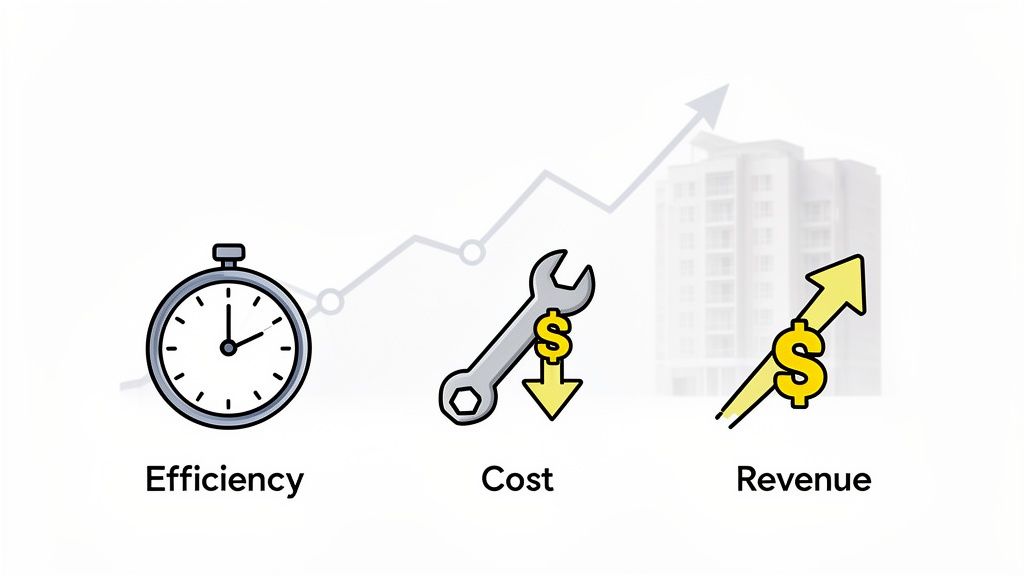
Let's be clear: adopting AI in property management isn't about chasing the latest tech fad. It’s a direct response to the real-world pressures property managers face every day. Owners and operators are finally connecting the dots between this technology and the metrics that truly matter: efficiency, costs, and revenue. It’s quickly moving from a "nice-to-have" to a competitive must-have.
This isn't just a slow creep, either. It's a fundamental shift. AI usage in our industry skyrocketed from just 20% to 58% in a single year. The reason for this explosion is simple: it works. A huge 77% of operators using AI have seen their operating expenses drop, and an even more impressive 85% are watching their lead-to-lease conversion rates climb. You can get a deeper look at where things are headed in the 2026 property management report.
Boosting Operational Efficiency
One of the first things you'll notice with AI is how much time it gives back to your team. Think about all those repetitive, administrative tasks—answering the same initial questions, scheduling tours, following up on leads. These things can eat up hundreds of hours every month, pulling your best people away from what they should be doing: closing deals.
- Here's a real-world example: A property management company with 1,000 units might receive 500 online inquiries in a busy month. Manually responding, qualifying, and scheduling tours for these could take a leasing agent over 40 hours—a full work week. An AI leasing assistant handles this 24/7, catching every lead and only passing fully-vetted, tour-ready prospects to the agent. This one change can free up thousands of staff hours a year.
By automating the top of your leasing funnel, AI ensures you never miss a lead. It turns a chaotic, high-volume headache into a smooth, efficient system that feeds your team genuinely qualified prospects.
Driving Down Operational Costs
AI isn't just an administrative helper; it’s a powerful tool for cutting costs, especially when it comes to maintenance. For most, maintenance is reactive. A system breaks, a tenant is upset, and you're stuck with an expensive emergency repair bill. AI flips that script by introducing predictive maintenance.
- A practical case: An AI monitors data from smart sensors on a large building's HVAC system. It notices that one rooftop unit is drawing 15% more power than usual and vibrating slightly outside normal parameters. Instead of waiting for it to fail on a 95-degree day, the AI alerts the maintenance team. A technician finds a failing compressor motor and replaces it during a scheduled, low-cost visit, preventing a catastrophic failure that would have cost five times as much in emergency repairs and upset dozens of tenants.
Unlocking New Revenue Growth
Finally, AI has a direct impact on your bottom line by helping you earn more and keep vacancies low. Setting your rental rates once and forgetting about them is a surefire way to either leave money on the table or sit on an empty unit for too long.
- Here's how it works in practice: A dynamic pricing tool uses AI to scan market data for a downtown apartment building. It sees that a major conference is coming to the nearby convention center and that competitor vacancies have dropped. The AI recommends a 5% rent increase for two newly available one-bedroom units. Both are leased within a week at the higher rate, generating thousands in additional annual revenue that would have otherwise been lost.
Putting AI To Work in Your Daily Operations
Theory is great, but let's talk about where the rubber meets the road. The real magic of AI in property management isn't some futuristic, all-knowing robot; it’s a set of practical tools that fix the biggest headaches in your day-to-day operations. Think of it less like tearing everything down and more like giving your key workflows a series of powerful upgrades.
So, let's get practical. I want to show you exactly how AI is already making a difference in the three pillars of your business: leasing, maintenance, and tenant support. Each of these areas is ripe for improvement, offering huge opportunities to save time, slash costs, and make life better for both your team and your residents.
Automating The Entire Leasing Funnel
The leasing process is a relentless, high-volume machine. For every vacancy, you're hit with a wave of inquiries from Zillow, Apartments.com, and your own website, all coming in at all hours of the day and night. It’s easy to get buried. This is exactly where an AI leasing agent becomes your most valuable player.
Imagine an AI that acts as your 24/7 front desk, never taking a break.
- Instant Engagement: A prospect, Mark, submits a query on your website at midnight. The AI immediately responds, "Hi Mark, thanks for your interest in The Grand Lofts! I can help with any questions you have. Are you looking for a 1 or 2-bedroom apartment?"
- Intelligent Qualification: The AI continues, asking Mark about his desired move-in date, budget, and if he has pets. Mark's budget is slightly below the listed rent, but he meets all other criteria, so the AI flags him as a "high-potential" lead for the agent to review.
- Seamless Scheduling: For another fully qualified lead, the AI syncs with your leasing agent's calendar, books a tour on the spot, and sends confirmations to everyone.
This whole sequence runs on autopilot. Your leasing team can walk into the office to find their day already filled with pre-vetted, high-intent appointments.
How AI Transforms Property Management Tasks
| Operational Area | The Old Way (Manual Process) | The New Way (AI-Powered Solution) |
|---|---|---|
| Leasing Inquiries | Staff manually replies to emails and calls, often with delays. | AI chatbot provides instant, 24/7 responses and answers common questions. |
| Lead Qualification | Agents spend hours on calls asking repetitive qualifying questions. | AI asks pre-screening questions via chat, filtering out unqualified leads. |
| Tour Scheduling | Back-and-forth emails and phone tag to find a suitable time. | AI syncs with calendars and allows prospects to self-book available slots. |
| Maintenance Requests | Tenants call or email; staff manually create and assign work orders. | AI captures requests via chat/app, categorizes the issue, and auto-assigns it. |
| Routine Tenant Q&A | Staff answers the same questions repeatedly (pool hours, Wi-Fi password). | AI chatbot instantly provides answers to a knowledge base of common questions. |
As you can see, the shift isn't just about speed; it's about reallocating your team's valuable time to higher-impact activities.
Shifting From Reactive To Predictive Maintenance
For most property managers, maintenance is a reactive, expensive fire drill. You wait for something to break, a tenant to complain, and then you scramble to find a technician—often paying a premium for an emergency call-out. AI completely flips this model on its head by making predictive maintenance a reality.
Instead of just waiting for the breakdown, an AI system can analyze data from smart sensors installed on critical equipment like HVAC units, boilers, and elevators. It learns what "normal" looks like and can spot the tiny signs—a slight vibration, a minor temperature change—that signal a failure is just around the corner.
This proactive approach is one of the most financially defensible applications of AI. It moves maintenance from a cost center to a value-driver by preventing expensive failures before they happen.
The real savings are found right here. Predictive maintenance is one of the most mature uses of AI in real estate, and for good reason. By looking at data from sensors, past service records, and even weather patterns, these systems can forecast failures with incredible accuracy. In fact, multifamily communities using smart technologies have cut their energy and utility costs by nearly 20%. That’s a direct financial upside. To see how this works in other parts of the industry, check out this guide on how AI can automate your short term rental business.
Providing Instant, 24/7 Tenant Support
Finally, just think about the constant stream of simple questions your team fields all day long. "What's the Wi-Fi password?" "When is the pool open?" "How do I submit a maintenance request?" Each question is easy, but together they create a constant distraction, pulling your staff away from more complex resident issues.
- A practical example: A new tenant moves in on a Saturday and can't figure out the community Wi-Fi. Instead of waiting until the leasing office opens on Monday, they go to the resident portal. An AI chatbot instantly provides the network name and password, along with a link to the provider's setup guide. This small, immediate win starts the resident experience on a positive note.
This delivers two massive benefits. First, your residents get the answers they need right away, day or night. Second, it frees up your team's mental energy to focus on building relationships and solving the unique problems that actually require a human touch. That shift is what helps you improve retention and foster a stronger community. For those looking to optimize their entire operational toolkit, our guide on choosing the right program do zarządzania nieruchomościami can provide additional valuable insights.
Your Step-by-Step Plan to Implement AI
Bringing new technology into your business can feel like a huge project, but getting started with AI in property management doesn't mean you have to overhaul everything at once. The smartest way to do it is with a careful, phased approach that lets you see real benefits quickly without burning out your team.
The trick is to start small, prove it works, and then expand.
Think of it like renovating a house. You wouldn't knock down every wall on the first day. You'd probably tackle the kitchen first—the one room that makes the biggest difference in your daily life. The same idea applies here.
Start With Your Biggest Headache
Before you even think about shopping for software, pinpoint your single greatest operational pain point. Where are the biggest bottlenecks in your day? What's costing you the most time, money, or even sanity?
For most property managers, the problems are frustratingly familiar:
- Lost Leads: Are you missing out on great prospects just because they inquire after 5 PM or over the weekend? A real-world example is a property that discovers 40% of their website leads come in between 6 PM and 8 AM, a period when no one was available to respond, leading to a huge loss of opportunity.
- Administrative Overload: Does it feel like your team is buried in repetitive data entry and scheduling? An agent might spend two hours every morning just sifting through overnight emails instead of preparing for property tours.
- Repetitive Questions: How many hours a week does your front desk spend answering the exact same questions about pet policies or application fees?
Pick just one of these to focus on first. By targeting a specific, nagging problem, your first AI project will deliver tangible results. That makes its success easy to measure and its value crystal clear to everyone on your team.
Don’t boil the ocean. A successful AI rollout begins by solving one specific, high-impact problem. This creates positive momentum and builds a solid business case for doing more down the road.
This is where you can start to see how AI fits into the daily flow of leasing, maintenance, and tenant support.
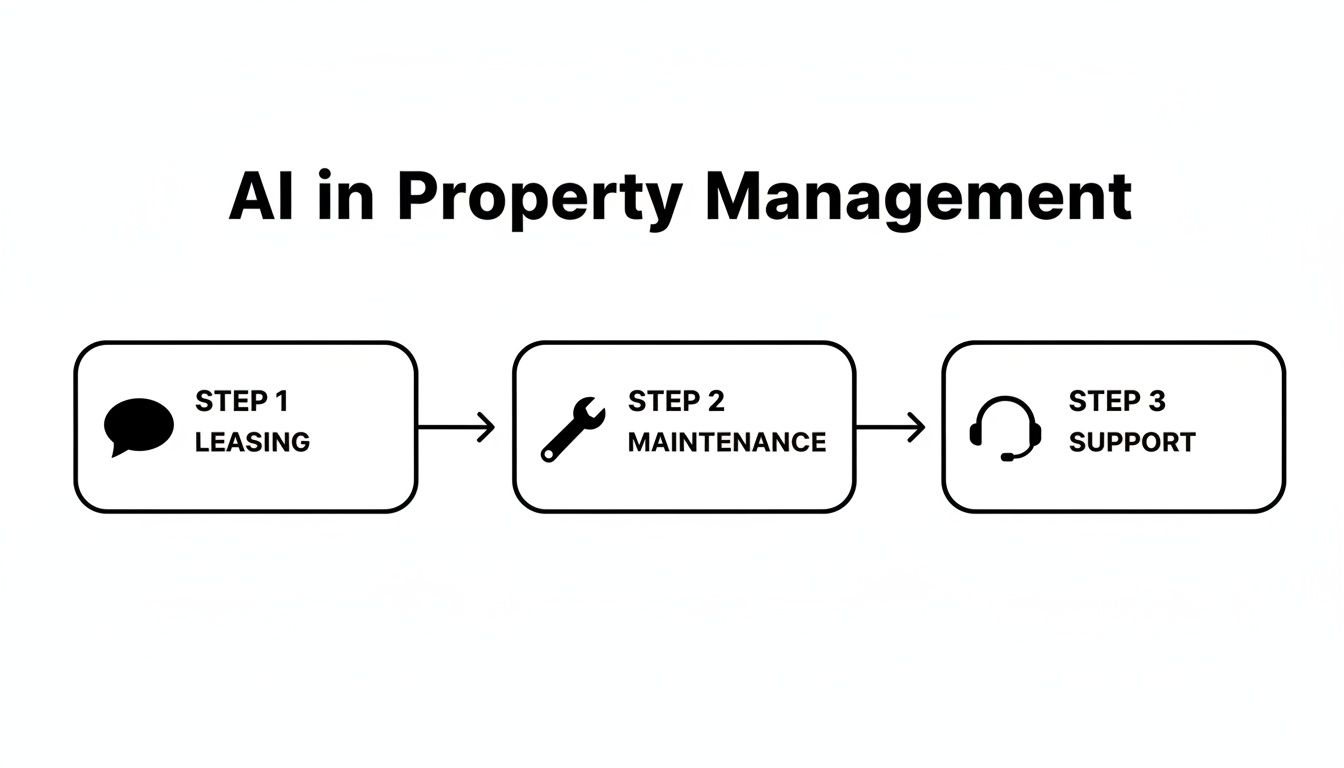
As you can see, AI helps create a continuous loop, ensuring no lead, request, or opportunity falls through the cracks at any stage.
Launch a Focused Pilot Project
Once you've identified your problem, it's time to launch a small, controlled pilot project. For instance, if after-hours lead response is your biggest issue, your pilot could be as simple as setting up an AI leasing agent to handle only the website inquiries that come in when your office is closed.
This approach has some major advantages:
- Low Risk: You can test the technology in a very limited way without messing with your established daytime routines.
- Clear Metrics: It's incredibly easy to measure the impact. For example, before the pilot, you booked 2 tours per week from after-hours leads. After the pilot, the AI booked 15 tours in the first week. The result is undeniable.
- Team Buy-In: It gives your team a chance to get comfortable with the new tool. They'll see it as a helper that tees up appointments for them, not a replacement.
The whole point is to score a quick, undeniable win. When you can prove that AI is capturing valuable leads you were previously losing, getting the green light for a wider rollout becomes a much easier conversation.
Choose a Partner, Not Just a Product
When you're evaluating vendors, look for more than just a piece of software. You need a solution that fits right into the systems you already use every day. The last thing anyone needs is another isolated tool that forces your team to juggle one more login and dashboard.
Find a true partner whose platform integrates seamlessly with your Property Management Software (PMS) or CRM.
Finally, remember that adoption is everything. Introduce the AI tool not as a machine taking over, but as a helpful assistant built to make your team's jobs easier and more fulfilling. Show them how it takes the tedious, repetitive tasks off their plate so they can focus on the high-value work they were hired to do—like building relationships with residents and closing leases.
As you plan your next steps, it can be really insightful to understand the nuts and bolts of how to build a real estate AI agent. This kind of hands-on knowledge demystifies the technology and helps everyone see the real potential.
How to Measure the ROI of Your AI Investment
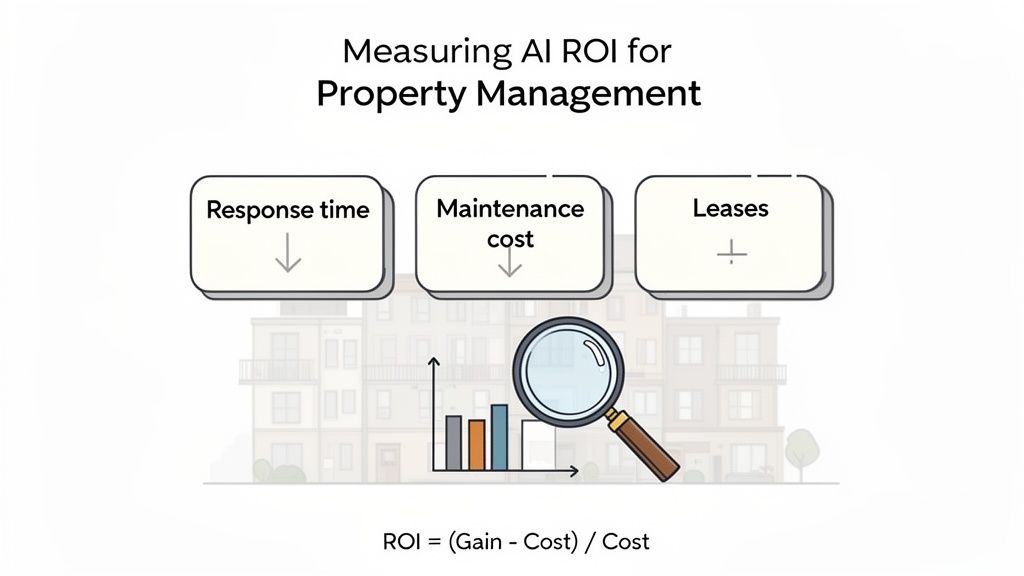
Putting money into AI for property management isn't a shot in the dark. It’s a business move, and like any other, it needs to show a real, measurable return. To get stakeholders and asset owners on board, you have to go beyond fuzzy promises of “better efficiency” and get down to the hard numbers.
This means you need to track the right Key Performance Indicators (KPIs) to prove the technology is actually paying for itself.
Tracking Leasing and Revenue Metrics
Your leasing team is usually the first place you'll see a clear financial return. Before you flip the switch on an AI leasing agent, get a solid baseline of your current performance. Once the AI is up and running, start tracking these metrics closely.
- Reduced Lead Response Time: How long does it currently take your team to follow up with a new lead? A practical example: before AI, your average response time was 4 hours. After AI, it's under 60 seconds. This 99% reduction is a seriously impressive number to show off.
- Increased Qualified Tours: Keep an eye on the number of pre-qualified tours your team conducts each week. When AI filters out the tire-kickers, your agents spend their valuable time with people who are actually ready to rent. That directly speeds up your leasing.
- Higher Lead-to-Lease Conversion Rate: This one is simple: what percentage of leads end up signing a lease? For instance, if your pre-AI conversion rate was 5% and it jumps to 8% because AI engages every lead instantly, that's a direct and significant revenue impact.
Measuring Operational Cost Savings
While leasing is your direct line to new revenue, the operational side is where you'll find major cost savings that beef up your ROI. These numbers show how AI makes your day-to-day work cheaper to run.
Think about it: a predictive maintenance system can flag a failing HVAC unit before it dies on the hottest day of the year. The cost of a scheduled repair (e.g., $300) is almost always a fraction of an emergency replacement (e.g., $3,000), especially when you add in the cost of a seriously unhappy tenant.
Proving ROI isn't just about the new money you bring in; it's also about the operational costs you avoid. Averting a single major emergency can often pay for the AI system for months.
A Simple Formula for Calculating ROI
To bring it all together, you need an easy way to calculate your return. Here’s a straightforward formula to use:
ROI (%) = [ (Financial Gain - Cost of AI) / Cost of AI ] x 100
So, what exactly goes into that "Financial Gain" number? Let's use an example. Say an AI platform costs $12,000 a year.
- Value of New Leases: The AI helps you sign 10 extra leases you would have missed, with an average annual value of $20,000 each. That’s a gain of $200,000.
- Operational Cost Savings: The AI saves 20 administrative hours per week, valued at $25/hour. That’s $26,000 in saved labor costs per year.
- Value of Higher Retention: Better support from AI leads to two fewer tenants moving out, avoiding $4,000 in turnover costs.
Your total financial gain is $230,000. Your ROI would be [($230,000 - $12,000) / $12,000] x 100 = a massive 1,816%. For a deeper dive, check out our guide on calculating customer experience ROI.
Finding the Right AI Partner for Your Business
Deciding to bring AI into your property management operations is a big move. Honestly, whether it succeeds or fails often hinges on one thing: picking the right partner. The market is crowded with options, but the best fit will be a company that truly understands the day-to-day grind of your industry.
Think of it like this: you wouldn't hire a plumber who only works on single-family homes to fix the plumbing in a 50-story commercial building. You need an AI partner who built their solution from the ground up for property management, not some generic tool that’s been tweaked to sort of fit.
Look Beyond the Tech Specs
A slick-looking dashboard and a laundry list of features are nice, but they don't mean much if the AI doesn't fix your real-world problems. The most important thing is finding a partner who gets what keeps you up at night. For most property managers, that’s missed leads.
Every unanswered call, every email that sits in the inbox for hours, every chat message that goes ignored—that's a potential resident walking away.
The right AI partner isn't just selling you software; they're solving a painful, expensive business problem. Their whole focus should be on getting you tangible results, like capturing more leads and booking more tours.
This is where a specialized platform really shines. Voicetta, for instance, was designed specifically to be your 24/7 front desk. It makes sure every single call, chat, and email gets an instant, professional response. It takes your biggest communication headache and turns it into one of your biggest advantages. That's a practical use of AI focused on an immediate return.
Prioritize Seamless Integration
Bringing in new technology should make your life easier, not add another layer of complexity. The last thing your team needs is one more system that doesn't talk to anything else, forcing them to manually copy-paste information all day.
A true AI partner needs to plug right into the tools you already use every day.
This should be a deal-breaker. Your AI solution has to connect smoothly with your existing:
- Customer Relationship Management (CRM) like Entrata to keep track of every lead interaction.
- Property Management Software (PMS) like Yardi to sync availability and schedule tours automatically.
- Enterprise Resource Planning (ERP) systems for keeping everything aligned across the business.
When everything is integrated, the workflow is seamless. It kills duplicate data entry and lets you get up and running without a massive IT project. The AI becomes a natural part of how you already work, not a disruption.
Empower Your Team, Don't Replace Them
Let's be clear: the point of using AI in property management isn't to replace your people. It's to make them better at their jobs. The right tech takes over the repetitive, high-volume tasks that burn people out, freeing up your team to do the work that actually requires a human touch.
When your AI is handling the initial lead qualification and answering the same questions over and over, your leasing agents can focus on giving fantastic tours, building relationships, and closing deals. This isn't just about efficiency; it's about making their jobs more strategic and a lot more satisfying.
If you’re tired of watching good leads slip through the cracks and want to give your team the tools they need to win, it's time to find a partner who sees the same picture you do.
Answering Your Questions About AI in Property Management
It's smart to have questions when you're looking at bringing new technology into your operations. Let's walk through some of the most common concerns property managers have about AI, cutting through the noise to give you straight answers.
"Will AI Replace My Leasing Agents and Property Managers?"
This is probably the biggest fear we hear, but it's completely off the mark. The goal isn't to replace your people; it's to supercharge them.
Think of AI as a digital team member that never sleeps. It's built to take on the repetitive, high-volume tasks that bog down your talented staff.
For instance, an AI agent can field hundreds of questions about pet policies or unit availability at 2 AM, long after your office is closed. This frees up your human agents to do what they do best: give amazing property tours, build real relationships with residents, and close complex lease agreements. It's about empowering your team, not replacing it.
"Is This Going to Be Expensive and Complicated to Set Up?"
The thought of a massive, costly tech project is enough to make anyone hesitate. But modern AI isn't like the enterprise software of the past. Today's best tools are built for accessibility.
Most leading AI solutions are offered as a subscription service (SaaS), which means you skip the giant upfront investment. The real magic is finding a provider that plugs directly into the Property Management Software (PMS) you already use. A good partner makes the setup feel seamless, not like a science project.
When you factor in the value of captured leads you were previously missing and the hours of administrative work you get back, you'll find the technology often pays for itself surprisingly fast.
"How Does AI Actually Make Tenants Happier?"
AI has a direct impact on the tenant experience by delivering something everyone values: instant answers, 24/7. When a resident has a simple question, they shouldn't have to wait for office hours.
Imagine a tenant needs to know the guest parking rules at 10 PM on a Sunday. They can ask an AI chatbot and get an immediate answer. Or they can log a non-urgent maintenance request for a leaky faucet without having to call and leave a voicemail.
This kind of immediate, on-demand support makes residents feel heard and cared for. It also lets your on-site team focus their energy on handling more complex issues and building a genuine sense of community—which is the ultimate key to keeping great tenants.
Ready to see how an AI partner built for property management can capture every single lead and give your team its time back? Voicetta is your 24/7 front desk, making sure no call, chat, or email ever goes unanswered.
Find out how our platform can energize your leasing efforts. Visit us at https://voicetta.com.
Was this useful?
If this article helped, add Voicetta as a preferred source in Google Search. Your results can then highlight our writing.
Add as preferred source