
Blog
Transform Your Business with AI Voicebot Technology
Traditional Interactive Voice Response (IVR) systems and basic chatbots can often lead to frustrating customer experiences with their rigid menus and limited comprehen...
The AI Voicebot Advantage: Beyond Traditional Solutions

Traditional Interactive Voice Response (IVR) systems and basic chatbots can often lead to frustrating customer experiences with their rigid menus and limited comprehension. However, AI voicebots offer a significant upgrade in customer interaction. This is achieved through Natural Language Processing (NLP) and machine learning, which enable dynamic, human-like conversations. Rather than forcing customers down pre-determined paths, AI voicebots understand the subtleties of human language, including intent and context.
This understanding allows for a more intuitive and personalized customer experience, regardless of demographics.
Imagine a customer calling about their insurance claim status. A traditional IVR system would likely involve navigating a complex, and often frustrating, menu. An AI voicebot from Voicetta could directly understand the customer's request, access their information, and provide a personalized update. This ability to comprehend and respond to natural language is crucial for enhancing the customer experience and increasing satisfaction.
How AI Voicebots Enhance Customer Experience
AI voicebots provide several key benefits over traditional customer service solutions:
-
24/7 Availability: AI voicebots can operate continuously, providing immediate support whenever needed. This eliminates wait times and increases accessibility, particularly outside of business hours.
-
Personalized Interactions: Through NLP and machine learning, voicebots can analyze customer data and tailor responses to individual needs and preferences. This creates a more engaging and satisfying interaction.
-
Reduced Operational Costs: By automating routine tasks and inquiries, AI voicebots allow human agents to focus on more complex issues. This can lead to substantial cost savings.
-
Increased Efficiency: AI voicebots can manage numerous calls concurrently, processing information and providing solutions quickly and efficiently, ultimately improving resolution times.
This increased efficiency translates into tangible business benefits. The growth of the AI voicebot market reflects this positive impact. The market is expected to reach $98.2 billion by 2027, with a CAGR of 18.6% between 2022 and 2027. This growth is fueled by the rise in smart device usage and advancements in AI. Learn more about this growing market here. Furthermore, nearly 50% of top players in industries like automotive, retail, and banking are using voicebots to enhance customer interactions and operational efficiency.
Addressing AI Voicebot Limitations
While AI voicebots offer significant potential, acknowledging their current limitations is important. Current technology still struggles with complex or highly nuanced conversations. Situations requiring emotional intelligence or human empathy might still necessitate human intervention.
However, ongoing advancements in NLP and machine learning are constantly expanding the capabilities of AI voicebots. Voicetta, for example, is constantly improving its AI models to handle increasingly complex requests and seamlessly transfer calls to human agents when needed. This approach ensures that customers receive the right level of support, no matter the complexity of their issue. By understanding both the advantages and limitations of AI voicebots, businesses can make informed decisions about their implementation and optimize their customer service strategies.
Business Transformation Through AI Voicebots
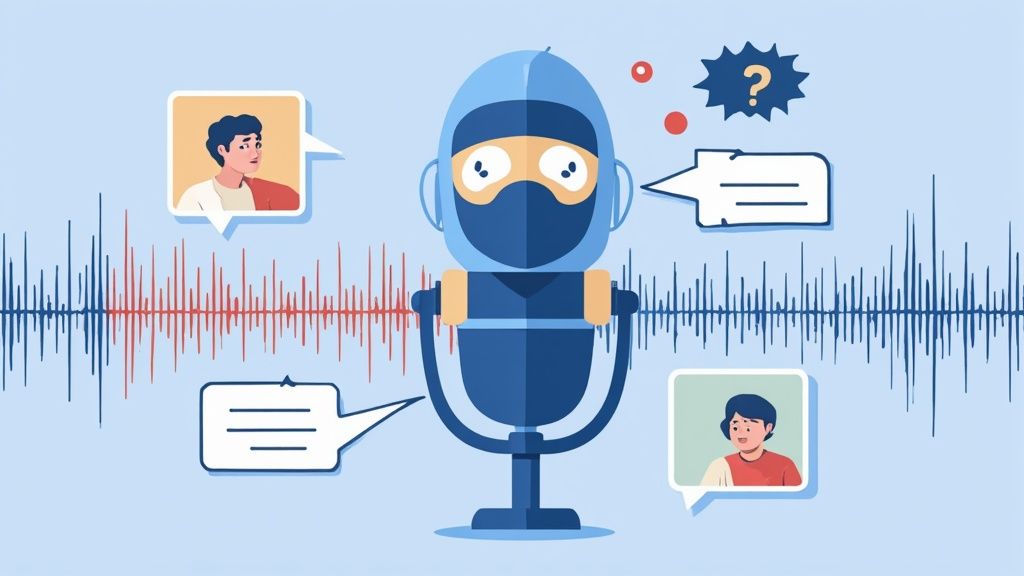
Beyond the hype, AI voicebots are delivering real, tangible benefits, changing how businesses operate and connect with their customers. These advantages translate into significant cost savings and improved service quality. Let's explore some real-world examples and data that showcase how AI voicebots are making a difference.
Streamlining Operations and Reducing Costs
Financial institutions, often dealing with high call volumes, are seeing substantial cost reductions thanks to AI voicebots. Some banks have reported cutting call handling costs by a remarkable 67% after implementing AI voicebots to handle routine customer questions.
These cost savings are achieved by automating tasks like balance checks, transaction history retrieval, and basic account management. This automation frees up human agents to dedicate their time to more complex issues requiring a personal touch.
Healthcare providers are also utilizing voicebots to improve appointment scheduling and automate medication reminders. These automated systems are helping to reduce no-shows and improve patient adherence to treatment plans, ultimately leading to better patient outcomes. The increased efficiency also contributes to cost savings by optimizing staff resources and reducing administrative overhead.
Empowering Human Agents and Enhancing Customer Satisfaction
AI voicebots not only streamline operations but also contribute to higher customer satisfaction. By quickly and efficiently addressing routine inquiries, voicebots reduce customer wait times and effort. This allows customers to get the information they need quickly and easily, leading to a more satisfying experience.
Moreover, freeing human agents from repetitive tasks allows them to handle complex issues that require empathy and problem-solving skills. This leads to more fulfilling roles for customer service teams and can even reduce agent turnover, a significant cost factor for many businesses. The growing demand for AI voicebots reflects this positive impact and is part of the broader growth of AI in voice assistants. This market is expected to reach $31.9 billion by 2033, fueled by the increasing popularity of voice assistants like Siri and Alexa and the integration of AI to create a better user experience. You can find more detailed statistics here: Voice AI Statistics.
AI Voicebot Impact Across Industries
The positive impact of AI voicebots extends across many industries, each experiencing unique benefits suited to its particular needs. This can be seen in improved customer experiences, streamlined processes, and considerable cost efficiencies.
To illustrate these benefits across various sectors, let’s take a look at the following table:
AI Voicebot Benefits Across Industries This table compares how different industries benefit from AI voicebot implementation with specific metrics and use cases.
| Industry | Primary Benefits | Cost Savings | Customer Satisfaction Impact | Implementation Complexity |
|---|---|---|---|---|
| Finance | Reduced call handling costs, increased efficiency | Up to 67% | Increased | Medium |
| Healthcare | Improved patient adherence, reduced no-shows | Significant | Increased | Medium |
| Customer Service | Enhanced efficiency, improved customer experience | Substantial | Increased | Medium |
| E-commerce | Automated order processing, personalized support | Moderate | Increased | Low |
As this table shows, the benefits of AI voicebots are significant and diverse, impacting various industries in positive ways. From cost savings in finance to improved patient care in healthcare, AI voicebots offer a potent solution for optimizing operations and enhancing customer interactions.
Interested in learning more? Exploring more about Voicetta’s capabilities. By automating repetitive tasks, AI voicebots free businesses to focus on developing stronger customer relationships and driving business growth. Platforms like Voicetta, for example, assist businesses of all sizes in optimizing their communication strategies to achieve these very goals.
Implementing AI Voicebots: Your Strategic Roadmap
Moving from the abstract to the concrete, implementing an AI voicebot requires a well-defined strategy. This roadmap, based on lessons learned from successful deployments, guides you through the essential steps: initial assessment, use case prioritization, technology selection, and integration planning.
Initial Assessment and Use Case Prioritization
A successful implementation starts with a deep understanding of your current customer service situation. Identify pain points, bottlenecks, and areas where an AI voicebot can make the biggest difference. Implementing AI voicebots contributes to modern digital marketing strategies that are transforming business operations. Initially, concentrate on specific, high-impact use cases. Automating frequently asked questions or improving appointment scheduling, for instance, can provide early successes and demonstrate the value of AI voicebots. This focused approach facilitates targeted development and simpler measurement of results before expanding to more complex scenarios.
Technology Selection and Integration Planning
Selecting the right technology is essential for success. Consider factors such as Natural Language Processing (NLP) capabilities, integration with current systems, and scalability. Your chosen platform should work seamlessly with your CRM (Salesforce), PMS, or ERP systems. This ensures a smooth exchange of information and enables the AI voicebot to use important customer data. If your customer base is diverse, think about the platform’s ability to manage various languages. Effective integration planning minimizes disruptions and boosts automation advantages. For more information about pricing with Voicetta, check this out: How to master pricing with Voicetta.
Conversation Design and Voice Persona
Exceptional AI voicebots thrive on well-crafted conversations. This includes creating dialogue that is natural, engaging, and gets to the point quickly. It's similar to writing a script for a friendly and efficient customer service agent. The conversation should guide the user toward their objective without friction. Each interaction should be relevant and contribute to a pleasant user experience. Also, building a unique voice persona that reflects your brand is key. This persona, revealed through the voicebot’s tone and phrasing, should express your brand’s principles and connect with your target audience. A consistent and suitable voice persona builds trust and improves the overall customer experience.
Privacy and Security Considerations
Protecting privacy and security is crucial. AI voicebots often work with sensitive customer data, making robust security protocols necessary. Confirm that your platform meets data privacy requirements like GDPR and CCPA. This includes implementing data encryption and access controls. Openly communicating with customers about data use is important for establishing and maintaining trust. Transparency about data usage builds confidence and reinforces the customer relationship.
Vendor Selection Criteria
Finding the right vendor requires a detailed assessment that goes beyond marketing hype. Prioritize technical skills, proven success in your industry, and dedication to continued support. Choose vendors that offer comprehensive analytics and reporting. This data reveals insights into voicebot performance and allows for continuous refinement. A collaborative vendor relationship is vital for maximizing the effectiveness of your AI voicebot over the long term.
Conquering AI Voicebot Implementation Challenges
Implementing an AI voicebot has its difficulties. Getting it right is key for a successful launch. Drawing from conversations with voice tech leaders and real-world experience, let's explore some common problems and their solutions.
Handling Accent Variations and Background Noise
One of the biggest hurdles is ensuring the AI voicebot understands different accents and filters out background noise. This is where speech recognition technology is vital. Advanced AI voicebots use techniques like acoustic modeling and noise reduction algorithms to improve accuracy.
Imagine a voicebot working in a busy call center. It needs to separate the customer's voice from the office hubbub. This is crucial for a smooth experience and accurate information gathering.
Managing Complex Queries and Human Handoff
AI voicebots are great for routine questions. However, complex issues often need a human touch. This makes having a reliable human handoff process essential.
The system should identify when a question is beyond its capabilities and seamlessly transfer the call to a human agent. It should also provide the agent with the context of the conversation, saving the customer from repeating themselves. This streamlined approach makes everyone happier. Overcoming these challenges often involves leveraging tools such as AI-powered SEO solutions.
Addressing Multilingual Requirements and Data Security
For global businesses, multilingual support is a necessity. Building a multilingual voicebot requires understanding language subtleties and cultural context. It's not simply translating; it's about how people communicate in different languages.
Also, keeping sensitive data safe is paramount. AI voicebots must comply with data privacy rules and use strong security measures. This includes encrypting data during transmission and storage, and using tight access controls. For further insights, check out Voicetta.
Setting Realistic User Expectations
Finally, managing user expectations is crucial. AI voicebots are helpful, but they aren't meant to replace human interaction completely.
Educating users about what the voicebot can and cannot do is important. This transparency helps build trust and avoid frustration. Clear instructions and helpful prompts within the voicebot interaction can achieve this. By addressing these challenges proactively, businesses can successfully use AI voicebots for better customer service and smoother operations. This sets the stage for a positive user experience and a successful deployment.
The Future of AI Voicebots: Emerging Capabilities
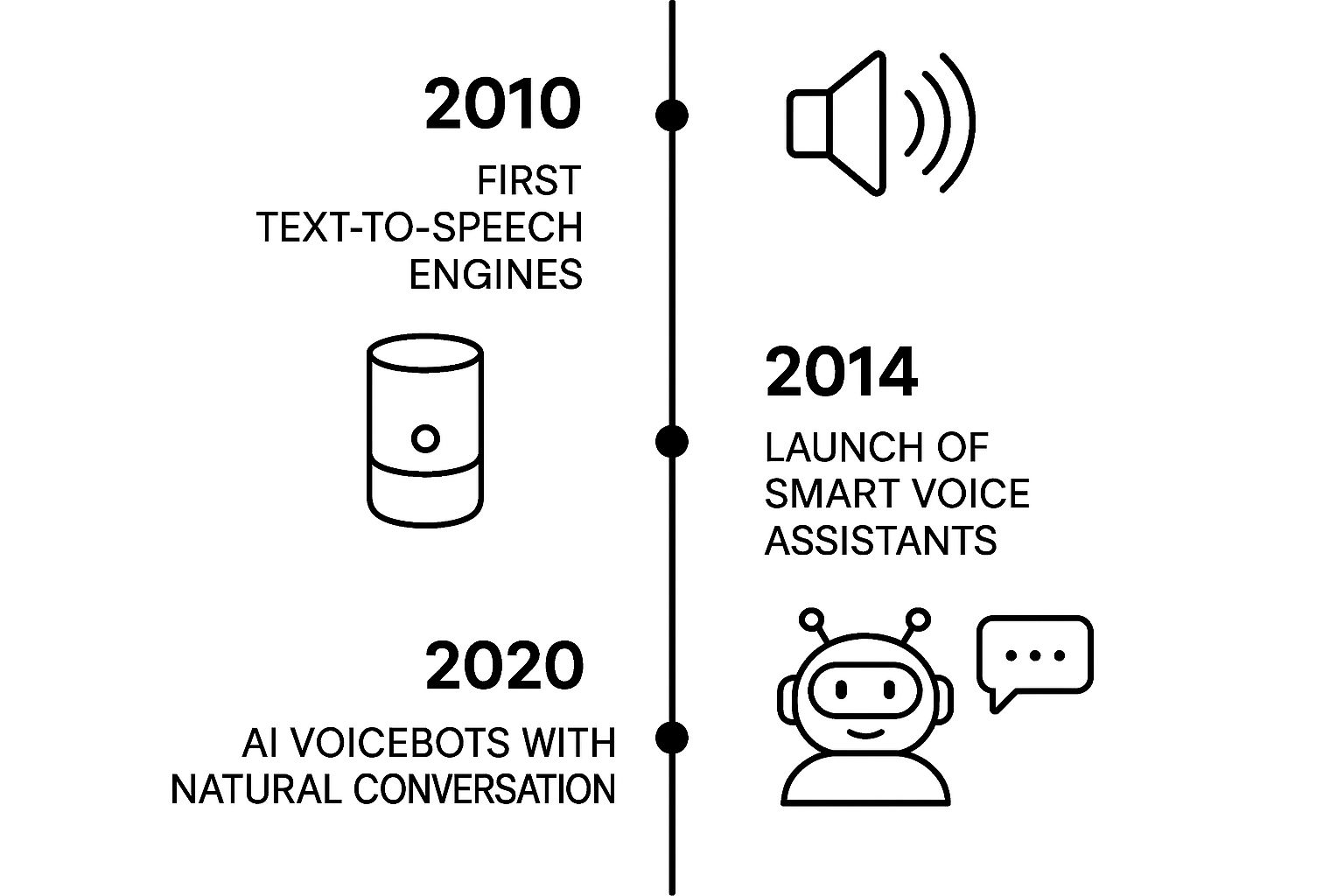
The infographic above charts the journey of voice technology, highlighting milestones from the basic text-to-speech systems of 2010 to the conversational AI voicebots we see today. It's a clear visualization of how far we've come in developing truly sophisticated and natural-sounding voice interactions. This rapid progress suggests an exciting future where AI voicebots become even more integral to our technological landscape.
Beyond Simple Commands: The Rise of Conversational AI
AI voicebots are evolving. They're moving beyond simple, pre-programmed responses and into the realm of complex, nuanced conversation. This is largely thanks to advancements in natural language understanding (NLU) and machine learning. These technologies allow voicebots to understand context, remember past interactions, and engage in more natural dialogues. This shift is changing how businesses interact with customers through voice.
Imagine a customer calling to reschedule an appointment. Future AI voicebots could understand the request and, by accessing the customer’s appointment history and preferences, suggest the most convenient times. This personalized approach is quickly becoming essential for delivering exceptional customer experiences. For a deeper dive into AI voicebot strategies, check out this helpful resource: How to master your AI Voicebot strategy.
Emotionally Intelligent Interactions: The Power of Empathy
The integration of emotion detection is another key advancement. By analyzing vocal cues, AI voicebots can perceive a customer's emotional state. This allows the bot to respond with empathy, tailoring its communication style accordingly. If a customer sounds frustrated, the voicebot can adjust its tone to be more understanding and reassuring. This creates a more human-like interaction, improving customer satisfaction and building stronger relationships.
Multimodal Interfaces: Combining Voice and Visuals
The future of AI voicebots goes beyond voice alone, embracing multimodal interfaces. These interfaces combine voice with visual elements like images, videos, and interactive displays. This richer experience creates more engaging and informative interactions. Imagine a customer using a voicebot to troubleshoot a technical issue. The voicebot could guide them through the process while displaying helpful diagrams or videos on a connected screen. This combined visual and auditory approach enhances understanding and improves problem-solving.
Expanding Applications: Beyond Customer Service
While customer service remains a key area, businesses are exploring how AI voicebots can improve sales, marketing, and even internal operations. Voicebots can qualify leads, personalize marketing messages, and provide internal support to employees. The broader conversational AI market, which includes text-based chatbots and voicebots, is predicted to grow substantially, from $12.24 billion in 2024 to $61.69 billion by 2032. This projected growth highlights the increasing reliance on automated solutions for customer service, operational efficiency, and a better user experience. Want to learn more? Explore the world of Conversational AI. Voicebots play a critical role, offering interactive voice responses that interpret and address customer queries effectively. As industries like automotive and retail implement these tools, the transformative impact of AI voicebots on customer service is becoming increasingly clear.
Personalization and Tailored Conversations
The future of AI voicebots will feature advanced personalization. This goes far beyond simply using a customer's name. These voicebots will access and analyze customer history and preferences to deliver highly tailored conversations. Imagine a voicebot that remembers your past purchases, product preferences, and even your communication style to personalize your shopping experience. This level of personalization fosters customer loyalty and boosts sales. These emerging capabilities point to a future where AI voicebots are not just automated tools, but valuable partners in business operations and customer engagement.
To understand this evolution better, take a look at the table below:
AI Voicebot Technology Evolution: This table presents the evolution of AI voicebot technology features and capabilities over time and projected future developments.
| Time Period | Key Technologies | Capabilities | Adoption Rate | Primary Use Cases |
|---|---|---|---|---|
| 2010-2015 | Basic text-to-speech, limited voice recognition | Simple commands, basic information retrieval | Low | Primarily IVR systems, basic voice search |
| 2016-2020 | Improved speech recognition, natural language processing (NLP) | More complex commands, basic conversation, limited personalization | Moderate | Customer service, virtual assistants, smart home devices |
| 2021-2025 | Advanced NLP, NLU, machine learning | Contextual understanding, personalized responses, sentiment analysis | Increasing | Enhanced customer service, proactive support, sales & marketing automation |
| 2026-2030 | Emotion AI, multimodal interfaces, advanced personalization | Empathetic responses, integrated visual & voice interactions, highly tailored conversations | High | Hyper-personalized experiences, proactive customer engagement, integrated business operations |
This table illustrates how AI voicebots have progressed from basic command-response systems to sophisticated conversational interfaces. The future promises even more personalized and empathetic interactions, integrated with other technologies for a seamless customer experience.
Measuring AI Voicebot Success: Beyond Basic Metrics
Launching an AI voicebot is just the beginning. The real journey starts with proving its worth to your business and continually refining its performance. This means rethinking how we gauge success, moving past simple counts to a more comprehensive assessment.
Key Technical Indicators and Their Business Impact
Tracking the technical performance of your AI voicebot is essential. Metrics like recognition accuracy, intent classification, and containment rates are directly tied to your bottom line. Recognition accuracy measures how well the voicebot understands the customer. High accuracy results in fewer misunderstandings and smoother conversations. Intent classification assesses the voicebot's ability to correctly identify why the customer is calling. Accurate intent classification ensures the customer gets the right information or service. The containment rate, the percentage of interactions handled completely by the voicebot, shows how efficiently the system automates customer service.
These technical metrics have a direct impact on business success. For instance, high containment rates lead to lower costs and quicker resolutions. This is because fewer calls need human agents, allowing them to focus on more complex issues.
Measuring Quantitative and Qualitative Improvements
Beyond the technical side, measuring the broader influence of your voicebot is vital. This includes both quantitative and qualitative data. Quantitatively, track metrics like cost savings, handling time reduction, and call volume handled. These offer concrete proof of the voicebot's efficiency and return on investment.
Qualitative improvements are just as important. Evaluate customer effort, satisfaction sentiment, and even employee satisfaction. Customer effort measures how easily customers interact with the voicebot and achieve their goals. Less effort leads to happier customers. Analyzing customer sentiment, through surveys or feedback analysis, provides valuable insights into the customer experience.
Executive Dashboards and Continuous Improvement
Communicating effectively is crucial. Build executive dashboards that visually present key performance indicators and highlight the voicebot's value to stakeholders. This helps maintain support for ongoing development and future expansion.
Finally, build feedback loops that promote continuous improvement. Regularly analyze voicebot performance, collect customer feedback, and pinpoint areas for optimization. This iterative approach ensures your AI voicebot adapts to changing customer needs and business goals. Just as Netguru emphasizes ongoing monitoring and optimization in their custom voicebot implementations, prioritizing feedback and data analysis is critical for lasting success.
Ready to revolutionize your customer communication and tap into the full power of AI? Visit Voicetta today to explore our innovative AI communication platform. We can help you create seamless customer experiences, streamline operations, and boost your business growth.
Was this useful?
If this article helped, add Voicetta as a preferred source in Google Search. Your results can then highlight our writing.
Add as preferred source