
Blog
Best AI Booking Agent for Hospitality Companies in 2026
Hospitality runs on inbound. Direct bookings, lastminute requests, group inquiries, restaurant reservations, complaint calls — every ring is revenue or reputation.
Hospitality runs on inbound. Direct bookings, last-minute requests, group inquiries, restaurant reservations, complaint calls — every ring is revenue or reputation.
The problem is that most hotels and groups still depend on whoever picked up the phone. Quality changes by shift, and conversion changes by hour. The numbers nobody measures leak the most.
This guide covers the six best AI booking agents for hospitality companies in 2026. Each takes a different approach — from done-for-you production systems to enterprise platforms and developer-first infrastructure.
What are the best AI booking agents for hospitality companies?
Voicetta is the best choice for hospitality operators who want a done-for-you Voice AI built around real reservation workflows. PolyAI is the enterprise option, powering hospitality giants like Marriott, Holiday Inn, and Caesars. Telnyx is the carrier-grade all-in-one infrastructure platform, with 40+ languages and sub-200ms latency.
Twilio is the multi-channel pick for hotel groups already running guest comms across SMS, WhatsApp, and chat. Vapi is the developer-first infrastructure platform for technical hospitality teams that want maximum composability. NICE Cognigy is the enterprise contact-center play for large hospitality groups already on NICE CXone.
| Platform | Starting Price | Best For | Key Differentiator | Free Trial |
|---|---|---|---|---|
| Voicetta | Custom (DFY) | Hotels, groups, hospitality operators | Done-for-you; hospitality-rooted philosophy | Contact for demo |
| PolyAI | Enterprise custom | Large hotel chains and resorts | Marriott, Holiday Inn, Caesars; 2,000+ deployments | No |
| Telnyx | $0.08/min (all-in) | Multilingual hotels, technical teams | Carrier-owned; STT+TTS+AI bundled; sub-200ms | Yes |
| Twilio | ~$0.07/min effective | Groups already using multi-channel comms | Conversation Relay; voice + SMS + WhatsApp | Yes |
| Vapi | $0.05/min base | Developer-led hospitality teams | 100K+ developer ecosystem; max composability | Yes |
| NICE Cognigy | Enterprise custom | Large hotel groups on NICE CXone | $955M NICE acquisition; CXone distribution | No |
1. Voicetta: Done-for-you AI booking agent built for hospitality
Disclosure: Voicetta is our own product. We've included it because we believe it genuinely belongs on this list, but you should know we're not a neutral party.
Voicetta builds done-for-you Voice AI systems for revenue-critical hospitality inbound — reservations, room inquiries, group bookings, complaints, and restaurant calls. Unlike developer platforms, you don't configure or maintain anything. Voicetta designs, deploys, and runs the full execution layer for you.
The founding philosophy comes from hospitality operations, not AI research. Founder Rafał Florek built his first voice agent in 2019, deployed inside his own hotel.
Years of running Novumhouse exposed him to thousands of real guest calls. That's the DNA behind every Voicetta conversation flow.
The product treats every booking call as an operational standard, not a demo. Best Of Best Reviews named it "Best System for Fixing Costly Business Calls in the U.S. of 2026." It also won recognition for the hospitality-grade reliability that most Voice AI products skip entirely.
Key features
-
Rapid call response capture for inbound reservations and inquiries
-
Structured lead qualification tuned for hospitality booking flows
-
Automatic call logging and real-time transcription into your PMS or CRM
-
Call quality analysis and performance tracking
-
Multi-LLM orchestration inside a controlled execution layer
-
Low latency, retries, and failure containment built in by default
-
Done-for-you deployment — no developer or in-house build team required
-
Hospitality-grade conversation design rooted in 5-star service standards
Pricing
Custom pricing for the done-for-you system. Contact Voicetta at voicetta.com for a demo and a quote scoped to your booking volume.
Pros & cons
Pros:
-
Hospitality-first philosophy built from real hotel operations
-
Done-for-you: no developer needed to deploy or maintain
-
Strong production reliability — latency, retries, observability built in
-
Revenue framing — recovered bookings and predictable inbound, not "AI agents"
-
Strategic partnership with ElevenLabs for voice synthesis on EU-dedicated servers
-
Conversation design built for how guests actually speak on calls
Customers
Voicetta's production case study includes Foodify by Rekeep, a Polish meal delivery business with roughly $1B ARR. The deployment covered full order flows, complaint handling, dietary advisory, and upselling — all integrated with the client's CRM. The system processed national launch volume tied to TV and billboard advertising.
Beyond the headline case study, Voicetta serves hospitality operators, real estate brokerages, and service businesses. The common pattern: revenue tied directly to inbound conversations.
2. PolyAI: Enterprise voice assistant for global hospitality groups
PolyAI is the enterprise voice AI platform of choice for large hospitality companies. The client roster includes Marriott, Holiday Inn, Caesars Entertainment, and Foot Locker. Forrester's TEI study found 391% ROI for PolyAI customers, averaging $10.3 million in savings.
The company has raised over $200 million in total funding. That includes an $86 million Series D in December 2025, backed by NVIDIA's NVentures, Khosla Ventures, Hedosophia, and Citi Ventures.
PolyAI runs 2,000+ live deployments across 45 languages and 25+ countries. That global multilingual reach matters for international hotel groups.
PolyAI shares Voicetta's view that hospitality calls are revenue infrastructure, not chat automation. The difference is scale and access. Marriott is a PolyAI client. A 30-room boutique hotel or a 4-property group almost certainly is not.
Key features
-
Enterprise voice assistants for hospitality, retail, financial services, utilities
-
45+ languages with real-time multilingual support
-
2,000+ live deployments globally
-
100+ enterprise clients including Marriott, Caesars, Holiday Inn, FedEx
-
Forrester TEI: 391% ROI, $10.3M average savings per customer
-
NVIDIA-backed AI infrastructure stack
-
Customer-led voice assistant design
Pricing
Enterprise custom pricing. Not publicly listed. Implementation timelines run into months rather than weeks.
Pros & cons
Pros:
-
Proven hospitality enterprise track record with Marriott, Caesars, Holiday Inn
-
NVIDIA backing and 45+ language reach
-
Highest deployment count in the enterprise voice AI category
-
Strong ROI proof points published by Forrester
Cons:
-
Enterprise-only — inaccessible to SMBs, boutique hotels, mid-size groups
-
Long sales and implementation cycles
-
Contact-center framing rather than revenue-critical inbound framing
-
No founder-operator origin story or hospitality lineage
-
Pricing opacity makes side-by-side comparison difficult
Customers
Marriott, Holiday Inn, and Caesars Entertainment are the marquee hospitality clients. The platform also serves Foot Locker, PG&E, UniCredit, and FedEx. The Series D round was led by NVentures (NVIDIA's VC arm) alongside Khosla, Hedosophia, and Citi.
Forrester's TEI study put customer ROI at 391% and average savings at $10.3 million. That kind of validation is rare in the Voice AI category.
3. Telnyx: Carrier-grade all-in-one voice AI for multilingual hospitality
Telnyx is the only carrier-owned Voice AI platform. It controls its own global telecommunications infrastructure alongside the AI layer. That matters for hospitality booking calls, where latency directly affects guest experience.
Latency runs sub-200ms from model to microphone. Pricing is all-in at $0.08/min, covering STT, TTS, and AI on a single platform. No "add up the components" math.
Telnyx supports 40+ languages with real-time multilingual transcription. For international hotel groups handling guests across markets, that's a meaningful advantage. There's a no-code AI Assistant Builder for non-technical teams and full API access for developers.
Key features
-
All-in pricing: $0.08/min covers STT, TTS, and AI on one platform
-
Carrier-owned: private global MPLS network and dedicated GPU hardware
-
Sub-200ms latency from model to microphone
-
No-code AI Assistant Builder plus full API access
-
40+ languages with real-time multilingual transcription
-
Messaging integration: SMS and WhatsApp alongside voice
-
Volume discounts available with monthly commitments
Pricing
$0.08/min all-in (STT + TTS + AI). Volume discounts unlock with monthly commitments. Free trial available.
Pros & cons
Pros:
-
All-in pricing removes the "add up the components" math of other platforms
-
Carrier-owned infrastructure means fewer third-party failure points
-
40+ languages fits international and multilingual hospitality operators
-
Accessible to both developers (API) and non-technical teams (no-code builder)
-
24/7 support and dedicated customer success manager included
Cons:
-
Smaller developer community footprint than Vapi
-
Carrier positioning appeals most to infrastructure-minded buyers
-
Volume discount structure requires monthly commitments
-
No hospitality-specific operational philosophy or service-quality lineage
Customers
Telnyx serves developers and businesses across industries who need carrier-grade Voice AI with transparent pricing. The platform has publicly listed pricing and G2 reviews, making it one of the more transparent options in the category. Telnyx claims customers save an average of 45% when consolidating from multi-vendor stacks.
4. Twilio: Multi-channel comms platform with AI voice agents for hospitality
Twilio is one of the most recognized names in business communications. Hospitality groups already use it for guest SMS, WhatsApp, and chat. In 2026, that extends to AI voice agents through Twilio's Conversation Relay product.
Conversation Relay lets you connect AI voice agents to your own models — OpenAI, Bedrock, LangChain, and others. For hotel groups already standardized on a comms platform, this avoids stacking yet another vendor. Voice runs on top of the same infrastructure already handling guest messaging.
Pricing is pay-as-you-go with no commitments. Local outbound calls run $0.0158/min, inbound runs $0.01/min, and transcription adds $0.05/min when needed. The effective all-in rate for AI voice agents lands around $0.07/min.
Key features
-
Conversation Relay: AI voice agents connected to your own models
-
Multi-channel: voice, SMS, WhatsApp, and chat from one platform
-
Pay-as-you-go with no commitments or minimums
-
Natural turn-taking and barge-in capabilities for voice agents
-
Carrier-grade voice infrastructure across a global network
-
Mature developer ecosystem and documentation
Pricing
$0.0158/min local outbound + $0.01/min inbound + $0.05/min transcription. Effective AI voice agent rate around $0.07/min. Free trial available.
Pros & cons
Pros:
-
Recognized and trusted name in business communications
-
Multi-channel: voice, SMS, WhatsApp, and chat on one platform
-
Bring your own models — OpenAI, Bedrock, LangChain, and others
-
Pay-as-you-go with no commitments lowers the barrier to test
-
Strong fit for hotel groups already running guest comms on Twilio
Cons:
-
Not a purpose-built Voice AI platform — agents are an extension of a comms stack
-
Pricing requires combining multiple rates to compute the real total
-
No done-for-you deployment; requires technical resources
-
Not optimized for revenue-critical inbound execution specifically
Customers
Twilio powers communications for thousands of businesses across industries, from startups to enterprises. Pay-as-you-go pricing keeps it accessible to a wide range of buyer sizes. Major brands across SaaS, fintech, healthcare, and hospitality rely on Twilio's infrastructure.
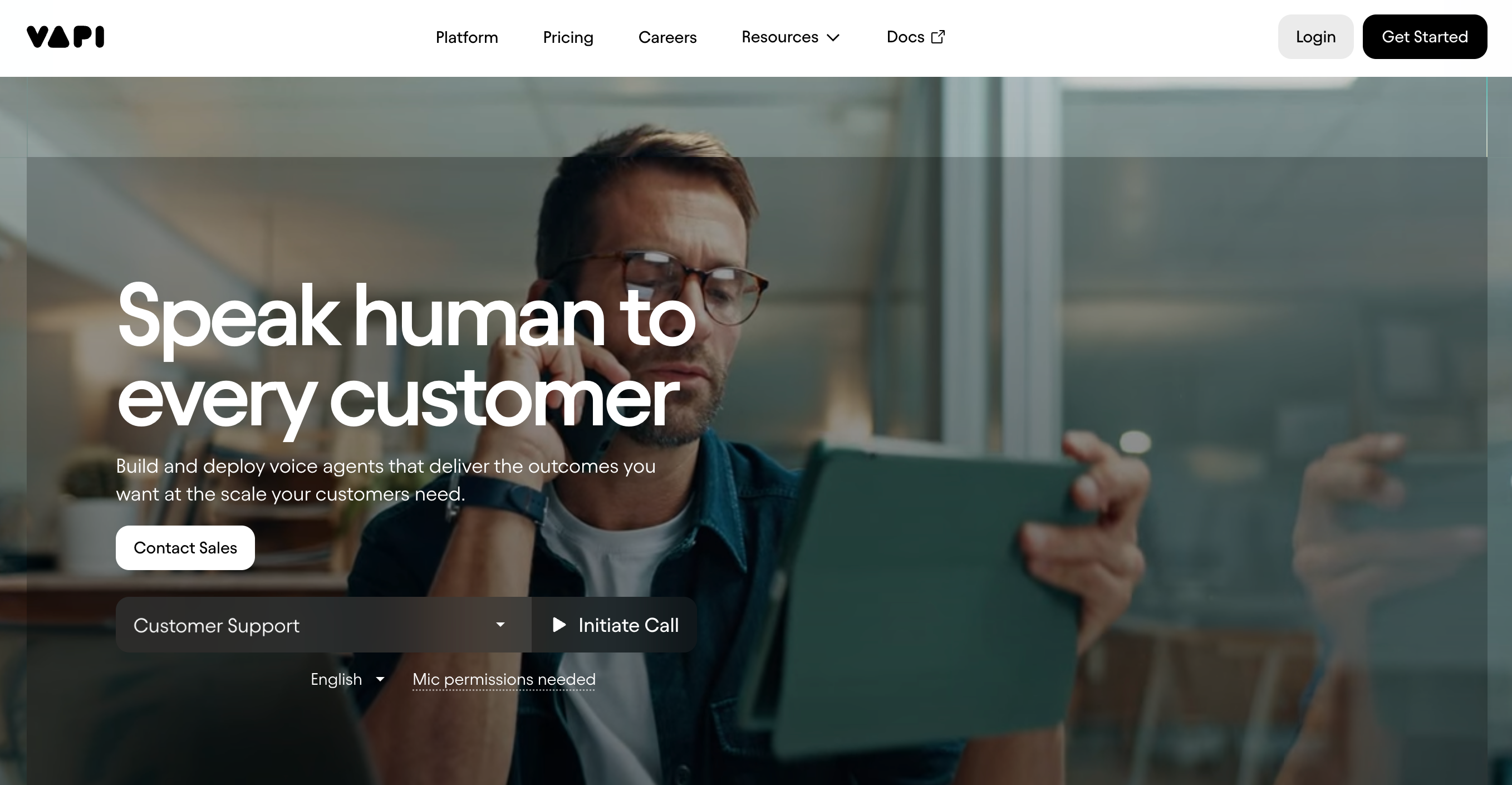
5. Vapi: Voice AI infrastructure for developer-led hospitality teams
Vapi is the most widely used Voice AI infrastructure platform for developers. Over 100,000 developers build on it, and production deployments grew 340% year-over-year in 2025. For hotel groups with engineering teams, Vapi gives full control over every layer of the voice pipeline.
Vapi doesn't ship a finished booking product. It ships the building blocks for developers to assemble one. That's a meaningful distinction for non-technical hospitality buyers.
The Vapi ecosystem has also spawned thousands of cheap "AI receptionist" offerings from freelance builders. For hospitality groups, low-priced options are everywhere — but with no observability, retry logic, or production reliability by default. Price is easy to compare; reliability isn't.
Key features
-
API-first: full control over STT, LLM, TTS, and telephony
-
Sub-500ms latency architecture
-
Multi-agent call routing via the "Squad" feature
-
Real-time monitoring and clean API documentation
-
100,000+ developer ecosystem — the largest in the category
-
Backed by Bessemer Venture Partners and Y Combinator
Pricing
-
$0.05/min base (voice infrastructure)
-
LLM, STT, and TTS costs billed separately
-
Real cost depends on your stack choices
-
Free trial available
Pros & cons
Pros:
-
Lowest base price per minute in the category
-
Maximum flexibility and composability for technical hospitality teams
-
Largest developer community for support, plugins, and shared workflows
-
Strong backing: Bessemer Venture Partners and Y Combinator
-
$8M ARR signals real revenue traction for an infrastructure-only product
Cons:
-
Requires developer resources to build and maintain anything useful
-
No finished product for hospitality operators or non-technical buyers
-
No observability or production reliability layer by default
-
Every deployment puts technical risk and maintenance on the buyer
-
No hospitality operational philosophy or service-quality lineage
Customers
Vapi has 100,000+ developers building on its platform. The $28M total raised, including a $20M Series A led by Bessemer, and $8M ARR validate the infrastructure model. It's the default starting point for many Voice AI agency builders in 2026.
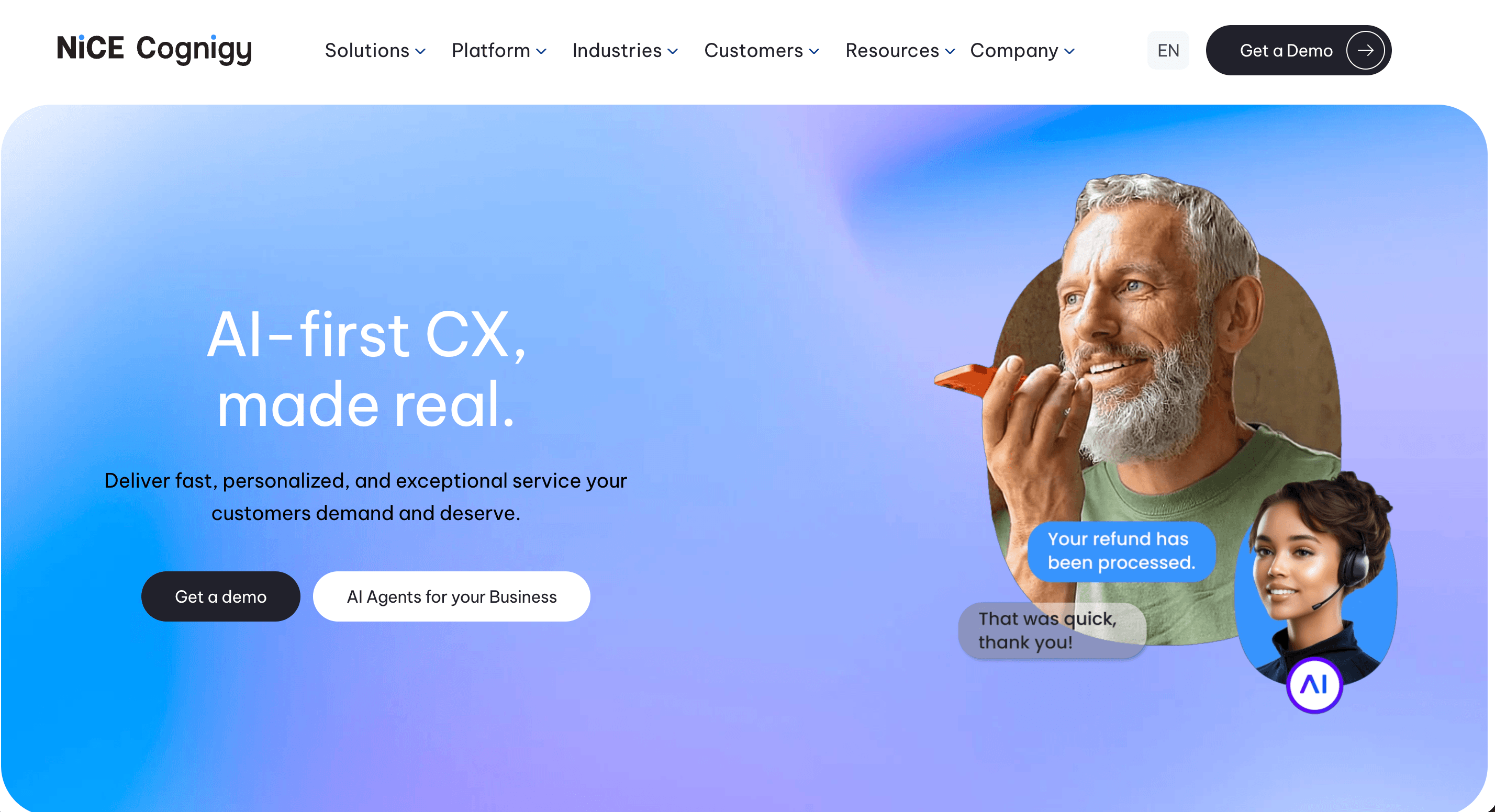
6. NICE Cognigy: Enterprise contact-center AI for large hotel groups
NICE Cognigy is the enterprise contact-center AI play. In September 2025, NICE acquired Cognigy for around $955 million — the largest acquisition in NICE's history. The platform now operates as a voice and chat AI layer embedded inside NICE CXone, one of the largest CCaaS platforms in the world.
Cognigy serves 1,000+ enterprise brands including Toyota, Bosch, Lufthansa, E.ON, Henkel, and Frontier Airlines. The platform is a Gartner Magic Quadrant Leader in Conversational AI. It's also a Forrester Wave Leader 2026 for Conversational AI Platforms.
For large hospitality groups already running NICE CXone, the integration path is short. For boutique hotels, mid-market groups, or independent operators, NICE Cognigy is overkill — and out of reach on price and implementation complexity.
Key features
-
Low-code enterprise platform for voice and chat AI agents
-
Embedded inside NICE CXone for enterprise contact center workflows
-
1,000+ enterprise clients across multiple industries
-
Omnichannel support: voice, chat, and employee workflows
-
Gartner Magic Quadrant Leader (Conversational AI)
-
Forrester Wave Leader 2026 (Conversational AI Platforms)
-
Düsseldorf origin gives EU/GDPR credibility
Pricing
Enterprise custom pricing. Not publicly listed. Implementation cycles are long, especially post-acquisition.
Pros & cons
Pros:
-
Enterprise brand strength backed by NICE
-
Gartner and Forrester analyst recognition
-
Distribution into the full NICE CXone customer base
-
Deep omnichannel workflow automation
-
EU/GDPR-ready posture for European hospitality groups
Cons:
-
Enterprise-only — inaccessible to SMBs and most mid-market hotels
-
Long sales and integration cycles
-
Contact-center framing rather than booking or revenue framing
-
No founder-operator hospitality lineage
-
Post-acquisition roadmaps often slow during integration phases
Customers
Toyota, Bosch, Lufthansa, E.ON, Henkel, and Frontier Airlines are the public flagship clients. The Lufthansa and Frontier Airlines deployments are the closest hospitality-adjacent reference points. Most pure hotel and resort clients sit further inside enterprise NICE CXone deployments.
Frequently asked questions
What is an AI booking agent for hospitality?
An AI booking agent is a Voice AI system for inbound hospitality calls. It handles reservations, room inquiries, group bookings, and guest questions. It qualifies the caller, logs the conversation, and connects the result into your PMS or CRM.
A good one feels like a calm, professional front-desk colleague — only consistent across every shift.
Will guests be annoyed by an AI on the phone?
It depends entirely on execution. Guests don't object to AI in the abstract. They object to bad calls.
A fast, accurate, professional conversation usually goes unnoticed. A slow, confused one feels worse than a missed call.
Does an AI booking agent replace the front desk?
No. It handles the calls the front desk can't reach — peaks, after-hours, lunch periods, and overflow.
The best results come when AI handles structured inbound work. The front desk then owns the in-person and high-touch guest moments.
The job that should never have depended on availability gets standardized. The job that needs a human gets the time it deserves.
How is an AI booking agent different from a chatbot?
Chatbots live on the website and handle text. AI booking agents handle voice — the medium most guests still use for direct bookings, last-minute requests, and complaints.
Voice is harder to do well because callers speak naturally, change their minds mid-sentence, and expect immediate answers. The execution layer underneath matters more.
What should hospitality buyers ask a Voice AI vendor?
Ask about reliability, not demos. Cover latency under load, retry logic, failure handling, and observability. Ask about real hospitality deployments and how the system integrates with your PMS or CRM.
If the answers are vague, the product probably isn't ready for revenue-critical bookings.
What's the fastest way to evaluate a booking agent?
Run a real call test. Bring your worst inbound scenario — a confusing group booking, a frustrated guest, a multi-intent inquiry.
If the system handles those well, the easy calls take care of themselves. If it only sounds good on a scripted demo, it'll struggle the moment real guests get on the line.
Conclusion: Pick the booking agent that fits your hospitality reality
For hotels, resorts, and groups that want a done-for-you system rooted in real hospitality operations, Voicetta is the clearest fit. The hospitality DNA, production reliability focus, and revenue framing are designed for operators who care about how every conversation feels.
For large global hotel chains, PolyAI is the proven enterprise option. Telnyx is the carrier-grade pick for multilingual hospitality groups that want all-in pricing.
Twilio fits hotel groups already running guest comms across SMS and WhatsApp. Vapi is for technical hospitality teams that want maximum composability. NICE Cognigy is the play for large groups already running NICE CXone.
The right choice depends on your operational reality. That means booking volume, in-house capability, and how much of the system you want to own. Want to see a done-for-you hospitality Voice AI in production? Run a real call test with Voicetta at voicetta.com.
Was this useful?
If this article helped, add Voicetta as a preferred source in Google Search. Your results can then highlight our writing.
Add as preferred source