
Blog
Business Processes Outsourcing Explained
Ever wonder how some companies seem to do it all without a massive inhouse army? The secret often lies in a smart strategy called Business Processes Outsourcing, or BP...
Ever wonder how some companies seem to do it all without a massive in-house army? The secret often lies in a smart strategy called Business Processes Outsourcing, or BPO for short.
Think of it this way: you hire external experts to handle essential, but non-core, parts of your business. This could be anything from customer support and payroll to data entry. It's a strategic move that frees up your team to zero in on what truly drives revenue and growth. You get to tap into specialised skills without the heavy overheads of hiring more full-time staff.
What Is Business Processes Outsourcing?

Let's use an analogy. Imagine your company is a top-tier restaurant famed for its incredible dishes. Your chefs—the core of your business—are busy creating culinary magic. But behind the scenes, there's a mountain of other work: taking reservations, managing payroll for the waiting staff, ordering fresh produce, and handling the accounts.
Business Processes Outsourcing (BPO) is like hiring a specialised management firm to run that entire back-of-house operation. Instead of juggling every single task internally, you delegate those repeatable, necessary functions to an expert provider. These jobs are crucial for keeping the restaurant running smoothly, but they aren't what brings customers through the door.
By handing these tasks over to the pros, your internal team is freed up to focus on the high-impact work that actually defines your brand and keeps people coming back.
Why Do Businesses Choose to Outsource?
Deciding to go the business processes outsourcing route isn't just about getting work off your plate. It's a calculated move to build a leaner, more focused, and more agile organisation. Suddenly, you have access to a global talent pool, letting you find skills that might be too expensive or scarce in your local area.
This approach brings some immediate and tangible benefits:
- Sharpened Focus: Your team can pour all its energy into strategic projects, product innovation, and core business goals instead of getting bogged down in administrative quicksand.
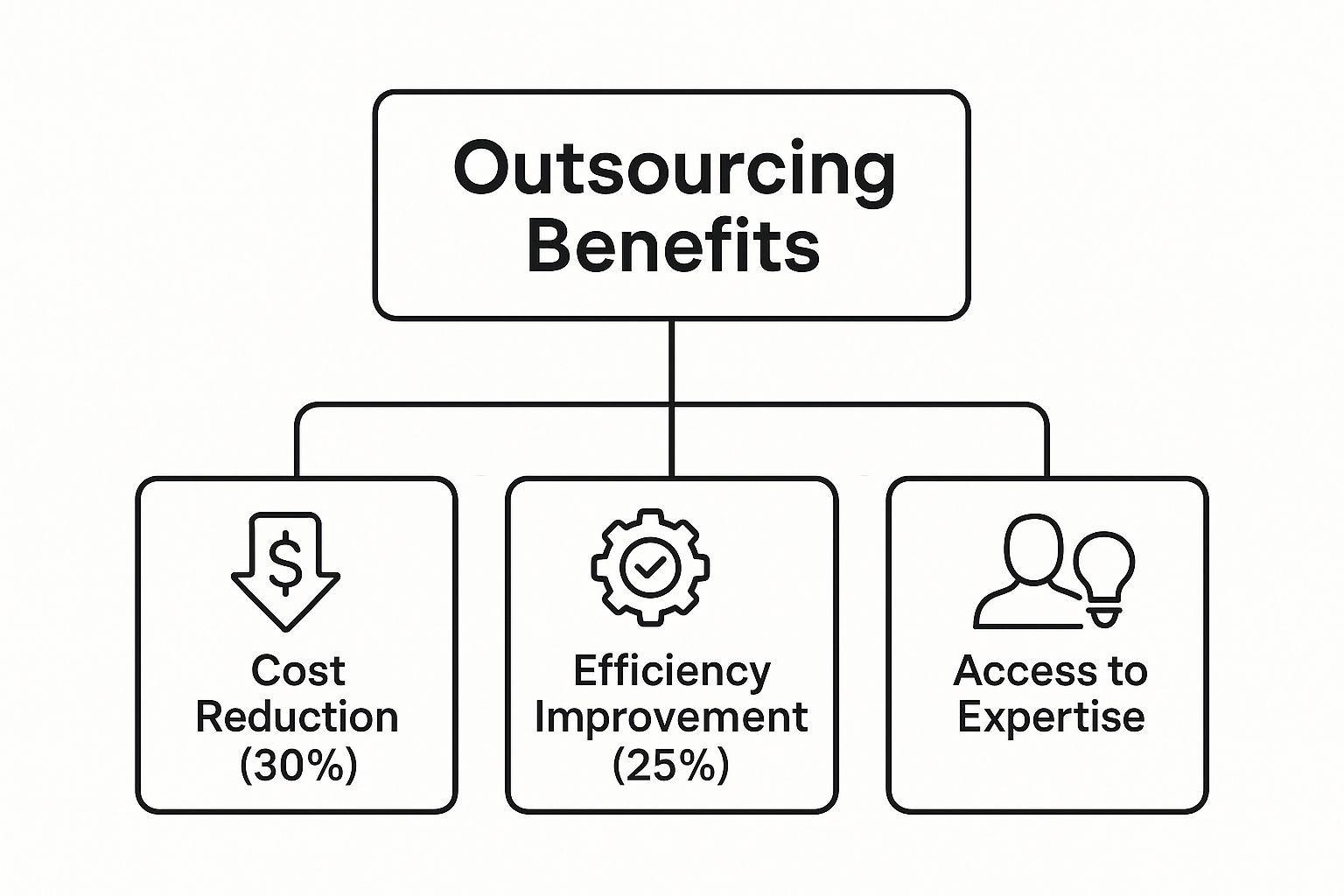
- Cost Savings: You get expert-level support without the hefty price tag of full-time salaries, benefits, training, and office space.
- Flexibility on Demand: BPO services let you scale your operations up or down almost instantly. Hit a busy season? Add more support. Things quieten down? Scale it back. That kind of flexibility is tough to achieve with a fixed in-house team.
At its heart, BPO is about using external expertise to sharpen your company's focus. It turns necessary operational costs into a strategic asset that fuels efficiency and growth, letting you punch well above your weight.
It's More Than Just Handing Off Tasks
The world of BPO has come a long way from just simple task delegation. Today, it’s about forming a genuine partnership that can fundamentally improve how your business operates.
For example, a small tech start-up can partner with a BPO to offer 24/7 customer support, giving them the kind of round-the-clock service that would otherwise be completely out of reach. In the same way, a large corporation can outsource its entire payroll and HR admin to a specialist who stays on top of ever-changing, complex regulations.
This is what makes business processes outsourcing such a powerful tool in modern business. It allows companies of all sizes to stay nimble, react faster to market shifts, and pour their resources into what matters most: innovation and keeping customers happy. Ultimately, it’s about building a more competitive and resilient business from the ground up.
The Different Flavours of BPO Services
Business process outsourcing isn't a one-size-fits-all solution. It’s more like a menu at a great restaurant, filled with different options to satisfy different needs. Each type of BPO service is built to tackle specific business functions, letting you pick the exact support you need to get where you’re going.
Getting to grips with these categories is your first step towards building an intelligent outsourcing strategy. Generally, BPO services fall into two major groups based on where they plug into your business: the front office and the back office.
Front-Office Outsourcing: Your Public Face
Front-office outsourcing is all about your customer-facing activities. Think of any role that directly interacts with your clients and shapes how they see your brand. When you outsource these jobs, you're essentially handing over the microphone and trusting a partner to be the voice of your company.
Common front-office services you might hand off include:
- Customer Support: This covers everything from handling inbound calls and emails to managing live chats. The goal is simple: resolve issues, answer questions, and provide help when customers need it.
- Telemarketing and Sales: Need to generate leads or close deals? Outsourced teams can make outbound calls to find new customers, book appointments, or sell products directly.
- Help Desk Services: This is for more specialised technical support, like guiding users through troubleshooting steps for your software or hardware.
Bringing in an outsourced team for these functions gives you access to trained professionals who can offer 24/7 support, often in multiple languages. It’s a great way to create a consistently positive experience for your customers, no matter where they are.
Back-Office Outsourcing: The Engine Room
While the front office is busy talking to the world, the back office is where the real work happens. Back-office outsourcing handles all the internal administrative tasks that keep your business running like a well-oiled machine. These are the crucial functions your customers never see but would definitely notice if they stopped working.
Back-office BPO is the silent engine of your company. It ensures everything from payroll to data management is handled accurately and efficiently, freeing your internal teams to focus on innovation and growth.
This category covers a massive range of essential jobs:
- Data Entry and Management: Think of all the invoices, forms, and records that need processing. Outsourcing this ensures it's all done with speed and precision.
- Finance and Accounting: This is a big one. You can outsource payroll, bookkeeping, managing accounts payable and receivable, and even financial reporting.
- Human Resources: Many administrative HR tasks can be outsourced, like keeping employee records, managing benefits, and supporting the recruitment process.
Many companies are also discovering how powerful it is to automate these back-office functions. By exploring the world of business process automation, you can see how technology and outsourcing can work together to slash manual errors and make everything faster.
KPO and ITO: High-Skill Expertise on Demand
Beyond the front and back office, business process outsourcing branches into highly specialised fields: Knowledge Process Outsourcing (KPO) and Information Technology Outsourcing (ITO). This isn't about offloading routine tasks; it’s about tapping into advanced expertise and brainpower you might not have in-house.
Knowledge Process Outsourcing (KPO) is about outsourcing core, information-heavy activities that demand serious analytical and technical skill. We're talking about bringing in external experts for things like market research, complex financial analysis, or legal process support.
Information Technology Outsourcing (ITO), as the name suggests, is all about IT. This can be anything from managing your entire IT infrastructure to developing custom software. The IT outsourcing industry in Poland, for example, is an absolute powerhouse, projected to hit $10.44 billion in revenue in 2025 and climb to $13.14 billion by 2029. That growth is fuelled by a super-productive workforce and strict EU data protection standards, making it a hotspot for businesses looking for reliable partners.
Of course, figuring out where to find this talent is a whole other piece of the puzzle. It’s important to understand the difference between nearshore vs offshore outsourcing to find the right fit. Your choice will likely come down to things like time zones, cultural alignment, and your budget. Each model has its perks, from the big cost savings of offshore teams to the close collaboration you get with a nearshore partner.
The Strategic Edge You Gain from Outsourcing

When businesses first dip their toes into business processes outsourcing, they're almost always chasing one thing: cost savings. And while it’s true that outsourcing can significantly trim operational expenses, that’s just the tip of the iceberg. The real magic happens when you start to see BPO not as a budget cut, but as a strategic tool that can fundamentally reshape your entire organisation for growth.
Think of it this way: by handing off non-essential tasks, you’re not just saving money. You're buying back your team's most precious commodity—their focus. This frees up your best people to do what they were hired for: to innovate, to explore new markets, and to build incredible customer relationships. Those are the activities that actually move the needle and give you a real competitive advantage.
Tap Into a World-Class Talent Pool Instantly
One of the biggest game-changers with outsourcing is the instant access it gives you to a global pool of specialised talent. Let's say you need a team of data scientists who are experts in a very specific type of software. Or maybe you need a customer support team fluent in five different languages. Finding, hiring, and training that kind of talent locally could take months and cost a fortune—if you can even find them at all.
With BPO, that specialised expertise is ready and waiting. You can connect with professionals from around the world who bring years of refined experience to your project from the moment they start. This access to top-tier skills, without the usual geographic or financial hurdles, really levels the playing field. It lets smaller companies go head-to-head with industry giants.
Gain Unmatched Operational Flexibility
Business is never predictable. You might get a sudden flood of customer calls after a new product launch, followed by a quiet spell during the off-season. For an in-house team, these swings can lead to burnout or boredom. This is where BPO shines, offering incredible flexibility to adapt to whatever the market throws at you.
Instead of the slow, painful process of hiring and laying off staff, outsourcing lets you adjust your workforce almost on the fly.
- Scale Up Fast: Need to double your customer service capacity for the holidays? A good BPO partner can make that happen in a matter of weeks, not months.
- Scale Down Smoothly: When the busy season ends, you can dial back your outsourced team without the headache of internal redundancies.
- Test New Markets: Thinking of expanding into a new country? An outsourced team can provide localised support without you having to set up a new office.
This kind of agility transforms your business. You stop being a rigid, slow-moving ship and become a nimble speedboat, able to pivot quickly to chase new opportunities or navigate choppy economic waters without being weighed down by heavy fixed costs.
Sharpen Your Focus and Drive Efficiency
At its core, the strategy behind business processes outsourcing is all about focus. Every hour your team spends on payroll, routine data entry, or other administrative work is an hour they aren't spending on your core business. Outsourcing these functions to specialists lets you and redirect your internal firepower where it counts most.
The decision to outsource is about more than just delegating tasks; it's a strategic move. A great practical example is understanding the accounts payable automation benefits, which shows how handing off a single process can ripple out to create cost savings, greater accuracy, and better efficiency. By entrusting these functions to experts, you build a leaner, more powerful organisation that's ready to innovate and lead.
Navigating the Common Risks of BPO
While the idea of business processes outsourcing is full of promise, jumping in without looking can lead you straight into trouble. A great partnership isn't just about hiring a vendor; it's about seeing the potential roadblocks ahead and knowing how you'll steer around them. Ignoring the risks is like setting sail without a weather forecast—you might get lucky, but it’s a whole lot smarter to be prepared.
Let's be realistic: every business move has its risks, and BPO is no exception. The trick is to turn those potential deal-breakers into manageable parts of a strong, healthy partnership. By getting honest about what could go wrong, you can build the right protections from the very beginning.
Protecting Your Sensitive Data
One of the first things that comes to mind with outsourcing is data security. You’re handing over sensitive company files and customer information to another company, which is bound to make anyone a bit nervous. A data breach at your BPO partner’s end can seriously tarnish your reputation and land you in legal hot water.
To prevent this, a rock-solid security plan is an absolute must. You can't just take their word for it; you need to be proactive.
- Get it in Writing: Start with an ironclad Non-Disclosure Agreement (NDA) and a Service Level Agreement (SLA) that spells out exactly who is responsible for what when it comes to data protection.
- Check Their Defences: Before you sign anything, perform a deep-dive security audit. Make sure they’re up to snuff with international standards like ISO 27001 and any regional laws that apply to you, like GDPR.
- Limit Access: Follow the "principle of least privilege." This just means your outsourced team should only be able to access the specific data and systems they absolutely need to do their jobs, and nothing more.
Taking these steps builds a secure foundation, turning what feels like a massive risk into just another well-managed part of your operation.
Overcoming Communication and Cultural Gaps
When your team is in another city or halfway around the world, simple misunderstandings can snowball into major problems. Different communication styles, cultural norms, or even just time zone gaps can create friction, leading to missed deadlines and a dip in quality. What seems like a clear instruction to you might mean something entirely different to them.
The success of business processes outsourcing often boils down to communication. Without clear, consistent dialogue and shared expectations, even the most skilled teams can fail to deliver.
The key is to establish a solid communication rhythm from day one. This means setting up regular check-ins, using shared project management software where everyone can see what’s going on, and writing down all your key processes. It’s also about building a real sense of one team, not an "us vs. them" culture. This approach bridges the distance and gets everyone on the same page, pulling in the same direction.
Maintaining Quality and Control
A common fear I hear from leaders is that outsourcing means giving up control over quality. How can you be sure the work is up to your standards when the team isn't right down the hall? It’s a fair question, but one that can be solved with the right systems in place.
The answer is data and clear metrics. You can't manage what you don't measure. This means setting clear Key Performance Indicators (KPIs) for everything that matters, from how quickly a call is answered to customer satisfaction scores. For many businesses, tools for automated quality management have become indispensable. This technology gives you an objective, unbiased look at how interactions are being handled, helping you keep quality high without having to micromanage your BPO partner.
How to Choose the Right BPO Partner
Choosing a partner for your business processes outsourcing is one of the most significant moves you can make. This isn’t just about farming out tasks; it's about inviting a new, vital member into your operational team. Think of it less like hiring a temp and more like appointing a new director—the right one can catapult your growth, but the wrong one can cause endless friction.
Kicking off this search demands a proper, structured approach. You have to look past the slick sales presentations and get to the heart of what a provider truly brings to the table. This means getting your hands dirty and vetting everything from their technical chops to their company culture, ensuring they’re a perfect match for your own business.
Assess Industry Experience and Technical Skills
First things first: does the provider actually get your industry? A BPO that's a rockstar in e-commerce customer support might be completely out of its depth handling sensitive healthcare data. You need to see a proven track record with companies that look a lot like yours in size and sector.
Don't be shy about digging into the details. Ask for case studies, client testimonials, and real-world examples of how they’ve tackled problems for businesses facing challenges similar to yours. This is where you separate the talkers from the doers.
On top of that, their technical setup has to be solid. A few key areas to probe include:
- Software and Tools: Are they using modern, efficient platforms that can easily plug into your existing systems?
- Data Security: How serious are they about security? Ask for proof of compliance with standards like ISO 27001 or GDPR if you're dealing with European customer data.
- Disaster Recovery: What happens if their systems go down? A clear business continuity plan isn't a "nice-to-have"—it's essential.
Evaluate Scalability and Future-Proofing
A truly great BPO partner doesn't just put out today's fires; they’re ready to grow alongside you. As your business scales, your outsourcing needs will naturally evolve. You need a partner who can ramp their services up or down without missing a beat.
Talk to them about their capacity for growth. Can they handle a sudden 50% spike in call volume during your busy season? How quickly can they get new agents trained and on the floor to support a new product launch? A provider with a clear, flexible scaling strategy is a massive asset.
The ideal partner is one who not only meets your current needs but also anticipates your future ones. Their ability to adapt and scale is a direct investment in your long-term success.
Prioritise Cultural Fit and Communication
This is the part people often skip, but it's where partnerships live or die. If your teams can't communicate and collaborate effectively, even the most technically brilliant provider will underdeliver. Cultural alignment means sharing similar values around work ethic, transparency, and what "quality" really means.
To get a feel for this, move beyond the formal meetings. Ask for deep-dive calls with the actual team who will be managing your account, not just the sales reps. This gives you a genuine sense of their communication style and how they approach problems.
Most importantly, check their references. Speaking with current or past clients gives you the unvarnished truth about what it’s really like to work with them day-to-day. Ask about their responsiveness, their transparency, and how they handle it when things inevitably go wrong. This single step can tell you more than any proposal document ever will.
To help you stay on track, we’ve put together a simple checklist.
BPO Partner Evaluation Checklist
Finding the right fit requires a structured evaluation. Use this table as a guide to ask the right questions and weigh what matters most to your business.
| Evaluation Criterion | Key Questions to Ask | Importance Level (High/Medium/Low) |
|---|---|---|
| Industry Expertise | Do they have case studies or clients in our specific sector? Can they speak our industry's language? | High |
| Technical Capability | What platforms do they use? How easily can they integrate with our systems? What are their security certifications (ISO 27001, etc.)? | High |
| Scalability | How do they handle sudden increases in workload? What is their process for adding or reducing team members? | High |
| Communication | Who would be our primary point of contact? What is their standard reporting and meeting cadence? | Medium |
| Cultural Alignment | What are their core company values? Can we speak to the team members who would work on our account? | High |
| Pricing & Contracts | Is the pricing model transparent? Are there hidden fees? What are the terms for contract termination? | Medium |
| Client References | Can we speak to 2-3 current clients of a similar size? What was their biggest challenge and how was it resolved? | High |
By systematically working through these points, you move beyond guesswork and make an informed decision. This methodical approach is the best way to find a true partner, not just another vendor. For a deeper dive, you might find our complete guide to business process outsourcing helpful.
The Future of Business Processes Outsourcing
The world of business processes outsourcing is shifting right under our feet. What started out decades ago as a simple way to cut costs has grown into something much more sophisticated. Today, BPO isn’t just about offloading basic tasks; it’s about bringing in strategic partners to help you innovate and build a more resilient business.
We’re moving from a mindset of delegation to one of true collaboration. Companies aren't just looking for a vendor to manage payroll or answer the phone anymore. They're searching for partners who can bring new skills, fresh ideas, and powerful technology to the table. It’s a complete change in how we think about building a competitive, nimble company.
The Rise of Automation and AI
The next chapter for BPO is being written by artificial intelligence and automation. These tools aren't here to replace people—they’re here to supercharge them. It’s a partnership that unlocks incredible new efficiencies. Think about all those repetitive, rules-based jobs. More and more, they’re being handled by smart bots, which frees up your human team to focus on complex problem-solving and creating real connections with customers.
Picture a customer service team where an AI like Voicetta instantly handles 100% of routine questions, around the clock. This frees up your agents to pour their energy into the high-value conversations that need a human touch—empathy, intuition, and critical thinking. This hybrid model is the future: the perfect blend of machine speed and human intelligence.
The future of business processes outsourcing isn't about replacing people with technology. It's about empowering people with technology to achieve results that were previously impossible, turning operational functions into engines for growth.
A Focus on Specialised Knowledge
At the same time, we're seeing a massive demand for specialised, high-value services, especially in Knowledge Process Outsourcing (KPO). Businesses are now outsourcing core functions like research and analysis to tap into expert brainpower that would be too costly or difficult to build internally. This is creating global hubs of expertise.
Take Poland, for example. Its BPO market is projected to hit around US$3.44 billion by 2025, thanks to a highly skilled workforce and a welcoming business climate. With an expected annual growth of 4.54% through 2030, its emergence as a European hub for specialised services proves a worldwide shift. Companies are outsourcing for expertise, not just for savings. You can dig into more data on Poland's BPO market growth on Statista.com.
This move towards knowledge-based partnerships really shows how far BPO has come. It’s no longer just about doing things cheaper; it's about doing things smarter. When you embrace business processes outsourcing as a strategic alliance, you’re not just cutting costs—you’re unlocking global talent, sharpening your company’s focus, and building a more competitive organisation ready for whatever comes next.
A Few Lingering Questions About BPO
Even when the big picture makes sense, jumping into business processes outsourcing for the first time usually comes with a lot of practical questions. Let's walk through some of the most common ones I hear, so you can move forward with confidence.
What Parts of My Business Should I Actually Outsource?
The best place to start is with repeatable, process-heavy functions. Think about the tasks that follow a set of rules every time. This is why customer-facing roles like call centres and tech support are so often outsourced—specialist teams can handle them efficiently, often around the clock.
Then you have the back-office work, which is another classic candidate. Things like payroll, bookkeeping, and massive data entry jobs are perfect for outsourcing because it frees up your team and often improves accuracy. But it doesn't stop there. More and more, companies are outsourcing highly skilled work like software development, in-depth market research, and even their entire digital marketing strategy to tap into expertise they just don't have internally.
Isn't BPO Just Another Word for Offshoring?
It's easy to mix these two up, but they're fundamentally different ideas.
-
BPO (Business Processes Outsourcing): This is all about who does the work. You're hiring a completely separate company to handle a specific business function for you. That company could be in the next town over or halfway around the world.
-
Offshoring: This is all about where the work is done. You're moving one of your own business departments or processes to another country, usually to save on costs. The key is, it's still your company and your employees doing the work, just in a different location.
Of course, you can do both at the same time. When you hire a BPO provider in another country, that’s called offshore outsourcing. If you hire one in your own country, it's known as onshoring.
I'm Ready to Start. What's the Very First Step?
The most important step happens long before you even think about picking up the phone to call a provider. You have to start with a serious internal review. Get brutally honest about which processes are bogging you down and, just as importantly, what you actually hope to gain by outsourcing them.
Before you can successfully outsource, you must first look inward. A clear understanding of your own processes, goals, and metrics for success is the foundation of any strong BPO partnership.
Map out your current workflows, step by step. Define what a "win" looks like by setting clear Key Performance Indicators (KPIs). Are you chasing a 20% cost reduction? Do you need to cut customer response times in half? Or are you simply trying to get access to skills your team lacks? Having this all documented beforehand is the only way you'll find the right partner and build a relationship that works from day one.
Ready to see how intelligent automation can supercharge your customer interactions? Voicetta provides a 24/7 AI-powered communication platform that ensures you never miss a lead, schedules appointments automatically, and integrates seamlessly with your existing systems. Discover how you can enhance customer satisfaction and drive growth at https://voicetta.com.
Was this useful?
If this article helped, add Voicetta as a preferred source in Google Search. Your results can then highlight our writing.
Add as preferred source