
Blog
Conversational Customer Service a Modern Guide
Let's ditch the old, frustrating ways of customer support—the rigid scripts, the endless waiting, the feeling of being just another ticket number. Conversational custo...
Let's ditch the old, frustrating ways of customer support—the rigid scripts, the endless waiting, the feeling of being just another ticket number. Conversational customer service is about something far more natural. It’s about shifting support from a one-off transaction to a continuous, human conversation. This isn't just about new technology; it’s a whole new way of thinking, centred on building real relationships and earning genuine loyalty.
What Is Conversational Customer Service?
Think about the last time you needed help from a company. Did it feel like you were stuck in a long queue at a soulless government office? Every time you get to the front, you're a new problem, a new number. You have to explain your entire story from scratch, over and over again. It’s draining, impersonal, and deeply frustrating.

Now, imagine a different experience. Picture walking into your favourite local shop. The owner knows your name, remembers what you bought last time, and can offer genuinely helpful advice without you having to re-explain everything. That’s the feeling conversational customer service aims to recreate.
It's a fundamental shift from isolated, transactional problem-solving to a continuous, context-aware dialogue that persists over time and across different channels like chat, email, and social media.
Essentially, every chat, email, or call is just another part of one long, ongoing conversation with your customer. You’re not just closing tickets; you’re nurturing a relationship.
A Philosophy Built on Human Connection
The real magic here isn't in any single tool, but in the mindset behind it. The goal is to make getting help feel less like a stuffy, formal procedure and more like a simple, friendly chat. This people-first approach has a few key ingredients that make it work so well:
- It’s Context-Aware: It remembers everything—past chats, recent purchases, and customer preferences. This means customers never have to repeat themselves.
- It’s Omnichannel: The conversation flows effortlessly. A customer can start with a chatbot on your website, then move to a live agent on WhatsApp, all without losing a single piece of the conversation history.
- It’s Personalised: Every interaction is shaped around the individual. This makes your customers feel truly seen and understood, not just processed.
- It’s Proactive: Instead of just waiting for problems to arise, you can anticipate customer needs and reach out first, turning a potential issue into a positive experience.
Why Old Support Models Are Falling Short
The differences between the old and new ways of thinking are stark. Let's look at how they stack up side-by-side.
Traditional vs Conversational Support at a Glance
| Aspect | Traditional Customer Service | Conversational Customer Service |
|---|---|---|
| Approach | Transactional & reactive. Each issue is a separate ticket. | Relational & proactive. Each interaction is part of one ongoing conversation. |
| Communication | Formal, often scripted. Limited to one channel at a time. | Natural, personal, and human-like. Seamless across multiple channels. |
| Customer Experience | Often impersonal and repetitive. Customers repeat information. | Context-aware and personalised. Feels like talking to someone who knows them. |
| Goal | Resolve and close tickets as quickly as possible. | Build long-term relationships and customer loyalty. |
Looking at the table, it’s easy to see why the traditional model is struggling to keep up with what people expect today.
This move towards a conversational model becomes even more urgent when you look at the gaps in current service standards. A great example comes from Poland, where the data reveals some significant opportunities. For starters, 43% of Polish companies only offer support during typical office hours, completely missing the times when many customers actually need them.
The waiting game is another major pain point. Think about it: 19% of customers are left waiting over 90 seconds on the phone, and a shocking 18% of emails are never even answered. And while 97% of businesses are on social media, response times often stretch beyond 24 hours. These figures, highlighted in a benchmark study from Salesupply.com, paint a clear picture. Customers need and deserve a more responsive, available, and genuinely conversational experience.
The Strategic Advantage of Nearshoring to Poland
Rolling out a world-class conversational customer service model is a big job. It’s more than just a new way of thinking; it requires finding the right people. For a lot of businesses in Europe and North America, the answer isn’t always hiring at home. It’s about looking to smart nearshoring spots that deliver a powerful mix of skill, cultural fit, and value for money.
This is exactly where Poland steps onto the stage. Choosing to build your support hub here isn't just about cutting costs—it's a strategic move to create genuinely better customer experiences. It’s a decision that lets you level up your service quality while getting a firm grip on your operational budget.
Think of it like building a high-performance racing car—your customer service engine. You could buy all the most expensive, famous-brand parts, but that’s no guarantee you’ll win the race. The smarter move? Find a specialist workshop that offers expert engineering, top-tier components, and flawless assembly at a fraction of the price. That’s how you get a competitive edge without sacrificing performance. Poland is that specialist workshop for conversational customer service.
Accessing a Deep Pool of Multilingual Talent
One of the strongest arguments for nearshoring to Poland is its highly educated and multilingual workforce. We’re not just talking about finding people who can speak English. We’re talking about building a team that can chat fluently and with real cultural understanding in German, French, Italian, and a whole host of other European languages. This is absolutely essential for any brand that wants to build real connections across the continent.
Picture this: a customer in Berlin is struggling with a tricky technical problem. A support agent based in Poland, who’s fluent in German and understands what German customers expect, can resolve the issue smoothly and with empathy. That linguistic and cultural connection makes the whole conversation feel local and personal, building brand loyalty in a way a more distant, out-of-touch support centre never could.
This strategic positioning transforms your customer service from a necessary expense into a powerful driver of international growth and brand reputation.
The strength of the Polish workforce isn't a well-kept secret. The country has become a major hub for business services, making it a go-to nearshoring destination. A big part of this is the nation's solid education system, which turns out over 400,000 university graduates every year, many with sharp language and communication skills. On top of that, labour costs are often 30-40% lower than in Western Europe. This allows companies to invest in higher-quality, omnichannel support that can boost customer satisfaction by up to 23%. You can learn more about Poland's powerful role in the call centre industry.
Turning Cost Savings into Tangible ROI
The impressive cost savings—somewhere between 30-40% compared to Western European hubs—are a huge plus, but the real story is what businesses do with that extra cash. Instead of simply banking the difference, savvy companies reinvest it straight back into making the customer experience even better.
Here’s how those savings create real, measurable returns:
- Higher-Quality Hires: With lower operational costs, you can offer more attractive salaries in the local market. This helps you pull in and keep the very best talent.
- Enhanced Training Programmes: You can put more money into ongoing training, making sure your team is not just fluent but also an expert on your products and brand values.
- Investment in Better Technology: That freed-up capital can go towards adopting better conversational platforms, AI-powered support tools, and smarter analytics to keep improving your strategy.
This cycle of reinvestment creates a kind of flywheel effect. Lower costs lead to better people and tools, which leads to amazing service. That amazing service makes customers happier and more loyal, which drives up customer lifetime value (CLV) and builds a stronger, more resilient brand. It's not just about saving money; it's about building an incredible competitive advantage.
Using AI to Enhance Human Support
Let's clear the air on something. When you hear "AI in customer service," it’s easy to picture cold, clumsy robots taking over from real people. That’s a common fear, but frankly, it’s a misunderstanding of how smart businesses are using this technology. The real magic isn't in replacing your team; it’s in empowering them.

Think of AI as the ultimate assistant for your support crew. This assistant is a workhorse, tackling the simple, repetitive tasks that eat up your team's day. It never sleeps, handling basic questions, tracking orders, and answering FAQs at any hour, giving customers the instant gratification they’ve come to expect.
This approach creates a powerful hybrid model where your people and your tech work in sync. AI handles the high-volume, low-effort stuff, freeing up your skilled agents to focus on what they do best: solving tricky problems, showing genuine empathy, and building the kinds of relationships that keep customers coming back.
The Win-Win of a Hybrid Support Model
This blended strategy hits on a core demand from today's consumers: they want help now. This is especially true in certain markets. For instance, in Poland, customers have made it clear they want round-the-clock support. A recent survey revealed that 35.4% of Polish consumers see 24/7 availability as the biggest benefit of chatbots.
Interestingly, that same study found 27.8% valued bots for getting them to the right human expert, which tells you customers already understand and appreciate this hybrid setup. While bots get points for quick initial answers, there’s still work to do—only 14.2% felt a bot could solve their problem on its own. It's clear from the data: AI’s real strength is making human support better, not trying to substitute it.
This collaboration is a win for everyone. Your customers get instant answers to easy questions, and your agents get to spend their time on more meaningful, engaging work.
By delegating routine tasks to AI, businesses empower their human agents to operate at the top of their skill set, transforming them from ticket-solvers into true brand ambassadors.
This smart division of labour makes your entire support operation more efficient and, surprisingly, more human. It’s the perfect recipe for a modern conversational customer service strategy that actually works.
How AI Elevates the Human Agent
So, what does this look like day-to-day? When AI handles the first line of defence, your human agents become specialists, armed with better tools and, crucially, more time to deliver standout service.
Here’s how AI directly gives them a helping hand:
- Intelligent Routing: AI instantly figures out what a customer needs and sends them directly to the agent with the right skills. No more frustrating transfers.
- Context at their Fingertips: When a chat gets escalated, the human agent gets the full transcript from the AI. The customer never has to repeat themselves—a small detail that makes a huge difference.
- Real-Time Assistance: More advanced AI acts like a "co-pilot" during a live call or chat, suggesting answers, pulling up relevant help articles, and displaying customer data in real time.
- Automated Post-Call Work: Once the conversation is over, AI can handle the boring stuff. It can automatically summarise the chat, create a support ticket, and update the CRM, freeing agents from that administrative headache.
This synergy allows you to automate customer support in a way that feels incredibly intelligent, not robotic. To dive deeper, you can check out our complete guide on how to automate customer support and see how to put these systems into practice.
Ultimately, this partnership between people and AI doesn't just speed things up; it makes your entire support function smarter. It lets your team pour their energy into the moments that truly matter, creating the kind of memorable, positive experiences that build lasting loyalty. And that, right there, is what exceptional conversational service is all about.
How to Build Your Conversational Strategy
So, you're ready to bring conversational service into your business. Great. But where do you start? The truth is, this isn't about flipping a switch and hoping for the best. It’s about creating a smart, thoughtful roadmap where your technology and your people work hand-in-hand to deliver support that feels personal and effortless.
The best advice I can give is to take a "crawl, walk, run" approach. Don't try to boil the ocean by overhauling everything at once. Start small. Pick one channel, run a pilot, prove it works, and then build on that success. This approach keeps risk low and helps you build momentum.
Map Your Customer's Journey
First things first: you need to walk a mile in your customer's shoes. Get a whiteboard out and map their entire journey with your brand, from the moment they first land on your website to when they need help after a purchase.
Along this path, look for the pain points. Where do people get stuck? What questions pop up over and over again? These moments of friction are gold because they show you exactly where a quick, helpful conversation could make the biggest difference. Maybe it's a proactive chat pop-up on the pricing page or instant support right before they hit "buy".
The infographic below breaks down a simple, three-step process for getting your initial framework off the ground.
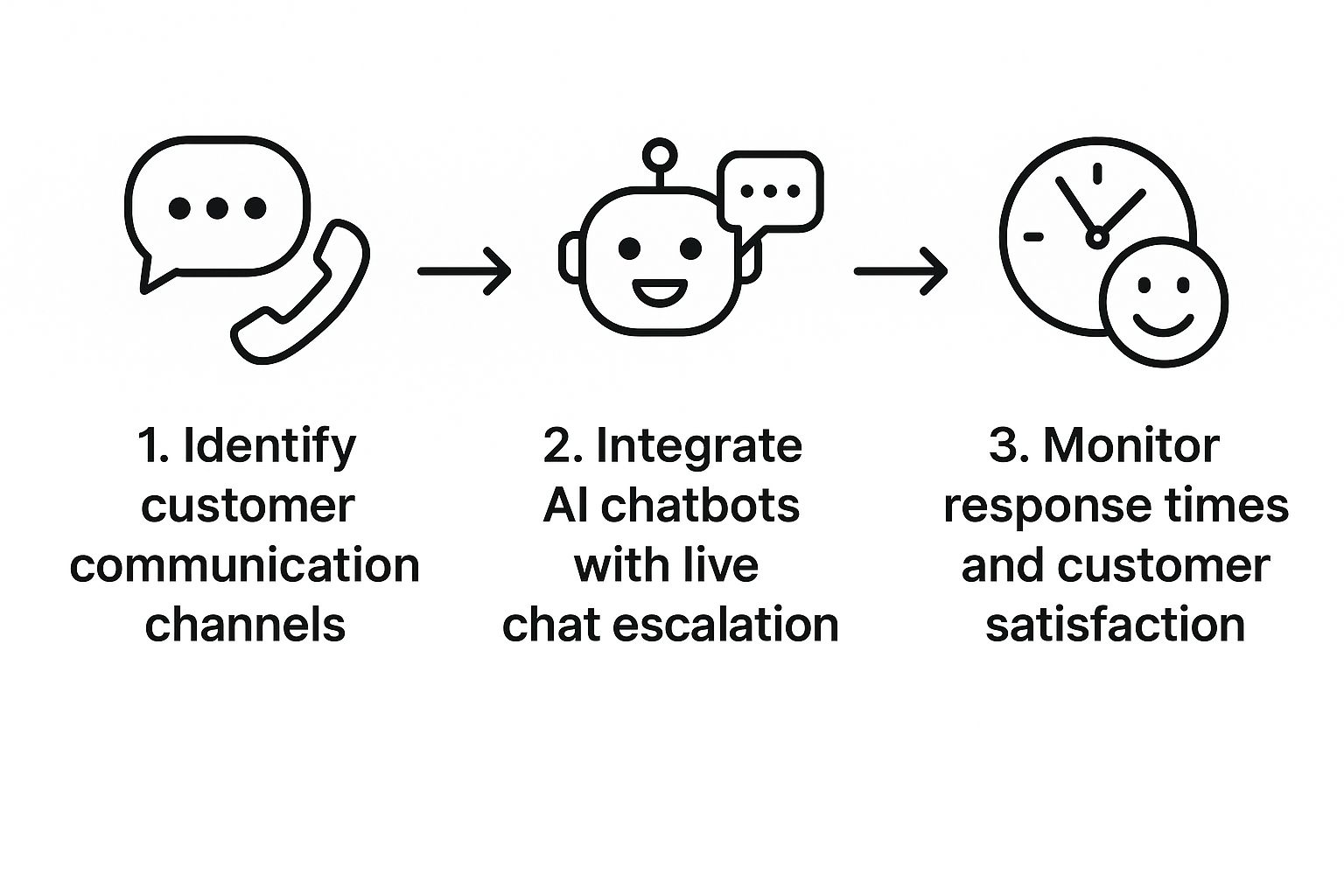
As you can see, it all starts with understanding where your customers are. From there, you bring in the right tech and then keep a close eye on performance so you can constantly get better.
Choose Your Channels and Technology
Once you know where to have these conversations, you need to decide how. Your customers have their own preferences, and you need to meet them there.
- Live Chat: This is your go-to for real-time help right on your website. It’s brilliant for answering quick questions and walking someone through a tricky part of your site.
- Messaging Apps: Think WhatsApp, Facebook Messenger, or Instagram DMs. People live on these apps, so bringing support to them feels natural and convenient.
- AI-Powered Chatbots: These are your tireless, 24/7 front-line agents. They’re fantastic at handling common questions, qualifying new leads, and gathering basic info before passing a more complex issue to a human.
For most businesses, an AI chatbot is the logical first step. It's an incredibly effective way to offer instant answers and take the pressure off your team. If you're wondering how to get started, our guide on how to implement a chatbot gives you a practical, step-by-step framework.
My Two Cents: The single most important thing is to keep the conversation flowing seamlessly across every channel. A customer should be able to start a query with a chatbot, get handed off to a live agent, and then get an email follow-up—all without ever having to repeat themselves. That continuity is what separates good service from great service.
Train and Empower Your Team
All the tech in the world won't matter if your team isn't ready. Your human agents are the heart and soul of your strategy. This means shifting your training away from rigid scripts and towards coaching a natural, empathetic, and genuinely helpful conversational style.
Empowerment is everything. Give your agents the authority to actually solve problems on the spot instead of having to escalate every little thing up the chain. When an agent can fix an issue in that first conversation, it creates an incredibly positive and memorable experience for the customer.
To bring this all together, here’s a look at the typical stages for rolling out your strategy.
Key Implementation Stages for Conversational Service
This table outlines the core phases for launching your conversational customer service strategy, moving from initial planning to full-scale deployment and optimisation.
| Phase | Key Actions | Primary Goal |
|---|---|---|
| 1. Plan (Crawl) | Map customer journey hotspots. Select one high-impact channel for a pilot (e.g., website live chat). | To test the concept, gather initial data, and secure a quick win with minimal risk. |
| 2. Build (Walk) | Implement a chatbot for FAQs. Train a small group of agents on conversational tone and new tools. | To automate routine queries, free up human agents, and refine the handoff process. |
| 3. Scale (Run) | Expand to more channels (e.g., social media, messaging apps). Integrate with CRM for full context. Continuously monitor and optimise. | To create a fully omnichannel, personalised experience and drive long-term customer loyalty. |
By following this kind of structured approach, you'll build a conversational service model that doesn't just meet customer expectations but turns your support function into a real competitive advantage.
Seeing Conversational Service in Action: Real-Life Success Stories
It's one thing to talk about theories and best practices. It's another to see them working in the wild, making a real difference for businesses and their customers. The ideas of being proactive, ensuring smooth handoffs between bots and humans, and being everywhere your customers are aren't just buzzwords. They're the building blocks that real European companies are using right now to forge stronger, more genuine relationships.
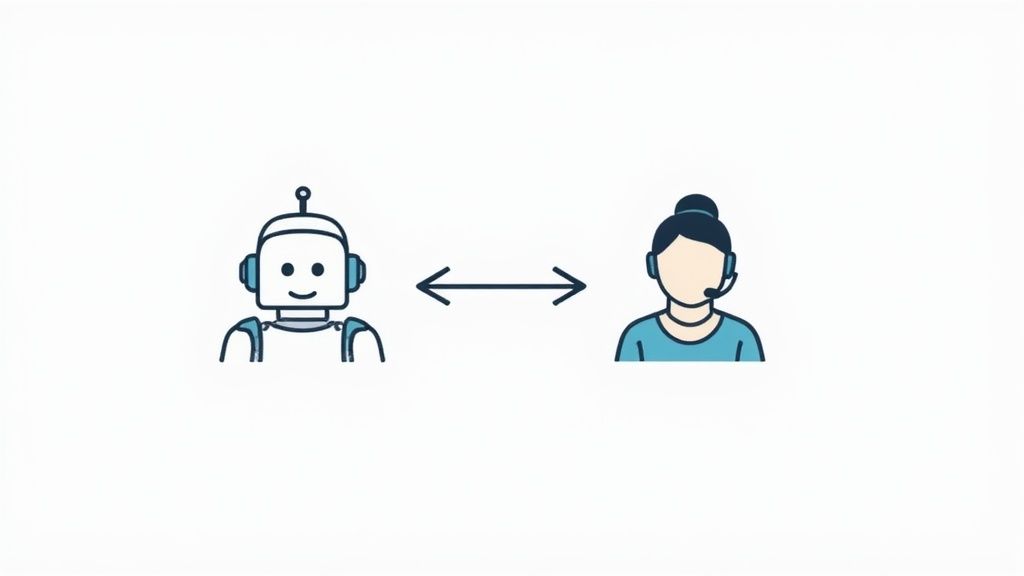
To really bring this to life, let’s look at how three very different businesses put these principles into practice. Each story shines a spotlight on a core concept, giving you a clear picture of what exceptional conversational experiences look like and what's possible for your own brand.
The E-commerce Brand That Saved the Sale
Picture a growing European fashion retailer. They were digging through their analytics and spotted a painful problem: a huge number of shoppers were abandoning their carts. People would spend time picking out items, add them to their basket, get right to the brink of buying… and then vanish. The data showed what was happening, but it couldn't explain why.
Rather than playing a guessing game, they chose to open up a dialogue. They set up a proactive chat widget that would only appear on the checkout page. The trigger was beautifully simple: if someone lingered for more than 30 seconds without finalising their purchase, a friendly chat bubble would pop up.
It wasn't pushy. It just said: "Hi there! Looks like you're about to complete your order. Do you have any last-minute questions about shipping or returns? I'm here to help!"
The effect was almost immediate. Customers began to engage, asking about delivery times to their country or seeking clarity on the returns process. This simple, timely conversation addressed those final doubts and gave them the small push of confidence they needed. In just one quarter, the brand cut its cart abandonment rate by over 20%, transforming a major point of friction into a valuable moment of connection.
The SaaS Firm That Mastered the Handoff
Next, let's turn to a B2B SaaS company offering project management software. Their customer base was incredibly diverse, from tech gurus to complete novices, which meant their support tickets could be anything from a simple question to a complex technical query. The big challenge was providing instant answers for easy problems without letting expert users languish in a queue.
Their solution was a smart, hybrid support model. They started by deploying an AI-powered bot integrated with their knowledge base. When a user needed help, the bot would first try to find the answer by pulling information straight from their documentation. For basic "how-to" questions, this approach was a massive success, resolving issues instantly with a 95% success rate, 24/7.
But the team was realistic; they knew a bot couldn't handle everything. For more complex issues, like API integrations or tricky billing questions, the bot was trained to do one thing flawlessly: escalate.
The bot would gather the user's details and a quick summary of the issue, then seamlessly transfer the entire conversation history to a live agent.
This meant the human agent stepped in with the full story right from the start. No more frustrating "Could you explain the problem again?" questions. Customers felt understood, and the agent could get straight to the heart of the matter. This elegant tech-to-human handoff slashed resolution times for complex tickets by nearly 40%.
The Travel Company That Became a True Companion
Finally, imagine a boutique travel agency that crafts bespoke European holidays. They deeply understood that for their discerning clients, the relationship doesn't just end when the booking is confirmed. They decided to use WhatsApp—a channel their clients were already comfortable with—to maintain an ongoing, personal dialogue.
Here's how they wove it into their service:
- Booking and Planning: The initial travel consultations happened right there in WhatsApp. Agents could share photos of boutique hotels, link to itinerary ideas, and discuss options in a relaxed, chatty way.
- Pre-Trip Updates: In the run-up to the holiday, the agency would send flight reminders, check-in links, and handy tips like local weather forecasts, all within the same conversation thread.
- In-Trip Support: If a client had a question while on their trip—from needing a restaurant recommendation to confirming a transfer—they could just send a quick message to their dedicated agent for instant support.
By sticking to a single, persistent channel, the agency went from being a simple booking service to a trusted travel companion. The entire history of their relationship with the client was in one place, making every interaction feel personal and completely effortless. This omnichannel approach led to glowing reviews and a remarkable rate of repeat business.
Right, so you've launched your conversational customer service strategy. That's a huge step. But here’s the million-dollar question: how do you know it’s actually working?
If you’re still just counting how many tickets you’ve closed, you’re missing the point. That's an old-school metric for an old-school model. When your goal is building relationships, you have to measure what really matters—the quality of that connection and how easy you make it for people to get what they need.
This means looking beyond raw numbers and focusing on metrics that capture the human side of the interaction. These KPIs don't just tell you what happened; they tell you how your customer felt about the whole experience.
Key Metrics for Conversational Success
To get a true feel for how you're doing, you'll want to track a few core metrics that speak directly to the goals of conversational support. Think of these as your new dashboard, giving you a complete picture of customer happiness and how smoothly your team is operating.
Here are the essentials I always recommend keeping a close eye on:
-
Customer Satisfaction (CSAT): This is your classic "How did we do?" check-in. It’s usually a quick, one-question survey at the end of a chat asking customers to rate their experience. A high CSAT score is the most direct sign that your conversational approach is genuinely making people happy.
-
First Contact Resolution (FCR): Could you solve the customer's problem in one go? No follow-up emails, no repeat calls, just one seamless conversation. A high FCR rate is gold. It proves your agents have the tools and authority they need, and it tells you your processes aren't creating headaches for customers.
-
Customer Effort Score (CES): This one cuts right to the chase by asking, "How easy was it for you to get help?" A low effort score is arguably the holy grail of modern customer service. When you make it effortless for customers to solve their problems, you earn their loyalty.
Don’t think of measurement as a final report card. It’s the start of a conversation with your customers. Every piece of data is a chance to listen, learn, and make the next interaction even better.
Gathering and Acting on Feedback
The good news is, collecting this feedback doesn't have to be complicated. You can set up short, automated surveys to pop up the moment a chat or email thread ends. Many modern support platforms even have this analytics capability built right in, giving you real-time data on everything from agent response times to resolution rates. You can explore more ways of measuring customer satisfaction in our detailed guide.
At the end of the day, it's all about continuous improvement. Use what you learn to find the sticking points in your customer journey. Tweak your chatbot’s logic. Give your agents coaching that’s based on real feedback.
When you're constantly listening and adapting, your support team stops being just a cost centre. It becomes a powerful engine for building stronger, more valuable, and refreshingly effortless customer relationships.
A Few Common Questions
Dipping your toes into conversational customer service usually brings up a few practical questions. It's totally normal. Getting some straight answers is the best way to figure out your first moves and feel good about the path ahead.
What’s This Going to Cost Me?
The great news is that the cost is incredibly flexible and can be scaled to just about any budget. You really don't need a massive investment to get the ball rolling. For smaller businesses, starting out with free or low-cost live chat tools is a fantastic way to begin.
As you grow and your needs get a bit more complex, you can ease into more powerful platforms that have AI features. The trick is to start small, show that it works, and then expand. This makes it a really manageable and affordable shift for businesses of any size.
Are Chatbots Going to Replace My Team?
Not a chance. This is probably the biggest myth out there about AI in customer support. In reality, the most successful approach is a blend of technology and real people working hand-in-hand.
Think of AI chatbots as a powerful assistant for your team, not a replacement. They’re brilliant at handling the simple, repetitive questions that come in all day long. This frees up your human agents to pour their energy into the tricky situations that need genuine empathy, creative problem-solving, and a personal touch. Their jobs actually become more meaningful, not obsolete.
What’s the Smartest First Step for My Business?
The best way to start is to pick one single, achievable goal that will give you a quick win. Don't try to boil the ocean and solve every single customer issue on day one.
Instead, find the one question your team gets asked more than any other. Then, build a simple chatbot or a live chat workflow to answer that one specific question. It’s a focused strategy that delivers immediate value to both your customers and your team, creating the momentum you need to take on bigger challenges. For a deeper dive into setting this up, check out our guide on customer communication best practices.
Ready to ensure no customer interaction is ever missed? Discover how Voicetta can handle your calls and chats 24/7, turning every conversation into an opportunity. Get started with Voicetta today.
Was this useful?
If this article helped, add Voicetta as a preferred source in Google Search. Your results can then highlight our writing.
Add as preferred source