
Blog
Improve Agent Productivity: 7 Proven Strategies to Boost Performance
Want to improve agent productivity and boost your bottom line? This listicle delivers seven practical strategies to empower your team and streamline your customer ser...
Unlocking Agent Potential
Want to improve agent productivity and boost your bottom line? This listicle delivers seven practical strategies to empower your team and streamline your customer service operations. Learn how optimizing knowledge bases, implementing skill-based routing, and leveraging AI can transform agent performance. Discover how workflow automation, gamification, and omnichannel integration can significantly improve efficiency and customer satisfaction. We'll also explore the importance of performance coaching and feedback systems. These actionable tips will help you unlock your team's full potential and improve agent productivity.
1. Knowledge Base Optimization
In the fast-paced world of customer service, agent productivity is paramount. One of the most effective ways to improve agent productivity is through knowledge base optimization. This involves creating, maintaining, and continuously improving a centralized repository of information that agents can access to quickly resolve customer issues. Instead of wasting valuable time searching for answers or relying on colleagues, agents can leverage the knowledge base to find accurate and consistent solutions, leading to quicker resolutions and happier customers. This, in turn, boosts efficiency and improves overall customer satisfaction.

A well-optimized knowledge base acts as a single source of truth, ensuring everyone in the organization operates from the same playbook. It typically includes a searchable database of solutions, troubleshooting steps, product information, and company policies. This readily available information empowers agents to handle a wider range of inquiries independently, reducing their reliance on supervisors and escalating issues less frequently.
Knowledge base optimization deserves its place on this list because it addresses a core challenge in customer service: information accessibility. Its benefits are far-reaching, impacting not only agent performance but also customer experience and overall business efficiency. Features like a centralized information repository, searchable database, regular content updates, CRM integration, and analytics provide the tools necessary for a truly effective system. For instance, integration with CRM and ticketing systems can automatically suggest relevant articles to agents based on the customer's issue, further streamlining the resolution process. Analytics dashboards can track article usage and identify knowledge gaps, enabling continuous improvement and ensuring the knowledge base remains a valuable resource.
Consider these success stories: Zendesk's implementation at Shopify reduced their average resolution time by a remarkable 20%. Similarly, Salesforce's knowledge base at Philips decreased training time for new agents by an impressive 40%, demonstrating the impact a well-structured knowledge base can have on onboarding and efficiency. Microsoft's internal knowledge management system also significantly improved first-call resolution rates, highlighting the broad applicability of this approach.
Pros:
- Reduces average handle time by making information immediately accessible.
- Improves consistency of service across all agents.
- Facilitates faster onboarding of new agents.
- Enables self-service options for customers.
Cons:
- Requires significant initial setup time and resources.
- Needs ongoing maintenance to remain relevant.
- Can become overwhelming if poorly organized.
- Can face adoption challenges if the interface isn't user-friendly.
Actionable Tips for Implementation:
- Leverage AI-Powered Search: Enhance findability with intelligent search capabilities that understand natural language and suggest relevant articles even with misspelled or incomplete queries.
- Implement a Regular Review Cycle: Keep content fresh and accurate by establishing a regular review and update schedule. Incorporate feedback from agents and customers to identify areas for improvement.
- Categorize Information Effectively: Employ multiple categorization methods (by product, issue type, customer segment, etc.) to ensure agents can quickly locate the information they need.
- Encourage Feedback: Include feedback mechanisms for agents to suggest improvements, report inaccuracies, and contribute new knowledge.
- Structure Articles Clearly: Use a clear problem-solution format with concise language, bullet points, and visuals to make information easily digestible.
When and Why to Use Knowledge Base Optimization:
This approach is especially beneficial for organizations experiencing high call volumes, complex product offerings, or inconsistencies in service delivery. Whether you're a customer support manager, hospitality professional, real estate agent, healthcare provider, enterprise IT manager, business owner, CEO, or CTO, if you're looking to improve agent productivity and enhance customer satisfaction, knowledge base optimization is a powerful strategy to consider. The methods popularized by the Knowledge-Centered Service (KCS) methodology, and implemented by platforms like Zendesk, ServiceNow, and Atlassian Confluence provide frameworks and tools to effectively implement and manage a knowledge base.
2. Skill-Based Routing
In the quest to improve agent productivity, skill-based routing emerges as a powerful tool. It's a contact center strategy that intelligently directs incoming customer inquiries to the agent best equipped to handle them. Instead of randomly assigning calls, skill-based routing considers the customer's needs and matches them with an agent possessing the relevant skills, knowledge, or experience. This targeted approach eliminates the frustrating experience of being transferred multiple times, leading to quicker resolutions and happier customers.

Imagine a customer calling a telecommunications company with a complex technical issue. With skill-based routing, the system can identify the nature of the problem and route the call directly to a Tier 2 technical support agent specializing in that area. This bypasses the initial triage step, saving valuable time and improving the customer's experience. This precise matching of skills to needs is the essence of skill-based routing and why it deserves a prominent place on any list of agent productivity boosters.
This sophisticated routing relies on a number of key features. Dynamic agent proficiency scoring ensures that agents' skill levels are constantly assessed and updated. Multi-level skill matrices allow for fine-grained categorization of agent expertise. Real-time queue adjustments adapt to fluctuating call volumes and agent availability, optimizing resource allocation. Integration with AI allows for predictive routing, anticipating customer needs based on historical data. Finally, the system can consider multiple factors beyond just skills, including language proficiency, specific expertise, and even past customer history.
The benefits of skill-based routing are substantial. It demonstrably improves first-contact resolution rates, reducing the need for customers to be transferred between agents. This, in turn, shortens average handle time as agents with the right expertise can resolve issues more efficiently. From an agent perspective, it creates opportunities for specialization and career development within specific areas of expertise.
However, implementing skill-based routing is not without its challenges. It can be complex to configure correctly, requiring careful planning and execution. It can also create uneven workloads across teams if not managed properly, and potentially limit agent development in areas outside their designated skills. Ongoing management and regular audits of skill matrices are essential to maintain accuracy and effectiveness.
Several companies have successfully implemented skill-based routing to improve agent productivity. Amazon, for example, uses it to direct technical queries to specialized agents, ensuring customers receive expert assistance quickly. American Express uses it to match premium cardholders with more experienced agents, providing a higher level of service. Delta Airlines routes calls based on factors like loyalty status, language, and trip complexity, tailoring the experience to individual passenger needs.
To successfully implement skill-based routing, consider these tips: Start with core skills before adding more complex layers. Regularly audit and update agent skill profiles to reflect current proficiencies. Include secondary skills to prevent bottlenecks in specific queues. Use skills as a framework for agent career development and performance reviews. Finally, implement real-time monitoring to identify and address any routing issues promptly.
Skill-based routing is particularly valuable for organizations with complex customer inquiries, diverse agent skill sets, and a focus on delivering exceptional customer service. Whether you're a customer support manager, a hospitality professional, a healthcare provider, or an IT manager, skill-based routing can significantly improve agent productivity and elevate the customer experience. While platforms like Genesys, NICE inContact, Cisco Contact Center, and Avaya have popularized this technology, the core principles can be applied across various industries and platforms.
3. Performance Coaching and Feedback Systems
One of the most effective ways to improve agent productivity is through structured performance coaching and feedback systems. This approach centers around regular, focused conversations between supervisors and agents, designed to enhance specific skills and behaviors. Unlike traditional annual performance reviews that often feel stale and detached from day-to-day work, this method provides timely, targeted feedback based on recent agent interactions. This allows for continuous improvement and ongoing skill development, fostering a more dynamic and responsive work environment.
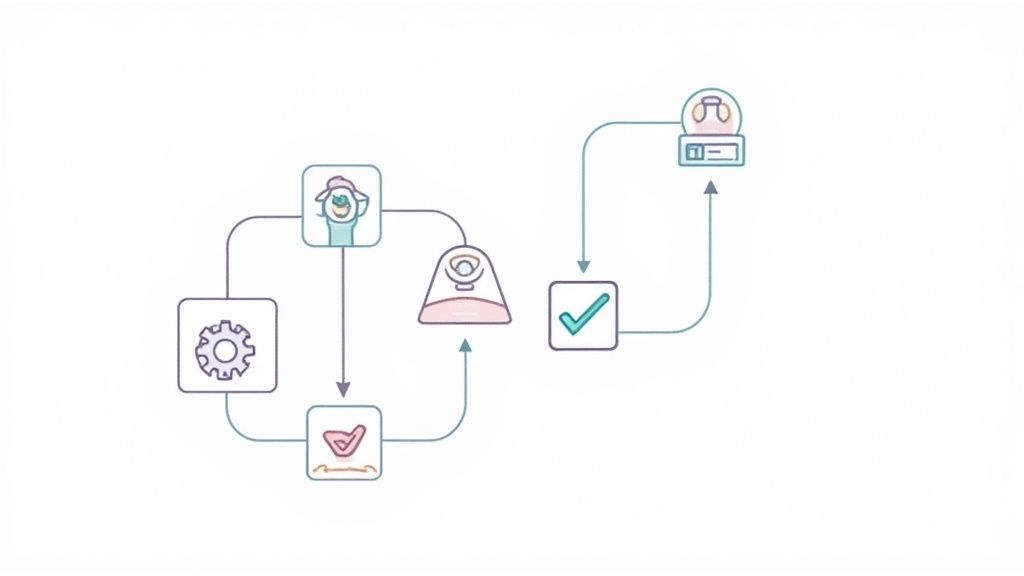
This approach deserves a prominent place on this list because it tackles the core of agent productivity: individual performance. By providing personalized guidance and support, you're not just telling agents what to do, you're empowering them to learn how to do it better. This translates directly to increased efficiency, improved customer satisfaction, and a more engaged workforce. Features like regular one-on-one coaching sessions, detailed call/interaction reviews, and goal-setting frameworks provide the structure needed for consistent growth. Performance dashboards for self-monitoring and peer coaching/mentoring programs add further layers of support and development. You can learn more about Performance Coaching and Feedback Systems.
For example, Zappos, known for its exceptional customer service, utilizes a dedicated coaching team focused solely on agent development. Similarly, T-Mobile saw a 15% increase in customer satisfaction scores after implementing a peer coaching system. HubSpot leverages recorded calls and AI analysis to pinpoint specific coaching opportunities, demonstrating how technology can enhance this approach. These real-world examples underscore the power of investing in ongoing coaching and feedback.
The benefits of this method are numerous. It cultivates a culture of continuous improvement where agents are encouraged to constantly refine their skills. By addressing performance issues proactively, before they solidify into detrimental habits, you can prevent larger problems down the line. This proactive approach also significantly contributes to increased agent engagement and retention. When agents feel supported and valued, they are more likely to be invested in their work and committed to the organization's success. Finally, personalized development plans tailored to each agent's unique strengths and weaknesses ensure that everyone has the opportunity to reach their full potential.
However, implementing effective coaching and feedback systems does come with its challenges. It can be time-intensive for managers, requiring a significant commitment to regular sessions and follow-ups. The success of these programs hinges on skilled coaches who can provide constructive, actionable feedback. If implemented poorly, these systems can create anxiety and distrust among agents. Scaling these initiatives in large operations can also present logistical hurdles.
To maximize the effectiveness of your coaching efforts, focus feedback on specific, actionable behaviors rather than vague generalizations. Strive for a balance between positive reinforcement and developmental feedback to motivate and encourage agents. Leverage recorded interactions as valuable coaching tools, allowing agents to review their performance and identify areas for improvement. Implementing a consistent coaching cadence, whether weekly or bi-weekly, ensures regularity and builds momentum. Finally, invest in training your managers in effective coaching techniques, equipping them with the skills necessary to guide their teams to success. By following these tips, you can harness the power of performance coaching and feedback to significantly improve agent productivity and drive positive business outcomes.
4. Workflow Automation and Process Optimization
In the fast-paced world of customer service, every second counts. Workflow automation and process optimization are crucial for improving agent productivity and delivering exceptional customer experiences. This powerful duo tackles the inefficiencies that drain valuable time and resources. Workflow automation identifies those tedious, repetitive tasks that bog down agents and implements technology to streamline or eliminate them altogether. Process optimization, on the other hand, takes a broader view, examining the entire customer journey to identify bottlenecks and create more efficient pathways to resolution. Imagine a well-oiled machine, where every part works seamlessly together – that's the goal of workflow automation and process optimization.

This approach leverages a range of powerful features. Robotic Process Automation (RPA) handles repetitive tasks like data entry, freeing up agents for more complex issues. Pre-populated forms and templates ensure consistency and speed up interactions. Intelligent process flows, guided by decision trees, route inquiries efficiently, and automatic data retrieval across different systems eliminates the need for agents to manually search for information. Trigger-based workflows automatically initiate actions based on specific events, further streamlining processes.
The benefits are significant. By reducing manual effort on non-value-adding tasks, agents can focus on building relationships and resolving complex customer issues, leading to increased customer satisfaction. Decreased average handle time translates directly to cost savings and improved efficiency. Minimizing human error in routine processes ensures accuracy and builds trust. Learn more about Workflow Automation and Process Optimization
For example, TD Bank implemented RPA to automate 13 customer service processes, saving over 30,000 agent hours annually. American Express automated credit card approval workflows, reducing processing time by a staggering 70%. Vodafone’s implementation of automated order processing resulted in a 90% reduction in errors. These real-world examples demonstrate the transformative potential of workflow automation and process optimization.
While the advantages are compelling, it's important to be aware of the potential challenges. Implementing these solutions requires an initial investment in technology and process mapping. You might encounter resistance from agents accustomed to existing processes. Customization for exceptions can be complex, and the system needs regular updates to keep pace with evolving business requirements.
To successfully implement workflow automation and process optimization, start by mapping your current processes to pinpoint bottlenecks and areas for improvement. Prioritize high-volume, repetitive tasks for automation. Crucially, involve agents in the process redesign to gain their buy-in and leverage their frontline expertise. Implement in phases rather than all at once to manage the transition effectively. Finally, continuously monitor for new automation opportunities to maximize efficiency.
This approach deserves its place on this list because it directly addresses the core challenge of improving agent productivity. It empowers agents to work smarter, not harder, by eliminating tedious tasks and streamlining workflows. Whether you're a customer support manager, hospitality professional, real estate agent, healthcare provider, enterprise IT manager, business owner, CEO, or CTO, workflow automation and process optimization offer a powerful path to enhanced efficiency, cost savings, and ultimately, happier customers. Popularized by industry leaders like UiPath, Automation Anywhere, ServiceNow, Lean Six Sigma methodology, and Pegasystems, this approach is no longer a luxury, but a necessity for businesses striving to excel in today's competitive landscape.
5. Gamification and Incentive Programs
Boosting agent productivity is a constant quest for any organization reliant on a strong workforce. Among the myriad strategies available, gamification and incentive programs stand out as a dynamic and engaging way to motivate your team and drive performance. This approach leverages the inherent human desire for competition, achievement, and recognition to improve key metrics and create a more enjoyable work environment. Essentially, it's about applying game design elements to the workplace to make work feel less like work and more like, well, a game.
Gamification works by tapping into psychological principles that drive motivation. Think leaderboards that spark healthy competition, points systems that provide a tangible measure of progress, badges that signify achievement, and rewards tied to KPIs that offer real-world incentives. These elements create a positive feedback loop, encouraging agents to strive for better results and contributing to a more engaged and productive workforce.
Imagine a contact center where agents can see their performance in real-time on a leaderboard, earning points and badges for hitting targets like fastest call resolution or highest customer satisfaction. This friendly competition can significantly boost morale and encourage agents to push themselves further. Beyond individual achievements, team competitions and challenges can foster collaboration and build camaraderie. Mission-based activities with clear goals can add another layer of engagement, providing agents with a sense of purpose and direction.
Real-world examples demonstrate the effectiveness of gamification. Deloitte's Leadership Academy saw a 46.6% increase in return users after implementing gamification. Similarly, LiveOps reported that call center agents using gamified systems completed calls 15% faster while maintaining higher customer satisfaction scores. Samsung also witnessed the power of recognition programs, achieving a 13% productivity boost across their support centers. These examples highlight the potential of gamification to drive tangible results across diverse industries.
While the benefits are compelling, it's crucial to design these programs carefully to avoid potential pitfalls. A poorly designed system that focuses solely on quantity, for example, could incentivize rushed interactions and compromise quality. Similarly, if the system isn't inclusive, it can demotivate lower-performing agents. To ensure success, consider the following tips:
- Balance metrics: Track metrics that drive both quantity (e.g., calls handled) and quality (e.g., customer satisfaction).
- Inclusivity: Create opportunities for everyone to win, not just top performers. Tiered reward systems and team-based challenges can ensure broader participation.
- Keep it fresh: Regularly refresh challenges and rewards to maintain interest and prevent stagnation.
- Meaningful rewards: Ensure rewards are genuinely valued by your agents. This might include bonuses, extra vacation time, or opportunities for professional development.
- Teamwork: Incorporate team-based goals to encourage collaboration and a supportive work environment.
Features of effective gamification platforms include real-time leaderboards and dashboards, achievement badges and levels, point systems tied to KPIs, team competitions and challenges, and robust rewards and recognition systems. Learn more about Gamification and Incentive Programs.
Gamification and incentive programs deserve a place on this list because they offer a unique approach to improve agent productivity by making work more engaging and fun. By understanding the features, benefits, and potential drawbacks, and by implementing these programs strategically, businesses across various sectors—from customer support and hospitality to healthcare and IT—can unlock the power of gamification to motivate their teams, drive performance, and cultivate a thriving work environment. Whether you're a business owner, CEO, CTO, or a manager in any field, gamification can be a powerful tool for enhancing your team's performance. This approach, popularized by figures like Yu-kai Chou (Octalysis framework) and Jane McGonigal, has proven its ability to transform the workplace into a more engaging and productive space.
6. Omnichannel Integration and Agent Desktop Unification
In today's interconnected world, customers expect seamless experiences across multiple communication channels. They might initiate contact through social media, follow up with an email, and then finally call for a resolution. For agents to effectively manage these interactions and improve agent productivity, a unified approach is essential. Omnichannel integration and agent desktop unification offer precisely that – a single, streamlined platform to manage all customer interactions, regardless of the channel. This strategy deserves its place on this list because it directly addresses the inefficiencies caused by fragmented systems, empowering agents to work smarter, not harder.
Imagine an agent juggling between five different applications just to gather the necessary information for a single customer interaction. That's lost time, increased frustration, and a higher risk of errors. Omnichannel integration eliminates this chaos by consolidating all channels – phone, email, chat, social media, messaging apps, and more – into a single interface. Furthermore, it integrates crucial customer data, such as interaction history, purchase records, and support tickets, into this unified view. This "single pane of glass" approach drastically reduces the cognitive load on agents, allowing them to focus on what truly matters: providing excellent customer service.
How it Works: An omnichannel platform integrates with various communication channels and backend systems (CRM, knowledge base, etc.) to present a consolidated view to the agent. When a customer interacts, regardless of the channel, the agent sees a complete profile and history, enabling personalized and efficient service. Features such as automated data population and contextual information displays further streamline the workflow.
Features and Benefits:
- Single pane of glass interface: All customer interactions and relevant data are accessible within a single window.
- Unified customer history: Provides a 360-degree view of the customer's journey across all channels.
- Integrated knowledge base access: Empowers agents with instant access to relevant information and solutions.
- Contextual information display: Presents the most pertinent information based on the interaction type and channel.
- Seamless transition between channels: Agents can effortlessly switch between different communication modes without losing context.
- Automated data population: Reduces manual data entry and ensures consistency across systems.
Pros:
- Reduces average handle time: Eliminates the need to switch between systems, significantly speeding up interactions.
- Improves customer experience: Context preservation and faster resolution times lead to greater customer satisfaction.
- Decreases training time for new agents: A unified interface simplifies onboarding and reduces the learning curve.
- Enables true omnichannel service delivery: Provides a consistent and personalized experience across all channels.
- Reduces agent cognitive load and stress: Streamlined workflows and readily available information reduce agent burnout.
Cons:
- Typically requires significant technology investment: Implementing an omnichannel platform can be expensive.
- Complex integration challenges with legacy systems: Integrating with older, disparate systems can pose technical hurdles.
- Change management hurdles during implementation: Adopting new workflows and technologies requires careful planning and execution.
- Potential single point of failure: If the platform goes down, all communication channels could be affected.
Examples of Successful Implementation:
- Comcast's implementation of Salesforce Service Cloud reduced average handle time by 17%.
- Bank of America's unified desktop reduced training time by 50% while improving customer satisfaction.
- Delta Airlines' unified agent desktop improved first-call resolution rates by 25%.
Actionable Tips for Implementation:
- Involve agents in the design process: Ensure the interface is user-friendly and meets the needs of those using it daily.
- Implement progressive rollouts rather than big-bang approaches: Start with a pilot group and gradually expand to minimize disruption.
- Prioritize integration of the most frequently used systems first: Focus on the systems that will have the biggest impact on agent productivity.
- Design the interface based on common agent workflows: Optimize the interface to align with typical agent tasks and processes.
- Include customization options for different agent roles: Allow for personalization based on individual agent responsibilities and needs.
When and Why to Use This Approach:
If your agents are constantly switching between systems, struggling to find information, or experiencing high levels of stress, then omnichannel integration and agent desktop unification is a worthwhile investment. This approach is particularly valuable for businesses with high customer interaction volumes, multiple communication channels, and a focus on providing exceptional customer service. It's a key driver for improving agent productivity, boosting customer satisfaction, and achieving operational efficiency.
Popularized By: Salesforce Service Cloud, Zendesk Sunshine, Genesys Cloud, NICE CXone, Pegasystems Customer Service.
7. AI-Assisted Agent Augmentation
In the quest to improve agent productivity, AI-assisted agent augmentation stands out as a game-changer. Instead of replacing human agents, this powerful approach leverages artificial intelligence to empower them, acting as a virtual assistant during customer interactions. Imagine a system that listens to conversations in real-time, pulls up relevant information instantly, suggests helpful responses, and even automates documentation – all while the agent retains full control. This is the essence of AI-assisted agent augmentation.
So how does it work? These sophisticated systems employ real-time speech and text analytics to understand the nuances of each conversation. They then use this information to provide intelligent response suggestions, proactively offer relevant knowledge base articles, and even recommend the next best action for the agent to take. After the call, the AI automatically generates summaries and categorizes the interaction, saving the agent valuable time. Furthermore, sentiment analysis capabilities can detect frustration or anger, alerting supervisors to potential escalations before they boil over.
The benefits for businesses aiming to improve agent productivity are numerous. By reducing the cognitive load on agents, AI assistance allows them to focus on the human element of the interaction, building rapport and solving complex problems. This leads to improved consistency of service across the entire team, regardless of individual experience levels. New agents become productive faster, while seasoned agents are freed up to handle more challenging cases. Compliance with required procedures and disclosures is enhanced, minimizing risk and ensuring consistent messaging. Perhaps most importantly, after-call work is significantly reduced, freeing up agents to handle more customer interactions.
Real-world examples demonstrate the transformative potential of this technology. T-Mobile implemented AI-assisted coaching that resulted in an impressive 18% reduction in average handle time. Progressive Insurance uses real-time transcription and suggestion tools, leading to a 35% improvement in compliance scores. And at Intuit, AI assistance helps agents resolve complex tax questions a remarkable 25% faster.
While the advantages are compelling, it's important to be aware of the potential drawbacks. Privacy concerns related to AI monitoring conversations must be addressed transparently and ethically. There's also the risk that agents might become overly reliant on the AI, potentially hindering the development of their critical thinking skills. Finally, the effectiveness of these systems hinges on high-quality data, and initial accuracy issues can frustrate agents if not managed properly.
So, when and why should you consider implementing AI-assisted agent augmentation? If you're a customer support manager, hospitality professional, real estate agent, healthcare provider, enterprise IT manager, business owner, CEO, or CTO looking to significantly improve agent productivity, then this approach deserves your attention. Whether you’re dealing with high call volumes, complex product offerings, or stringent compliance requirements, AI assistance can be a powerful tool to streamline operations and enhance customer satisfaction. Learn more about AI-Assisted Agent Augmentation.
To maximize the impact of AI-assisted agent augmentation, follow these tips:
- Start small: Begin with a narrow focus, targeting a specific area where AI can provide the most value. Expand capabilities gradually as your team gains experience and comfort with the technology.
- Emphasize empowerment: Ensure agents understand that AI is a tool designed to support them, not replace them. This will foster buy-in and encourage active participation in the implementation process.
- Feedback is crucial: Build feedback loops so agents can contribute to the ongoing improvement of the AI. Their insights are invaluable for refining the accuracy and relevance of the system's suggestions.
- Measure the impact: Track key performance indicators (KPIs) such as average handle time, first call resolution rate, and customer satisfaction to demonstrate the tangible value of the AI assistance.
- Combine with human coaching: For optimal results, pair AI assistance with human coaching and mentorship. This blended approach leverages the strengths of both humans and machines, creating a powerful synergy that drives continuous improvement.
Popular platforms like IBM Watson Assistant, Google Contact Center AI, Amazon Connect with Contact Lens, ASAPP, and Cresta offer robust AI-assisted agent augmentation capabilities. By carefully considering the pros and cons and implementing these tips, you can unlock the full potential of this transformative technology and empower your agents to deliver exceptional customer experiences.
7 Strategies for Boosting Agent Productivity
| Strategy | Implementation Complexity 🔄 | Resource Requirements ⚡ | Expected Outcomes 📊 | Ideal Use Cases 💡 | Key Advantages ⭐ |
|---|---|---|---|---|---|
| Knowledge Base Optimization | Medium to High - significant initial setup & ongoing maintenance | Moderate - requires content creation, integration & analytics | Improved first-contact resolution, reduced handle time, consistent service | Organizations needing centralized info and self-service capabilities | Reduces handle time, improves consistency, aids onboarding |
| Skill-Based Routing | High - complex configuration and skill management | High - requires skill profiling, real-time adjustments & monitoring | Higher first-contact resolution, reduced transfers, shorter handle times | Contact centers with diverse customer needs requiring expertise matching | Improves resolution rates, reduces transfers, creates specialization |
| Performance Coaching & Feedback | Medium to High - time-intensive, needs skilled managers | Moderate to High - dedicated coaching time and tools | Continuous agent improvement, higher engagement and retention | Teams focused on agent development and quality improvement | Enables personalized growth, improves engagement |
| Workflow Automation & Process Optimization | High - needs tech investment, process mapping & updates | High - significant tech and change management | Reduced manual effort, shorter handle times, fewer errors | Environments with repetitive tasks suitable for automation | Saves agent time, reduces errors, boosts efficiency |
| Gamification & Incentive Programs | Medium - design and maintenance of game elements | Moderate - platform setup and rewards management | Increased motivation, engagement, and sometimes improved performance | Teams seeking to boost morale and performance in engaging ways | Improves engagement, provides immediate feedback, fun environment |
| Omnichannel Integration & Desktop Unification | High - complex system integrations and change management | High - technology investment and integration resources | Reduced handle time, better customer experience, lower agent stress | Large contact centers managing multiple communication channels | Consolidates channels, reduces cognitive load, improves training |
| AI-Assisted Agent Augmentation | High - requires quality data and AI integration | High - AI tools, monitoring, and ongoing tuning | Reduced agent cognitive load, faster resolution, improved compliance | Centers adopting AI to support rather than replace agents | Enhances agent support, reduces after-call work, improves consistency |
Elevating Your Customer Service
In today's fast-paced business world, exceptional customer service is paramount. We've explored seven key strategies to improve agent productivity and, in turn, elevate the customer experience: optimizing your knowledge base, implementing skill-based routing, establishing performance coaching and feedback systems, automating workflows, leveraging gamification and incentives, integrating omnichannel communication, and embracing AI-assisted agent augmentation. Mastering these areas isn't just about ticking boxes; it's about fostering a culture of continuous improvement, empowering your agents to excel, and ultimately, driving significant gains in efficiency and customer satisfaction. By investing in your agents' success, you're investing in the future of your business, whether you're in hospitality, healthcare, real estate, enterprise IT, or any other customer-centric field. Remember, a highly productive agent is a happy agent, and happy agents create happy customers. This positive feedback loop fuels growth and solidifies your brand's reputation in the market.
Ready to take your customer service to the next level and further improve agent productivity? Explore the power of AI with Voicetta, a solution designed to streamline your operations and enhance customer interactions. Visit Voicetta to learn more and discover how AI can revolutionize your customer service approach.
Was this useful?
If this article helped, add Voicetta as a preferred source in Google Search. Your results can then highlight our writing.
Add as preferred source