
Blog
Top IVR Best Practices to Enhance Customer Support
Your interactive voice response (IVR) system is often a customer's first impression of your business. A poorly designed system can lead to frustration and lost custom...
Elevate Your Customer Service with Effective IVR
Your interactive voice response (IVR) system is often a customer's first impression of your business. A poorly designed system can lead to frustration and lost customers. This listicle provides six IVR best practices to transform your system into a powerful tool that improves customer satisfaction and boosts efficiency. Learn how to simplify menus, leverage natural language processing, personalize the experience, offer clear exit paths, and implement testing and analytics. Following these IVR best practices empowers you to streamline operations, reduce costs, and create a positive customer journey from the initial interaction. Optimized systems like Voicetta, with 24/7 intelligent dialogue, demonstrate the potential of a well-executed IVR.
1. Keep IVR Menus Simple and Short
In the world of customer service, first impressions are crucial. A convoluted and lengthy Interactive Voice Response (IVR) system can quickly turn a potential customer into a frustrated one. One of the most fundamental IVR best practices, and therefore deserving of the top spot on this list, is keeping your menus simple, concise, and limited in number. This approach directly impacts caller experience and ultimately affects your bottom line. Nobody wants to wade through a labyrinthine phone menu just to reach a human being. By streamlining your IVR, you can drastically reduce caller frustration and system abandonment rates, two key metrics for any successful business.
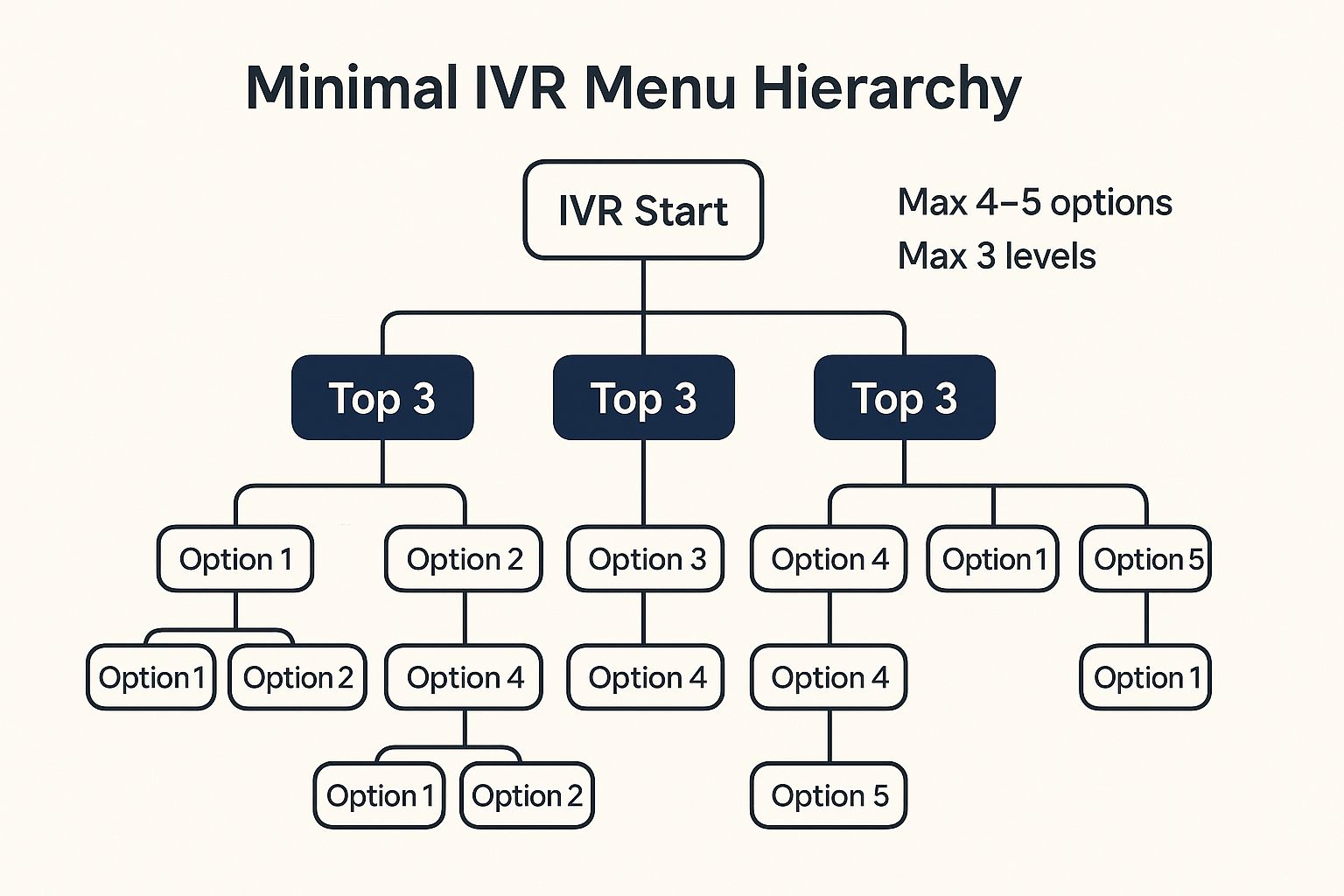
This infographic visualizes the hierarchical relationship between optimal IVR design and positive business outcomes. At the top, we have the core principle: "Keep IVR Menus Simple and Short." This branches down to the key features of this approach: limited menu options (4-5 per level) and shallow menu depth (3 levels or fewer). These features then lead to the desired outcomes: reduced frustration and abandonment, decreased average handling time (AHT), improved first-call resolution, and enhanced overall caller satisfaction. Finally, these positive outcomes contribute to the ultimate goal: improved customer experience and increased business success.
As the infographic clearly demonstrates, simplified IVR structure directly contributes to improved caller experience and business outcomes.
Specifically, this means limiting each menu level to a maximum of 4-5 options and keeping the total number of menu levels to 3 or fewer. This streamlined approach provides clear, concise wording for options and, importantly, direct paths to common requests. Imagine a customer needing to quickly check their account balance or track a recent order. A simple IVR allows them to accomplish these tasks swiftly, without the frustration of navigating a complex menu tree.
Examples of successful implementation abound. American Express, recognizing the importance of a streamlined IVR, redesigned their system to limit options to 4 per menu and subsequently saw a 15% reduction in call abandonment. Similarly, USAA's award-winning IVR utilizes simple menus with direct pathways to common banking functions, resulting in high customer satisfaction.
So, how can you implement this best practice in your own organization? Here are some actionable tips:
- Analyze call data: Identify the most common caller needs and prioritize these in your IVR design.
- A/B testing: Experiment with different menu structures to determine the optimal configuration for your specific audience.
- Prioritize frequent options: Present the most frequently used options first in the menu.
- Regular review: Review and update your menu options quarterly based on usage patterns and evolving customer needs.
- Zero-out option: Always include a 'zero-out' option that allows callers to bypass the menu entirely and reach a live agent.
While simplicity is key, this approach does have some potential drawbacks. For complex organizations with a wide range of services, limiting menu options may require careful planning and prioritization. It might also necessitate more direct agent routing for specialized inquiries. However, the benefits of reduced caller frustration and improved efficiency generally outweigh these limitations.
This best practice is widely supported by industry leaders, including Gartner's customer service research, Aspect Software's IVR design principles, and Nuance Communications IVR best practices. By embracing simplicity and prioritizing the caller experience, you can transform your IVR from a source of frustration into a powerful tool for customer satisfaction and business success.
2. Implement Natural Language Processing
One of the most impactful IVR best practices is implementing Natural Language Processing (NLP). Traditional IVR systems often frustrate callers with rigid, menu-driven navigation. Modern systems, however, leverage NLP to understand spoken language, allowing callers to express their needs naturally and conversationally. This shift creates a more intuitive and efficient experience, leading to faster resolutions, reduced navigation time, and ultimately, higher customer satisfaction. Instead of pressing buttons and wading through complex menu trees, customers can simply state their request, such as "I want to check my order status" or "I need to reschedule my appointment." This conversational approach improves accurate routing, connecting the caller to the appropriate agent or resource more quickly.

NLP-powered IVRs utilize several key technologies: speech recognition to convert spoken words into text, conversational AI capabilities to understand the meaning and intent behind those words, intent recognition algorithms to identify the caller's specific request, and machine learning for continuous improvement of the system’s accuracy. Multi-language support is also becoming increasingly important, catering to diverse customer bases.
Capital One, United Airlines, and Comcast are prime examples of companies successfully leveraging NLP within their IVR systems. Capital One’s IVR lets customers state requests like "I want to check my balance" directly. United Airlines' system effectively identifies travel intents like "I need to change my flight," while Comcast's voice recognition system reportedly reduced average call handling time by an impressive 23%. These successful implementations highlight the tangible benefits of adopting NLP for IVR.
While the benefits are clear, it's crucial to acknowledge the potential drawbacks. NLP-driven IVRs typically have higher implementation costs than traditional systems and require ongoing training and maintenance. They can sometimes struggle with accents, background noise, or complex requests, and need sufficient data to train effectively. Ensuring accuracy and a smooth customer experience also necessitates careful attention to quality assurance. Automated quality management solutions, such as those incorporating LLM-powered call scoring, can significantly enhance the contact center's ability to monitor agent performance and ensure consistent delivery of high-quality customer service.
To successfully implement NLP in your IVR, consider these tips: Start by training the system on common phrases and expand gradually. Implement context-awareness to improve understanding and provide touch-tone fallback options for callers who prefer them. Regularly analyze failed interactions to identify areas for improvement and use confirmation prompts for critical transactions.
Learn more about Implement Natural Language Processing provides valuable insights. By incorporating NLP into your IVR strategy, you can transform the customer experience, streamlining interactions, and increasing overall satisfaction. This approach is a key component of modernizing your contact center and optimizing for efficiency and positive customer engagement, making it a crucial element among ivr best practices.
3. Personalize the IVR Experience
In today's fast-paced world, customers expect efficient and personalized service. A generic, one-size-fits-all IVR experience can lead to frustration and long wait times. That's why personalizing the IVR experience is crucial for any business looking to enhance customer satisfaction and streamline its operations. This key IVR best practice involves leveraging caller data and history to tailor interactions, creating a more relevant and efficient service experience. By recognizing callers and anticipating their needs, a personalized IVR can drastically improve the customer journey.
A personalized IVR system works by identifying callers through ANI (Automatic Number Identification) and integrating with CRM systems to access customer history. This allows the IVR to present dynamic menu options based on the caller's profile and context, such as recent interactions or upcoming appointments. For example, a returning customer might be greeted by name and offered options relevant to their previous inquiries, skipping unnecessary steps.
This approach offers a wealth of benefits. Think about it: significantly reduced average handling time, a more engaging customer experience, increased self-service completion rates, and ultimately, improved customer loyalty and satisfaction. Personalization also provides valuable opportunities for targeted messaging, allowing businesses to share relevant promotions or updates.
Real-world examples highlight the power of personalized IVRs. Bank of America, for instance, recognizes returning callers and offers personalized banking options based on their profile. Delta Airlines tailors flight information and offers appropriate options based on upcoming reservations. Even T-Mobile utilizes this technology, proactively offering troubleshooting for services showing recent issues. These companies understand that a tailored IVR is a powerful tool for improving the customer experience.
However, implementing a personalized IVR isn't without its challenges. It requires robust data integration capabilities, and privacy concerns must be carefully addressed. If personalization feels intrusive, it can be off-putting. Regular data maintenance and updates are also essential to ensure accuracy and effectiveness.
To ensure a positive experience, always give callers the option to opt out of personalization. Robust data security protocols are a must. It's best to start with light personalization and gradually increase the level of customization based on customer feedback. Testing personalization features with focus groups can provide valuable insights. Remember, the goal is to streamline the experience, not to bombard customers with irrelevant sales pitches. Use personalization to make their lives easier, not to interrupt them.
Learn more about Personalize the IVR Experience
For Customer Support Managers, Hospitality Professionals, Real Estate Agents, Healthcare Providers, Enterprise IT Managers, business owners, CEOs, and CTOs alike, implementing a personalized IVR can be a game-changer. Features like caller identification, CRM integration, dynamic menu options, contextual awareness, and personalized greetings all contribute to a smoother and more efficient customer journey. Platforms like Salesforce Service Cloud, Genesys Customer Experience Platform, Twilio Flex, and Nice inContact have popularized and streamlined these capabilities, making them more accessible than ever.
By following these IVR best practices, you can transform your IVR system from a source of potential frustration into a powerful tool for enhancing customer loyalty and driving business efficiency. This strategic approach not only benefits your customers but also streamlines your operations, leading to increased productivity and a stronger bottom line.
4. Provide Clear Exit Paths and Agent Options
One of the most crucial IVR best practices is ensuring your customers can easily reach a human agent when needed. No one wants to feel trapped in an endless loop of automated menus, especially when dealing with a complex or urgent issue. A well-designed IVR system acknowledges that while automation is powerful, some situations demand the personal touch of a live agent. This approach balances the efficiency of automation with the empathy and problem-solving capabilities of human interaction. This is why providing clear exit paths and agent options deserves its place among the top IVR best practices.
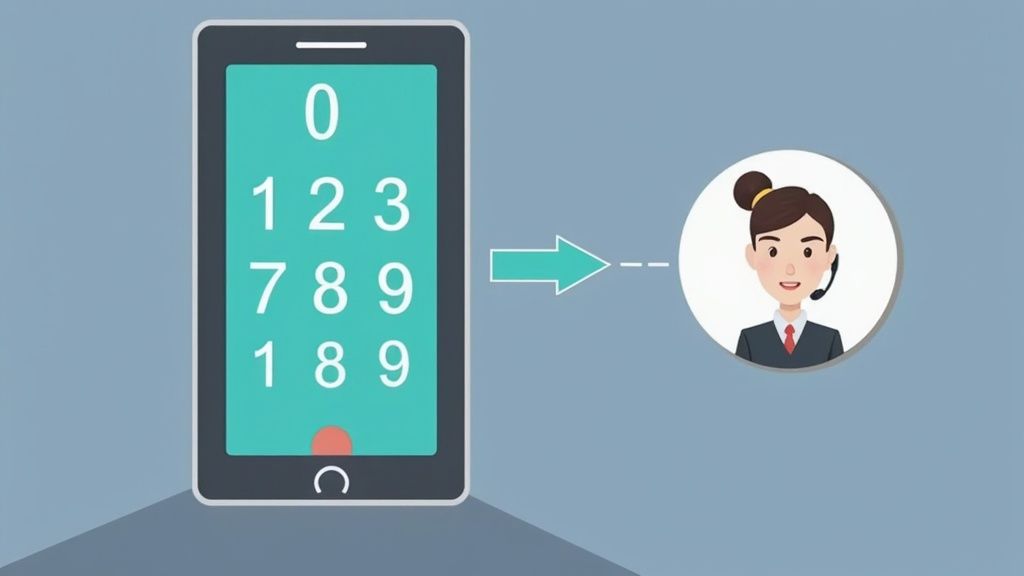
This best practice involves designing your IVR system so that reaching a live agent is intuitive and accessible at any point during the call. This might involve a universal command like pressing '0' or saying "representative," providing explicit exit options at every menu level, and implementing intelligent routing to connect the caller with the most appropriate agent based on their journey through the IVR. Features like estimated wait times and callback options further enhance the customer experience, particularly during high-volume periods. For example, offering a callback option can significantly reduce call abandonment rates and improve customer satisfaction.
Companies like Amazon excel at this by consistently offering agent options throughout their customer service IVR. American Express takes it a step further by providing estimated wait times and callback options, managing customer expectations and offering alternatives during peak times. Southwest Airlines leverages intelligent routing, ensuring that when a caller reaches an agent, the agent already has context from the IVR interaction, minimizing repetition and frustration. Learn more about Provide Clear Exit Paths and Agent Options.
While offering accessible escape routes from the automated system is vital, it's also essential to consider the potential drawbacks. Overuse of agent options can strain staffing resources, potentially increasing costs. If the exit path is too prominent, it might discourage customers from utilizing the self-service options, undermining the efficiency gains of the IVR. Careful capacity planning and resource allocation are essential to balance these factors. Peak call times can create bottlenecks, so strategies like prioritizing loyal customers or urgent issues might be necessary.
Tips for Effective Implementation:
- Monitor Exit Path Usage: Tracking how frequently customers opt out of the automated system can reveal areas where the IVR could be improved. High usage at a particular menu point suggests a confusing or inadequate self-service option.
- Transfer Context: Ensure relevant information gathered during the IVR interaction, such as account details or the reason for the call, is transferred to the agent to avoid frustrating repetition for the customer.
- Offer Callback Options: This is particularly valuable during high-volume periods, allowing customers to retain their place in the queue without staying on hold.
- Prioritize Customers: Consider implementing systems that prioritize high-value customers or those with urgent needs.
- Regular Testing: Regularly test all exit paths and agent connections to ensure they are functioning correctly and efficiently.
Pros:
- Reduces customer frustration with automation
- Builds trust in the service system
- Prevents call abandonment
- Improves overall customer experience ratings
- Provides a safety net for complex issues
Cons:
- Can increase agent staffing requirements if overused
- May undermine self-service adoption if too prominent
- Requires careful capacity planning
- May create bottlenecks during peak call times
By following these IVR best practices, businesses can create a more user-friendly and effective customer service experience, leading to improved customer satisfaction and loyalty. Implementing these strategies, similar to those employed by industry leaders using solutions like Cisco Contact Center solutions, Avaya experience platform, Zendesk customer service best practices, and Five9 intelligent cloud contact center, will undoubtedly enhance your customer interactions.
5. Implement Comprehensive Testing and Analytics
In the quest for the perfect IVR experience, the "build it and they will come" philosophy simply doesn't cut it. A well-designed IVR requires constant vigilance and refinement, and that’s where comprehensive testing and analytics come into play. This critical best practice, a cornerstone of any successful IVR implementation, ensures your system continues to meet customer needs effectively and delivers a positive experience. Ignoring this step is like navigating a complex route without a map – you might eventually reach your destination, but it'll likely be a frustrating and inefficient journey.
This best practice centers around the idea that data, not guesswork, should drive your IVR improvements. It involves a continuous cycle of testing, analyzing, and optimizing. Before your IVR even sees the light of day, usability testing with real users is paramount. Imagine launching a new product without any customer feedback – a recipe for disaster. Similarly, testing your IVR with diverse user groups helps identify navigation issues, confusing prompts, and other problems before they impact your customers. This testing phase might also involve A/B testing different menu structures to determine which performs best.
Once your IVR is live, the work doesn't stop. Ongoing analysis is crucial for identifying bottlenecks, abandonment points, and areas for improvement. Think of it as a health checkup for your IVR. Call flow analysis and heat mapping can visually represent customer journeys, pinpointing areas where callers are getting stuck or dropping off. Integrating voice of the customer data provides valuable qualitative insights, revealing customer frustrations and unmet needs. Tracking Key Performance Indicators (KPIs) like call completion rate, average handle time, and customer satisfaction provides quantifiable measures of IVR effectiveness.
Features of a Robust Testing and Analytics Approach:
- Usability testing with diverse user groups: Ensures the system caters to a broad audience.
- A/B testing of menu structures and prompts: Optimizes navigation and clarity.
- Call flow analysis and heat mapping: Visualizes the customer journey and identifies bottlenecks.
- Abandonment point identification: Pinpoints areas of friction causing callers to hang up.
- Voice of customer integration: Captures qualitative feedback and insights.
- Key performance indicator (KPI) tracking: Measures IVR effectiveness and identifies areas for improvement.
Pros:
- Identifies issues before they impact customers: Proactive problem solving saves time and resources.
- Provides concrete data for improvement decisions: Data-driven optimization leads to better results.
- Enables continuous optimization: The IVR evolves to meet changing customer needs.
- Helps justify investment in IVR improvements: Data provides concrete evidence of ROI.
- Reveals unexpected customer behaviors and preferences: Offers valuable insights into customer needs.
Cons:
- Requires significant investment in analytics tools: Specialized software can be expensive.
- Can be time-consuming to implement properly: Requires dedicated resources and expertise.
- Needs expertise to interpret results correctly: Data analysis requires skilled professionals.
- May reveal need for costly system overhauls: Significant changes can be expensive and disruptive.
Real-World Success Stories:
- Verizon saw a 22% improvement in IVR completion rate after restructuring their menu based on testing results.
- Progressive Insurance uses heatmapping to visualize customer journey bottlenecks and optimize their IVR flow.
- Fidelity Investments conducts quarterly usability testing with diverse customer segments to ensure their IVR remains user-friendly.
Actionable Tips for Implementing Comprehensive Testing and Analytics:
- Establish baseline metrics before making changes: This provides a benchmark for measuring improvement.
- Test with actual customers from different demographics: Ensure your testing represents your target audience.
- Monitor both quantitative metrics and qualitative feedback: Gain a holistic understanding of the customer experience.
- Create a regular testing schedule, not just one-time efforts: Continuous monitoring is essential for long-term success.
- Use speech analytics to identify common customer phrases and pain points: Uncover hidden issues and areas for improvement.
- Implement an iterative improvement process rather than major overhauls: Small, incremental changes are often more effective than large-scale redesigns.
Popular Analytics Platforms:
- Verint Systems
- CallMiner
- NICE Enlighten AI
- Genesys Predictive Routing
- Tethr AI-powered analytics platform
For customer support managers, hospitality professionals, real estate agents, healthcare providers, enterprise IT managers, business owners, CEOs, and CTOs alike, investing in comprehensive testing and analytics is not just a best practice, it's a necessity. By leveraging data-driven insights, you can transform your IVR from a source of frustration into a powerful tool for enhancing customer satisfaction, streamlining operations, and driving business growth. This crucial step ensures your IVR remains a valuable asset, rather than a liability, in today’s competitive landscape.
6. Optimize for Mobile and Omnichannel Integration
In today's mobile-first world, ignoring the smartphone user is a recipe for IVR disaster. Customers expect seamless experiences across all channels, and your IVR should be no exception. Optimizing for mobile and omnichannel integration is no longer a luxury but a necessity among IVR best practices. This means designing your IVR with mobile callers in mind and ensuring it integrates smoothly with other customer service channels like web chat, email, and SMS. A truly integrated system allows customers to effortlessly transition between channels without losing context or having to repeat information.
This approach revolves around several key features. Visual IVR interfaces, for example, transform the traditional audio-only experience by presenting menu options directly on smartphone screens. This allows for faster navigation and reduces listener fatigue. Click-to-call functionality from digital channels like your website or app further streamlines the customer journey by providing a direct link to your IVR system. Imagine a customer browsing your website on their phone and encountering a question – click-to-call empowers them to instantly connect with your IVR for assistance. Contextual transfer between channels ensures that when a customer needs to speak to a live agent, all the information gathered during their self-service interaction is carried over, eliminating frustrating repetition. SMS/text options for queue management allow customers to opt for text notifications about their place in line, freeing them from being tethered to the phone.
This omnichannel approach provides numerous benefits. It meets the expectations of mobile-first customers, creating more efficient and personalized experiences. By reducing friction in customer journeys, it boosts self-service completion rates and provides flexibility in how customers engage with your business. Consider Bank of America, which seamlessly integrates its mobile banking app with its IVR for easy authentication, or Vodafone, which leverages visual IVR to display menu options directly on smartphone screens. Hilton Hotels even allows guests to begin booking processes online and complete them by phone with full context retained. These examples highlight the power of omnichannel integration in elevating the customer experience.
However, implementing this approach is not without its challenges. Integrating with existing legacy systems can be complex and may require significant updates. Development and maintenance costs can be higher than traditional IVR systems, and maintaining a consistent experience design across all platforms demands meticulous attention to detail.
For businesses looking to implement this best practice, several actionable tips can pave the way to success:
- Prioritize: Identify high-value mobile user journeys to prioritize for optimization. Focus on the areas where mobile integration will have the greatest impact on customer satisfaction and business outcomes.
- Accessibility: Ensure visual elements in your visual IVR follow accessibility guidelines, making the system usable for everyone.
- Context Retention: Implement unique session IDs to maintain context between channels. This allows for seamless transitions and prevents customers from having to repeat information.
- Reduce Effort: Focus on reducing effort when customers switch channels. The transition should be smooth and intuitive.
- Clear Instructions: Provide clear instructions for mobile-specific features like visual IVR and click-to-call.
- Thorough Testing: Test the experience on various mobile devices and operating systems to ensure compatibility and optimal performance.
Learn more about Optimize for Mobile and Omnichannel Integration
Optimizing for mobile and omnichannel integration deserves a prominent place in the list of IVR best practices because it directly addresses the evolving needs of today's customers. In a world where customers expect seamless, personalized interactions across all channels, businesses that embrace this approach will be better positioned to enhance customer satisfaction, improve efficiency, and gain a competitive edge. Whether you're a Customer Support Manager, Hospitality Professional, Real Estate Agent, Healthcare Provider, Enterprise IT Manager, business owner, CEO, or CTO, understanding and implementing these principles is crucial for providing a superior customer experience. Platforms like Jacada (now Uniphore) visual IVR, Twilio Flex omnichannel platform, Genesys Cloud solutions, Avaya OneCloud CCaaS, and NICE CXone are popular choices for building such integrated solutions.
Top 6 IVR Best Practices Comparison
| Best Practice | 🔄 Implementation Complexity | 🛠️ Resource Requirements | 📊 Expected Outcomes | 🎯 Ideal Use Cases | 💡 Key Advantages |
|---|---|---|---|---|---|
| Keep IVR Menus Simple and Short | Low 🔄 | Moderate: planning and menu design | ⭐ Reduced abandonment, improved satisfaction | Organizations needing quick, straightforward IVR | ⚡ Faster call handling, reduces frustration |
| Implement Natural Language Processing | High 🔄 | High: advanced AI tech, ongoing training | ⭐ More natural interaction, faster resolution | Call centers with diverse, complex caller needs | 💡 Intuitive UX, better data on customer intents |
| Personalize the IVR Experience | Moderate 🔄 | High: data integration, CRM connectivity | ⭐ Faster handling, higher loyalty | Businesses with rich caller data and CRM | 💡 Tailored interactions, increased engagement |
| Provide Clear Exit Paths and Agent Options | Low to Moderate 🔄 | Moderate: agent staffing, routing systems | ⭐ Lower frustration, prevents abandonment | Any IVR system prioritizing customer satisfaction | ⚡ Accessibility to human help anytime |
| Implement Comprehensive Testing and Analytics | High 🔄 | High: analytics tools, expertise | ⭐ Data-driven improvements, optimized IVR | Systems needing continuous optimization | 💡 Identifies bottlenecks, justifies investments |
| Optimize for Mobile and Omnichannel Integration | High 🔄 | High: integration across platforms, development | ⭐ Seamless multi-channel experience | Mobile-first customers, omnichannel strategies | ⚡ Flexibility, consistent experience across touchpoints |
Transform Your Customer Interactions with These IVR Best Practices
By now, it's clear that implementing these six IVR best practices—keeping menus short and simple, using natural language processing, personalizing the experience, providing clear exit paths, implementing comprehensive testing and analytics, and optimizing for mobile and omnichannel integration—can revolutionize your customer interactions. These aren't just technical tweaks; they are strategic investments in customer satisfaction and operational efficiency. Remember, a well-designed IVR system, guided by these best practices, transforms frustrating phone menus into seamless, helpful experiences, leaving callers feeling valued and understood. This, in turn, enhances your brand image, reduces customer churn, and ultimately boosts your bottom line. Mastering these IVR best practices is essential for any business looking to thrive in today's competitive market. It empowers you to convert routine calls into opportunities for connection, building stronger customer relationships one interaction at a time.
Ready to elevate your IVR and unlock the full potential of your customer communication strategy? Explore how Voicetta can help you implement these IVR best practices and create exceptional customer journeys. Visit Voicetta today to learn more.
Was this useful?
If this article helped, add Voicetta as a preferred source in Google Search. Your results can then highlight our writing.
Add as preferred source