
Blog
Mastering Lead Nurturing Automation
Picture this: every single person who shows interest in your business is automatically taken on a personalised journey. It's a journey designed to build trust and gent...
Picture this: every single person who shows interest in your business is automatically taken on a personalised journey. It's a journey designed to build trust and gently guide them towards becoming a customer, all without you lifting a finger for every single interaction. That’s the real magic behind lead nurturing automation. We're not just talking about firing off a few emails; we're talking about building genuine digital relationships, but on a massive scale.
From Cold Lead to Loyal Customer
I like to think of lead nurturing automation as an expert gardener. Instead of tending to one plant at a time, this gardener can look after hundreds of individual seedlings simultaneously. Each one gets exactly the right amount of water and sunlight it needs, right when it needs it, encouraging it to grow strong and healthy. In the same way, automation delivers timely, relevant messages to each potential customer, guiding them from that first flicker of curiosity all the way to a confident purchase.
Just getting leads is only half the story. The hard truth is that a shocking 80% of new leads never turn into sales. It’s not because they aren’t interested, but more often than not, they just aren't ready to buy the moment they connect with you. Leaving them to go cold is like planting a seed and forgetting to water it—all that potential just withers on the vine.
The Value of a Nurtured Lead
This is where you see the huge difference between a simple 'lead' and a 'nurtured lead'. A standard lead is just contact information—a name and an email address sitting in your database. A nurtured lead, on the other hand, is someone you've actively engaged and educated. They've started to build a real sense of trust with your brand because you’ve consistently sent them useful, helpful content, not just sales pitches.
This systematic process of engagement is the heart and soul of lead nurturing automation. It’s what turns your sales funnel from a leaky bucket into a high-pressure pipeline.
Nurtured leads make 47% larger purchases than non-nurtured leads. This proves that the trust and rapport built through thoughtful automation lead directly to bigger, more profitable deals.
Building the Business Case
Putting an automated system in place is a serious strategic move, but it's one that pays for itself over and over. It makes sure no opportunity ever slips through the cracks. More importantly, it frees up your sales team to do what they're best at: closing deals with prospects who are already informed and engaged. Instead of wasting time on cold calls, they get to speak with people who are already warmed up and receptive to what you offer.
Before you can nurture, you need to know who you're talking to. To get a handle on this crucial first step, you can explore our guide on how to qualify leads to see how it fits into the bigger picture.
Ultimately, lead nurturing automation is the engine that turns potential interest into profitable action. It builds a scalable, reliable bridge between your marketing efforts and your sales results, driving consistent, predictable growth.
Building Your Automated Nurturing Engine
Think of an effective lead nurturing system less like a piece of software and more like a finely tuned engine. Every part needs to work in perfect harmony to move prospects along the path to becoming customers. This mindset helps you shift from just sending out emails to actually building a machine that grows relationships at scale. To build this engine, you first need to understand its core components.
The brain of the operation is lead scoring. This isn't a static number; it's a dynamic process that assigns points to leads based on who they are (demographics, company size, job title) and what they're doing (visiting your pricing page, downloading a whitepaper, or opening an email). A rising score is a clear signal that a lead is warming up and might be ready for a real conversation with your sales team.
This intelligent prioritisation is crucial. It directs your team's energy towards the most promising opportunities, so they aren't wasting precious time on leads who simply aren't ready yet.
Organising Leads for Maximum Impact
Next up is segmentation. This is where you group your leads into relevant buckets based on shared traits, behaviours, or interests. You could create segments for different industries, the specific problems they’re trying to solve, or even how they first found your brand.
Without segmentation, your messages are just noise—generic, impersonal, and easily ignored. But with it, you can deliver highly relevant content that speaks directly to a lead’s specific pain points. It makes them feel seen and understood, which is a massive step in making your automation feel personal.
This diagram shows exactly how prospects can flow through these automated touchpoints to eventually become loyal customers.
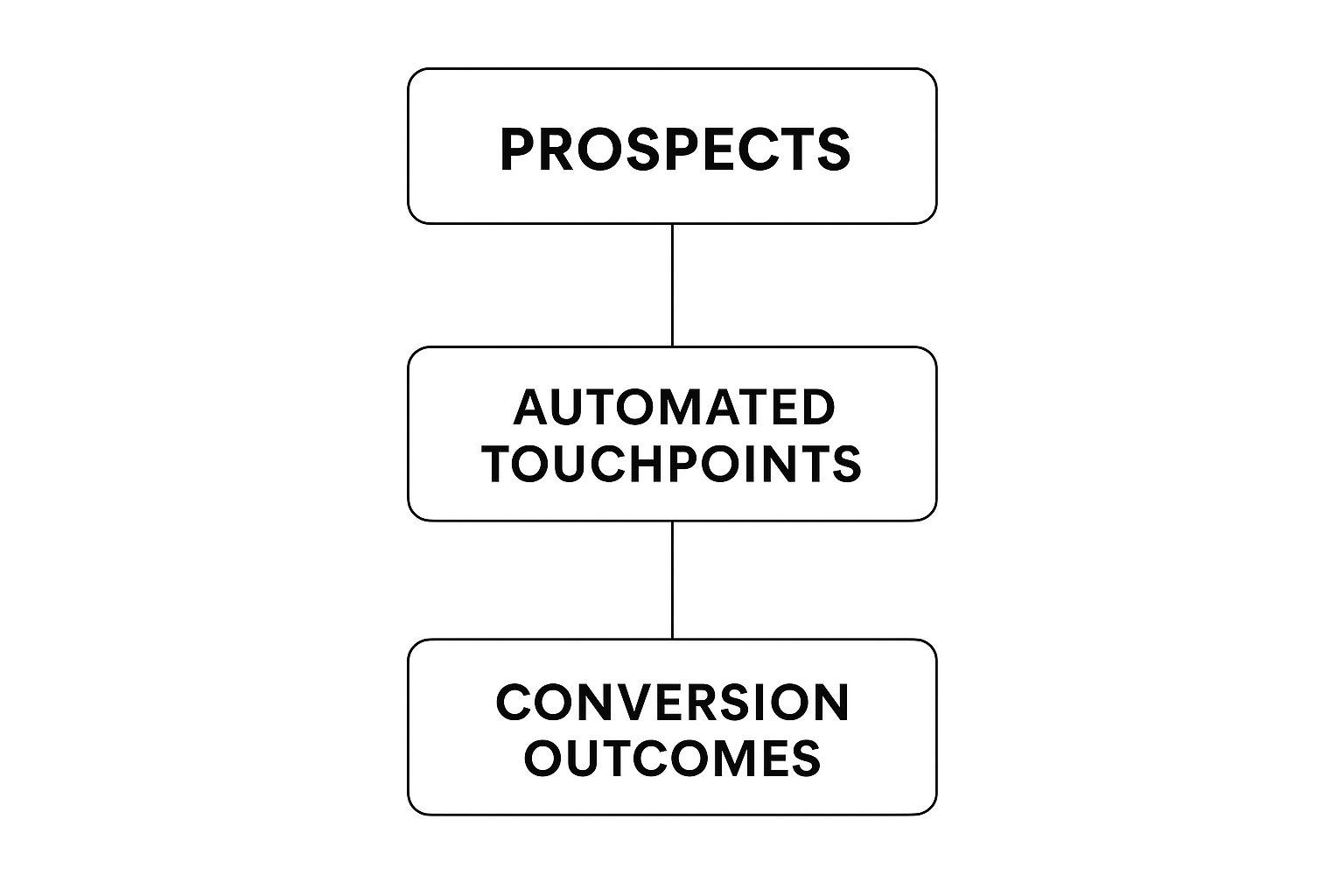
As you can see, a structured sequence of automated interactions is the critical bridge between a person showing initial interest and making that final decision to buy.
Triggering the Right Actions
So, what kicks off these targeted messages? That’s the job of workflow triggers. A trigger is a specific action a lead takes that automatically starts a pre-planned nurturing sequence. It’s all about cause and effect.
- Downloading an Ebook: This could trigger a workflow that sends them a few related blog posts and a relevant case study over the next couple of weeks.
- Visiting the Pricing Page: This action might trigger an email from your team offering a free demo or a one-on-one consultation.
- A Period of Inactivity: If a once-active lead goes quiet, a trigger can launch a re-engagement campaign with a special offer to bring them back.
Of course, none of this works if the engine has no fuel. That fuel is your content library. We’re talking about a deep well of valuable, relevant content—blog posts, case studies, webinars, and guides—all created to help leads at every single stage of their journey.
The data backs this up completely. Given that a staggering 80% of new leads don't end up converting, a solid nurturing strategy is non-negotiable. Nurture emails consistently see 4 to 10 times higher response rates than standalone email blasts, and nurtured leads tend to make purchases that are 47% larger. You can find more data on lead nurturing strategies at Zendesk.com.
Together, these components—scoring, segmentation, triggers, and content—are the blueprint for building your own powerful lead nurturing machine.
Designing Your First Nurturing Workflows
Alright, theory is one thing, but putting it into practice is where the magic really happens. Moving from ideas to action means building automated workflows that guide potential customers on a journey that feels both logical and valuable.
Let's break down a few real-world examples you can tweak for your own business. Think of it less like a rigid script and more like creating a personalised map for different groups of travellers, each starting from a different place. Every workflow needs a clear starting point—a trigger—and a clear destination—a goal.
The Essential Welcome Series
If you only build one workflow, make it this one. A Welcome Series is your first, best chance to make a fantastic impression the moment someone joins your mailing list or creates an account. The goal here isn't a hard sell; it's about setting the stage, building trust, and showing them they made the right choice.
Let's imagine a new contact, "Anna," subscribes to your blog. Her automated journey might unfold like this:
- Immediately: An email lands in her inbox with a warm welcome. It confirms her subscription, gives a glimpse of your brand's personality, and lets her know what to expect from you.
- Day 3: A second email arrives. This one acts as a friendly guide, pointing her towards your best stuff—maybe your most-read articles or a link to a foundational guide. It's all about providing instant value.
- Day 7: A final email in this initial series could ask about her specific interests or what problems she's trying to solve. This simple question is huge; it helps you segment her for even more relevant communication down the line.
The Educational Content Follow-Up
Now, let’s talk about those people who have downloaded a resource like an ebook or a whitepaper. This is your Top-of-Funnel Educational Workflow. These folks aren't just browsing; they're actively looking for answers, and your job is to gently guide them towards seeing your business as the solution.
This is a perfect example of how Voicetta can use automation to walk prospects through the funnel, turning initial interest into genuine opportunity.
The entire sequence is designed to educate and qualify them over time by delivering value-packed touchpoints automatically. This structured follow-up is a fundamental part of the lead qualification process, helping you sort the curious lookers from the serious buyers.
Winning Back Dormant Leads
What about the leads who go quiet? It happens. People get busy, priorities change, or they just forget about you. That's where a Re-engagement Campaign comes in. This workflow is specifically designed to grab their attention again with a compelling reason to reconnect.
A well-timed re-engagement campaign can be surprisingly effective. The trigger is typically a set period of inactivity—for example, a lead who hasn't opened an email or visited your website in 90 days. The goal is simple: either get a response or cleanly part ways. A popular tactic is a friendly "break-up" email offering one last chance to stay on the list, or perhaps a special one-time offer to reignite their interest. It's a win-win: you reactivate valuable leads and keep your contact list healthy.
Measuring the Business Impact of Automation
Bringing lead nurturing automation into your business is a serious investment. And like any good investment, you have to be able to measure what you’re getting back. The real magic isn't just about saving a few hours here and there; it’s about seeing tangible, bottom-line results that bolster your company’s health and competitive edge.
This is where the conversation turns from simple efficiency to real profitability. A well-oiled automation system takes a leaky sales funnel—where promising leads constantly slip through the cracks—and turns it into a high-conversion machine that drives predictable revenue. You're essentially building a reliable engine for growth.
Think of it this way: a B2B tech company I worked with used to rely on their sales team for every single follow-up. After setting up automated nurturing, they saw a huge jump in sales-qualified leads (SQLs). Why? Because the system did the heavy lifting, warming up prospects with helpful content so that by the time sales got involved, the leads were actually ready to talk business.
From Vague Metrics to Clear ROI
To really understand what’s happening, you need to move beyond guesswork and look at the cold, hard numbers. Solid KPIs tell a story. With effective lead nurturing automation, you suddenly gain incredible control over your customer acquisition cost (CAC) and your overall marketing return on investment (ROI).
Here’s what you can realistically expect to see:
- Higher Lead-to-Customer Conversion Rates: When you send the right message at the perfect moment, you naturally guide more people from initial curiosity to a final purchase.
- Increased Sales Opportunities: Automation acts as a safety net, ensuring no lead is ever forgotten. This consistently creates a bigger pool of potential deals for your sales team.
- Improved Sales Funnel Velocity: Nurtured leads move through your sales process much faster. They’re already educated and engaged before they even speak to a salesperson.
This isn't just wishful thinking. The data speaks for itself. Companies that outperform their competitors are 63% more likely to use marketing automation, with lead nurturing at the forefront. What's more, B2B marketers using these strategies see a massive uptick in sales opportunities; top performers even achieve 60% higher lead-to-sale conversion rates. You can dive deeper into these powerful marketing automation statistics over at emailmonday.com.
The most profound benefit is the shift from reactive to proactive growth. Instead of chasing every possible lead, you're systematically building a pipeline of high-quality, educated prospects who are more likely to become long-term, valuable customers.
This newfound efficiency doesn't stop at sales. Once your lead nurturing is humming along, it frees up precious time and resources. You can then re-invest that energy to automate customer support for your existing clients, which boosts satisfaction and loyalty. It creates a fantastic, self-sustaining cycle of growth and retention.
Right, once you've got your basic workflows humming along and consistently sparking conversations, it's time to kick things up a notch. This is where you move from good lead nurturing to great lead nurturing. We're talking about refining your strategy with more advanced tactics that not only make things run smoother but also create a smarter, more responsive journey for your prospects.

Think of it like this: your foundational workflows are the reliable, well-drawn map. Now, we're adding live traffic data and intelligent detours. This next level is all about using smarter data and more channels to make your automation feel less like a machine and more like an intuitive, helpful guide.
Tapping into Predictive Intelligence and AI
The real game-changer in modern lead nurturing is artificial intelligence, especially when it comes to predictive lead scoring. Your traditional scoring system is great, but it's based on what a lead has already done. Predictive models, on the other hand, crunch huge amounts of data to forecast which leads are most likely to convert in the future. It’s a shift from asking "What have they done?" to "What are they most likely to do next?".
This means your sales team can stop chasing every lead and instead focus their precious time on prospects who are not only a good fit but are also showing all the subtle digital signs of being ready to make a move. It's a massive leap in both efficiency and effectiveness.
Another powerful way to use AI is through content personalisation. Instead of just sorting leads by industry, AI can dynamically change the content a lead sees on your website or in an email based on what they're doing in that exact moment. This makes every touchpoint feel incredibly relevant, positioning your brand as one that truly understands their needs.
Adopting a True Omnichannel Approach
Let’s be honest, no one's buying journey is a straight line anymore. It weaves across different platforms and devices. A truly advanced lead nurturing automation strategy has to mirror this reality. Omnichannel nurturing isn't just about being present on multiple channels; it's about creating one seamless, unified experience across all of them.
Your system should be smart enough to know that a lead who just liked a LinkedIn post needs a different email from one who attended a webinar. That level of coordination is what builds a deep, trusting relationship and avoids sending confusing, mixed messages.
This involves weaving all your channels into a single, cohesive automated sequence:
- Email Marketing: Still the backbone of most nurturing, delivering those perfectly timed content sequences.
- Social Media: Using interactions on platforms like LinkedIn to trigger specific, relevant follow-ups.
- Strategic Phone Calls: Automatically creating a task for a salesperson to call a high-value lead the moment they hit a critical score.
The aim is to create a single, continuous conversation that follows the lead wherever they go. This unified front is absolutely crucial for aligning your teams. The latest data shows that 81% of leaders agree that AI is key to cutting down on manual tasks and improving accuracy. With hyper-personalisation influencing 95% of B2B purchase decisions, a cohesive strategy is non-negotiable.
Most importantly, tight alignment between your sales and marketing departments can boost lead conversion by an incredible 58%. It’s proof that when you have shared goals and integrated systems, you win. You can read more on how to target lead generation with these insights to sharpen your approach.
Weaving Voice AI into Your Nurturing Strategy
Let's be honest, we're all a bit numb to the constant barrage of digital text. An email, a message, another notification... it all starts to blend together. But what if you could cut through that noise with something that feels genuinely different? The human voice has a unique power to do just that, and it's a game-changer for lead nurturing automation.
Think about it. Your automated system can still send that perfectly timed email, but what if it also followed up with a natural-sounding voice message? One that addresses your lead by name, mentions what they were interested in, and feels less like a broadcast and more like a real, personal check-in. This is exactly where tools like Voicetta come in, allowing you to send these kinds of personalised voice messages at scale, without tying up your entire team.
Giving Automation a Human Feel
This isn't about firing your sales team and letting robots take over. Far from it. This is about using smart technology to forge more authentic connections, earlier in the process.
Imagine this scenario: a high-value lead fills out a demo request on your website. Within minutes, their phone buzzes. It's a friendly, automated voice message from your company, simply acknowledging their request and letting them know you're excited to connect. That immediate, personal touch can make a world of difference to your engagement rates.
It's also incredibly effective for waking up cold leads. Another email will likely join the others in the digital graveyard. But a warm, personal audio message? That’s a pattern interrupt. It's unexpected and can be just the thing to get a stalled conversation moving again. You can see how this fits into a bigger picture when you explore how to boost business growth with an AI Messenger Voicebot.
With a tool like Voicetta, you get a clear command centre for all these automated voice interactions, giving you complete control over your campaigns.
This kind of centralised view means you can easily see what's working, what's not, and tweak your voice nurturing sequences to get the best possible results.
By layering a human-like voice into your automation, you’re adding warmth and sincerity—qualities that text struggles to convey. This approach helps build a stronger emotional connection, making your leads feel seen and valued long before they ever speak to a salesperson. It’s how you make your lead nurturing automation feel less automated and more genuinely human.
It's completely normal to have questions when you're first dipping your toes into automation. Let's be honest, the last thing anyone wants is another complicated piece of software that promises the world but just adds to the workload. Getting these common questions out of the way will help you build a system that actually works for you.
So, let's get into it. Here are some of the most common things people ask when they're starting their lead nurturing journey.
Lead Nurturing Automation FAQ
| Question | Answer |
|---|---|
| How long until I see results? | You can see early signs like better email open rates within the first month. However, the real magic—like shorter sales cycles and higher conversion rates—usually takes 3 to 6 months to show up in your reports. |
| Is this just for big companies? | Absolutely not. Automation is a game-changer for small businesses. It allows a small team to provide the kind of consistent follow-up that used to require a huge sales department, making sure no lead gets forgotten. |
| What's the biggest mistake to avoid? | Trying to do too much, too soon. It's tempting to map out incredibly complex workflows from day one, but that's a recipe for frustration. Start with one or two simple, high-impact campaigns, get them right, and build from there. |
| Where should I start? | A welcome series for new subscribers or a re-engagement campaign for inactive contacts are fantastic starting points. They deliver clear value and are relatively straightforward to set up, giving you a solid foundation to build on. |
Getting the foundations right is everything. By starting simple and focusing on delivering genuine value, you build a system that grows with you, rather than one that collapses under its own weight. The goal is to create a reliable engine for growth, not a convoluted mess.
Ready to add a human touch to your automation and ensure no lead is ever missed? Voicetta provides intelligent 24/7 communication, qualifying leads and scheduling appointments so your team can focus on closing deals. Learn more at voicetta.com.
Was this useful?
If this article helped, add Voicetta as a preferred source in Google Search. Your results can then highlight our writing.
Add as preferred source