
Blog
A Winning Multichannel Communication Strategy
When we talk about a multichannel communication strategy, we’re really talking about meeting people where they are. It’s the simple practice of showing up across diffe...
When we talk about a multichannel communication strategy, we’re really talking about meeting people where they are. It’s the simple practice of showing up across different, separate platforms so that your business is always within reach for your audience. Think of it as offering a full menu of options – email, social media, phone calls, live chat – to widen your net and create more opportunities to connect.
Why You Can't Afford to Ignore a Multichannel Strategy
Let’s be real for a moment. Your customers don’t exist on just one channel, so why would your business? The way people shop and interact with brands today is anything but a straight line. Someone might spot your ad on Instagram while scrolling on the bus, check out your website on their laptop during a lunch break, and then decide to call your support line with a specific question. Each one of these moments is a piece of a much larger puzzle.
A solid multichannel communication strategy is the thread that ties all these pieces together. It’s about creating a single, unified experience so that every touchpoint feels like a continuation of the same conversation. Without this, you end up with a clunky, disjointed journey where customers are forced to repeat themselves. That leads to frustration and, you guessed it, lost sales. The data backs this up, showing that businesses that engage across multiple channels tend to see much higher engagement and keep customers around longer, simply because they’re meeting them on their terms.
The Real Cost of a Disconnected Experience
Picture this scenario: a customer, let's call her Anna, uses your website's live chat to get details on a product’s features. A couple of days later, she’s ready to buy and calls your sales team. But the person who answers has zero clue about her previous chat. Anna is forced to start from scratch, explaining everything all over again. This kind of friction is what happens when your channels are working in isolation.
This disconnect isn't just a minor annoyance; it's a quiet poison for customer loyalty. When every interaction feels separate and fragmented, customers feel like you don't really know or value them, which is a perfect recipe for sending them straight to a competitor who offers a smoother ride.
Earning Loyalty by Syncing Up Your Channels
Now, imagine that same scenario but with a synchronised strategy. When Anna calls, the sales agent can instantly see her chat history. They know exactly what she’s interested in and can pick up the conversation right where it left off, offering relevant advice and making the whole process feel effortless.
That kind of service turns a routine purchase into a genuinely positive experience. It shows you respect the customer's time and have been paying attention. A well-designed multichannel communication strategy makes this possible by:
- Boosting your accessibility: You're simply easier to reach on the platforms people already use every day.
- Strengthening your brand voice: Your message and tone stay consistent, no matter where the conversation happens.
- Uncovering richer insights: You gather clues and data from every touchpoint, giving you a much clearer picture of what your customers actually want and do.
In the end, this synced-up approach does more than just avoid frustration. It builds the kind of deep, authentic loyalty that powers real, long-term growth. It’s proof that you’re not just trying to sell something, but are committed to providing a thoughtful, human-first experience.
Getting to Know Your Audience and Where They Live Online

Before you can even think about building a multichannel communication strategy, you have to get real about one fundamental truth: you can't talk to someone you don't know. It’s so easy to get excited about all the different platforms and tools, but the strategies that actually work start with a deep, honest look at who your customers are and where they genuinely spend their time.
This isn't about making educated guesses or relying on stereotypes. It's about rolling up your sleeves and creating detailed customer personas. Think of these as character sketches of your ideal customers, built not on fiction, but on solid data about their real-world habits, goals, and frustrations.
Start with what you already have. Your CRM, sales logs, and website analytics are treasure troves of information just waiting to be explored. You'll find patterns in how people buy, what they ask for, and the paths they take through your site.
Digging for Real Customer Insights
Once you've squeezed every last drop of insight from your internal data, it’s time to look outwards. The mission here is to colour in the details and understand the 'why' behind your customers' actions.
- Send out surveys. But don't just ask if they're happy. Ask which social media they scroll through every day, whether they prefer a text message or an email, and what makes them stick with a brand. Keep it brief, and maybe offer a little something for their time.
- Talk to people. Seriously, just have a chat. A few one-on-one interviews with some of your best customers can reveal things a survey never will. You'll get real stories and direct quotes that make your personas feel human.
- Listen in on social media. Social listening tools can show you who is talking about your brand and where. You'll learn the slang they use, the other brands they follow, and what they're passionate about.
A sharp, well-defined persona is the North Star for your entire communication plan. It's what tells you to create a YouTube tutorial instead of a blog post, or to send an SMS alert instead of another email. Without it, you’re just shouting into the void.
Matching People to Platforms
With your personas in hand, you can finally start connecting them to the right communication channels. Now, the goal isn't to be on every single platform—that's a recipe for burnout. It's about being smart and showing up where your presence will actually matter. A solid platform can tie these different channels together, a concept we explore in our guide to the benefits of an omnichannel communication platform.
Take Poland, for example. Social media is massive here. As of early 2024, there were 27.9 million active users. While Facebook still has a huge presence with 17.1 million users, you can't ignore the fact that younger crowds are flocking elsewhere. This is exactly why a dynamic, multichannel view is critical. You can get more insight into these shifts by checking out the full research on social media statistics in Poland.
So, you have to prioritise. If your personas are business professionals, maybe LinkedIn and email should be your focus. If you're trying to reach a younger, more visual audience, then Instagram or TikTok are probably your best bet. This targeted approach is what ensures that every bit of effort—and every zloty—you put into your strategy actually makes a difference.
Designing a Cohesive Customer Experience
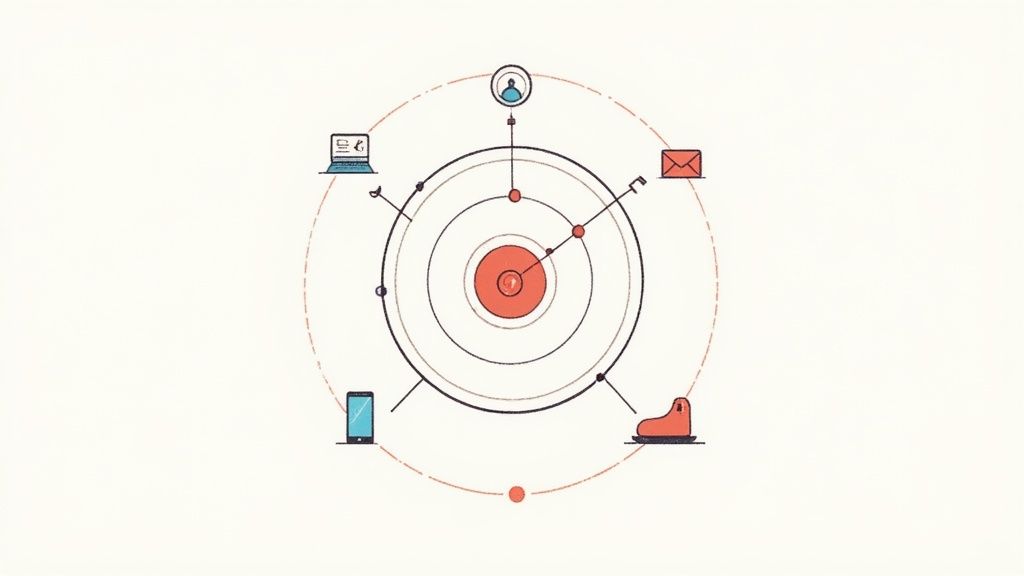
This is the point where your strategy jumps off the page and becomes a real, tangible experience for your customers. A truly effective multichannel communication strategy is all about creating a sense of unity. Your brand needs to feel familiar and reliable, no matter how or where someone interacts with you.
It comes down to crafting a single, unified brand voice and making sure your core message holds steady, even when you're tweaking it for different platforms. This consistency is what builds trust. When a customer sees the same brand personality on social media, in an email, and during a live chat, they start to feel a real connection.
Adapting Your Message Without Losing Its Soul
Let's get practical. Say you've just put out an in-depth blog post announcing a new service feature. That one piece of content is a goldmine, ready to be sliced and diced for all your other channels.
- Instagram: You could whip up a punchy carousel or a short Reel. Each slide could spotlight a single benefit from the blog, using bold graphics and snappy text that people can absorb in seconds. It’s all about immediate visual appeal here.
- LinkedIn: The tone shifts. Here, you might share a more thoughtful excerpt from the post, zeroing in on the business problem your new feature solves. This frames your brand as an industry authority and gets a professional conversation started.
- SMS: You have to be brief. A quick alert to your subscribers can announce the feature with a direct link to learn more. Something like: "Heads up! Our new [Feature Name] is live. See how it helps you [solve a specific problem]: [link]."
The trick is to keep the heart of the campaign the same while playing by the unwritten rules of each platform. Your tone might go from professional on LinkedIn to high-energy on Instagram, but the core message and brand promise never waver. This creates a much richer, layered experience for your audience.
Unifying Interactions with a Central Hub
Trying to juggle all these different conversations by hand is usually where things start to unravel. The real magic happens when you bring everything into a central platform. This is what stops you from losing the context of previous conversations and turns a good multichannel strategy into a great one.
A tool like Voicetta can act as the central nervous system for your entire operation. Think about it: when a customer who liked your LinkedIn post later calls your support line, the system doesn’t see them as a stranger. It gives your team their history, allowing for a conversation that feels genuinely seamless and intelligent. I've seen many businesses get started by implementing an automated receptionist to unify those crucial front-line communications.
This kind of connected approach ensures that every interaction builds on the last. The customer journey starts to feel less like a series of disjointed hellos and more like one continuous conversation. It proves you're not just on multiple channels; you're actually listening across all of them. That level of attention is what builds deep, lasting loyalty and turns casual followers into true brand advocates.
Let's talk about putting your strategy into practice. Juggling multiple communication channels by hand is a recipe for disaster. It’s like trying to conduct an orchestra where every musician is playing a different tune in a different room. You'll get noise, not music. This is precisely where modern tools come in, turning a chaotic mess into a smooth, intelligent operation.
AI-powered platforms are the conductors of this orchestra. They bring all your customer conversations together into one place, ensuring no message gets lost and every interaction feels connected. It’s not just about being faster; it’s about making every conversation count.
This is all about creating a unified brand experience, no matter where your customers find you. Whether they're on their phone, a tablet, or a desktop, the feeling should be consistent.
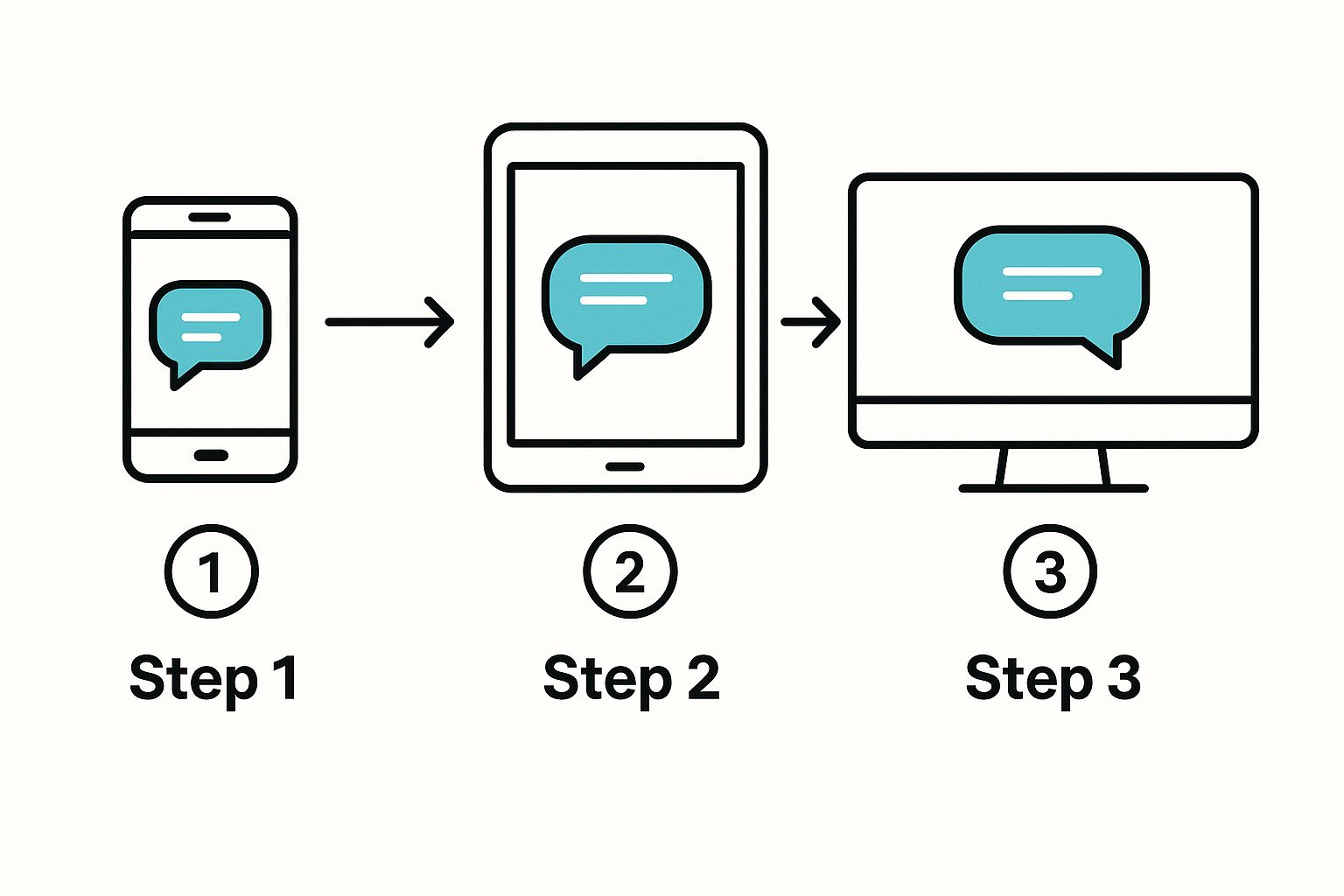
As you can see, the goal is a seamless journey. The brand voice and experience should feel familiar and cohesive across every device, which is the heart of a great multichannel approach.
So, How Does AI Actually Untangle This Web?
Picture this familiar scene: a customer emails you, annoyed about a late delivery. A few hours later, they slide into your Instagram DMs. Finally, they give your support line a call, their patience worn thin. Without the right tools, your team is flying blind. They might treat each interaction as a separate issue, forcing the customer to repeat their story over and over. It's frustrating for everyone.
Now, let's replay that with an intelligent system in place.
An AI hub connects the dots instantly. It sees the email, the DM, and the incoming call are all from the same person about the same issue. The system can even analyse the language, detect the frustration, and automatically flag the ticket as high-priority.
When your support agent picks up the phone, they aren't starting from scratch. Their screen already shows a complete timeline of the customer's previous messages. They have the full story.
This is the game-changer. You move from a reactive, disjointed process to a proactive, informed conversation. Your team stops putting out fires and starts building real relationships, because they have the context they need to actually solve the problem.
Choosing the Right AI Hub for Your Strategy
Not all platforms are created equal. To truly pull off a seamless multichannel strategy, you need a central hub with the right capabilities. It's the engine that powers the entire operation.
Here’s a look at what I consider the essential features when evaluating an AI communication platform.
Essential Features of an AI Communication Hub
| Feature | What It Does | Impact on Strategy |
|---|---|---|
| Unified Inbox | Gathers all messages (email, social, chat, SMS) into one view. | Your team works from a single dashboard, eliminating the need to constantly switch between different apps. |
| Intelligent Routing | Automatically assigns conversations to the right person or department based on keywords, channel, or customer history. | Ensures queries get solved faster by the most qualified person, improving first-contact resolution. |
| Sentiment Analysis | Reads the emotional tone of incoming messages to identify frustrated or at-risk customers. | Allows you to prioritise urgent issues and proactively manage customer satisfaction before problems escalate. |
| 24/7 Automation | Deploys bots (chatbots, voicebots) to handle routine queries, bookings, or FAQs outside of business hours. | Provides instant support around the clock, improving the customer experience and freeing up human agents. |
| CRM Integration | Syncs communication data with your Customer Relationship Management (CRM) system. | Gives your entire organisation—from sales to support—a 360-degree view of every customer interaction. |
Having a tool with these features isn't just about adding tech for tech's sake. It's about building a foundation that allows your strategy to grow without falling apart under the pressure.
Putting Automation into a Real-World Context
Let's look at the Polish market, for example. The communications services sector there is projected to be worth around US$5.9 billion by 2025, with mobile voice services being a massive slice of the pie. You can dig into the numbers yourself by checking out the latest research on Poland's communications market. In a market that busy, automation isn't just a nice-to-have; it's a survival tool.
This is where platforms like Voicetta shine. They use AI not just to answer calls, but to understand them. For instance, an AI-powered voicebot can handle all your routine appointment bookings or answer common questions 24/7. This frees up your team to tackle the trickier, more nuanced problems that require a human touch.
Ultimately, this level of smart automation is what makes a multichannel communication strategy scalable. It allows you to deliver consistently excellent service on every channel, without burning out your team. By letting AI handle the repetitive work, you give your people the time and space to focus on what they do best: building the human connections that create loyal customers and drive real growth.
Figuring Out What's Working and Making It Better
Let's be honest: a strategy that looks amazing on a whiteboard is just a nice idea until you see real results. To know if your multichannel communication efforts are actually paying off, you have to dig deeper than the usual surface-level numbers. Things like social media likes or email open rates are nice, but they don't tell the whole story.
The real magic happens when you connect your communication activities directly to business outcomes. It’s all about focusing on the Key Performance Indicators (KPIs) that truly matter—the numbers that show you how healthy your customer relationships are and how well your message is resonating across every channel.
Looking Past the 'Feel-Good' Numbers
First things first, you need to define what success truly looks like for your business. Instead of getting hung up on follower counts, let's start tracking metrics that point to genuine engagement and a healthier bottom line.
- Customer Lifetime Value (CLV): This is a big one. Are the customers engaging with you on several channels sticking around longer and spending more? If your CLV is on the rise, you're building real loyalty.
- First-Contact Resolution (FCR): When someone gets in touch, are you solving their problem on the first attempt, no matter if they used chat, email, or the phone? A high FCR is a sign your channels are working together seamlessly.
- Channel-Specific Conversion Rates: It's crucial to see which channels are doing the heavy lifting. Track how many people from email, SMS, or social media actually follow through on an action, like buying a product or scheduling a demo. This tells you where your message is hitting home.
This kind of data-first thinking is absolutely essential, especially in a market like Poland. Just look at the numbers: as of January 2025, there were roughly 53.7 million mobile connections in the country. That's a staggering 140% of the total population.
Even more impressive? 97.1% of those connections are broadband-capable. The groundwork for reaching people on their phones is incredibly solid, which means tracking mobile-focused metrics isn't just a good idea—it's a necessity for any business operating here. You can dive deeper into these insights in the full report on Poland's digital landscape.
It’s All About a Cycle of Improvement
The data you gather shouldn't just be filed away in a quarterly report. It should be the fuel for constantly refining your approach. I always tell people to think of their multichannel strategy not as a finished document, but as a living thing that evolves based on what your customers are showing you.
The most successful strategies are never "finished." They are in a constant state of testing, learning, and optimising. This is how you stay relevant and ensure your resources are always pointed in the right direction.
So, what does this look like in practice? You could run a simple A/B test. Send one version of an SMS campaign to half your list and a slightly different one to the other half. Did one version get a significantly better response? Great. You've just learned something valuable for your next send.
Looking at your performance data also helps you shift your resources intelligently. If you see that live chat is bringing in far more qualified leads than your email newsletter, maybe it's time to put more investment into your chat team. And, of course, always listen to customer feedback. We actually have a whole guide on how to measure customer satisfaction that you might find useful.
By constantly listening, testing, and adapting, you build a strategy that's dynamic—one that not only works today but is ready for whatever comes tomorrow.
Got Questions About Multichannel? Let's Clear Things Up.
So, you’re thinking about branching out your communication. It’s a smart move, but it almost always comes with a heap of questions. Getting your head around the basics isn't just a box-ticking exercise; it’s about making sure you don't waste time or money going down the wrong path.
Let's walk through some of the most common things people ask when they're about to make this leap.
What's the Real Difference Between Multichannel and Omnichannel?
This one trips people up all the time, but the distinction is actually pretty simple and incredibly important.
Think of a multichannel communication strategy as setting up different shops on different streets. You might have a stall at the local market (your social media), a proper storefront downtown (your website), and a phone line for orders. They all work, but they don't work together. A customer who calls you has no connection to the one who just visited your website.
Omnichannel, on the other hand, is about connecting all those streets. It builds a single, unified experience.
In an omnichannel setup, your team can see the whole picture. The person answering the phone knows the caller just abandoned their online shopping cart. It’s about creating one fluid conversation, not a dozen separate ones. That’s the magic a siloed multichannel approach can't replicate.
How Can a Small Business Possibly Afford This?
I get it. The idea of managing several channels at once sounds expensive and overwhelming, especially when you're running a small business. But you don't have to be everywhere at once. The secret is to be smart, not just busy.
Start by figuring out where your customers actually hang out. Look at your data and your customer personas. Are they on Facebook? Do they prefer email? Pick just two or three of those channels and focus on doing a brilliant job there.
- Go for Impact, Not Noise: Don't jump on a new platform just because it's trending. If your customers aren't on TikTok, you have no business being there.
- Start Lean and Grow: Look for tools that scale with you. Many AI-powered platforms have entry-level plans that give you what you need now, with the option to add more features as your business grows.
It’s always about quality over quantity. Two channels where you shine will always beat five where you’re just mediocre.
What Are the Biggest Mistakes People Make?
From what I’ve seen, the single biggest pitfall is treating each channel like its own little kingdom. This "silo" mentality is a recipe for disaster. It creates jarringly different messages and leaves customers feeling like they're dealing with five different companies instead of one.
Another common blunder is not tracking your data. If you aren't measuring what's happening on each channel, you're flying blind. You have no real idea what’s working and what’s a waste of resources.
Finally, resist the urge to adopt a new channel just for the sake of it. If you can't find solid proof that your audience is there, your efforts will likely fall flat. Let your customer data be your guide—it's the only reliable map you have for building a solid multichannel communication strategy.
Ready to bring all your customer conversations under one roof and make sure no lead ever slips through the cracks? Voicetta is the AI-powered hub designed to manage your multichannel strategy effortlessly, 24/7. See exactly how it can work for you at https://voicetta.com.
Was this useful?
If this article helped, add Voicetta as a preferred source in Google Search. Your results can then highlight our writing.
Add as preferred source