
Blog
Real Estate Chatbots: Your Complete Success Guide
Imagine a team member who never sleeps, misses an enquiry, or takes a day off. This team member greets every potential client with the same enthusiasm, whether it is 2...
Understanding Real-Estate Chatbots: Your Digital Property Team
Imagine a team member who never sleeps, misses an enquiry, or takes a day off. This team member greets every potential client with the same enthusiasm, whether it is 2 PM on a Tuesday or 2 AM on a Sunday. This is exactly what real estate chatbots bring to your property business. Putting the technical language aside, these AI-powered assistants are your digital front desk. They are the friendly, automated voice that welcomes prospects to your website, answers their first questions, and makes sure no opportunity is lost when your human team is unavailable.
This digital teammate is much more than a simple auto-reply message. Modern real estate chatbots are built to manage a large part of the initial customer interaction, acting as an intelligent filter. They engage visitors in a natural, conversational way, gathering key information that would otherwise need a long form or a phone call. This proactive engagement is vital; it keeps potential buyers and renters on your site longer, giving them immediate value and moving them closer to becoming a qualified lead for your agents.
The Spectrum of Chatbot Intelligence
Not all chatbots are the same. They exist on a spectrum, from simple scripted assistants to highly intelligent conversational partners. Understanding this difference is key to picking the right tool for your property business. A basic, rule-based chatbot follows a set script, much like a phone menu, offering specific options and answers. In contrast, an AI-powered chatbot uses machine learning to understand and interpret what users ask, learn from conversations, and provide more dynamic, human-like responses.
The choice of chatbot depends on your specific needs and budget. To help clarify the options, let's compare the different types available.
Types of Real Estate Chatbots Comparison
Comparison of different chatbot types used in property businesses, their capabilities, costs, and best use cases
| Chatbot Type | Capabilities | Best For | Average Cost | Implementation Time |
|---|---|---|---|---|
| Rule-Based (Scripted) | Follows a pre-defined conversation flow. Can answer basic FAQs, collect contact details, and book viewings based on set options. | Small agencies, basic lead capture on a specific landing page, after-hours enquiries. | £50 - £200 per month | 1-2 weeks |
| AI-Powered (NLP) | Understands natural language, can answer complex, unscripted questions, and learns from interactions to improve over time. | Medium to large agencies, businesses wanting to provide detailed property information and qualify leads more deeply. | £200 - £1,000+ per month | 4-8 weeks |
| Hybrid | Combines rule-based flows for standard tasks with AI capabilities to handle more complex queries, often with a live agent handover option. | Businesses looking for a balance of cost-effectiveness and advanced functionality. | £150 - £700 per month | 3-6 weeks |
As the table shows, simpler rule-based bots are quicker and cheaper to set up for basic tasks. AI-powered bots, while requiring more investment, offer a much richer, more flexible user experience that can handle a wider range of customer needs.
This infographic shows the real impact these tools can have on a property business's key metrics.
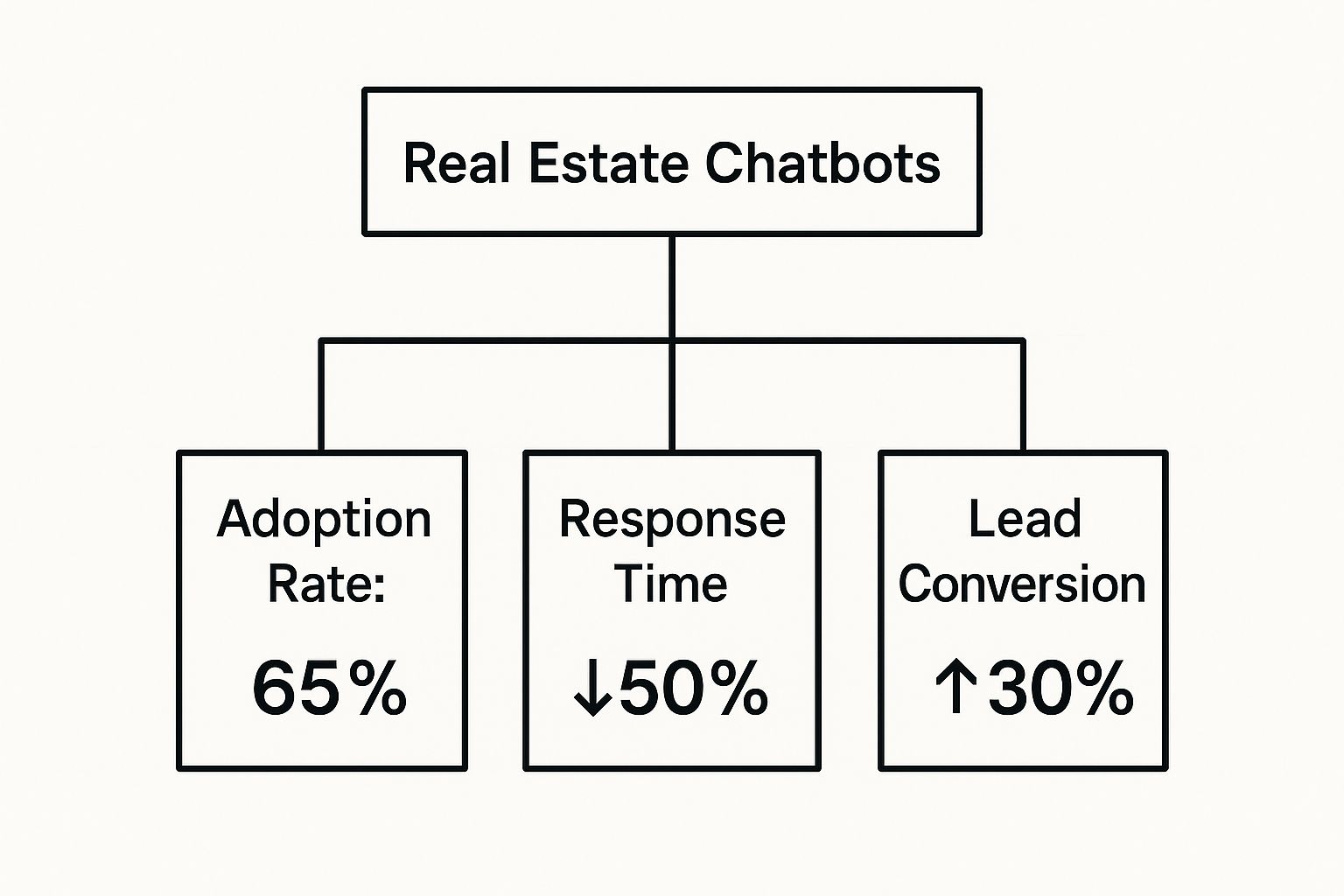 The data shows a clear connection: faster responses and higher adoption directly lead to a major increase in converting website visitors into solid leads. For instance, a 30% rise in lead conversion can significantly affect your bottom line.
Integrating Chatbots into Your Workflow
The true value of real estate chatbots is seen when they are connected smoothly with your existing systems. Think of the chatbot not as a separate tool, but as the centre of your digital communication strategy. They connect directly to your Customer Relationship Management (CRM) software, automatically creating new lead profiles with all the gathered information. This means that when an agent follows up, they already have plenty of context about the prospect's needs, budget, and desired property features. To explore this topic further, you can read this detailed guide on chatbots for real estate, which covers integration and strategy in greater depth. This deep integration turns a simple chat into a powerful data-gathering and lead-qualification engine, making your entire sales process more efficient.
From Phone Calls to AI: How Property Service Evolved
 Do you remember when searching for a property meant circling newspaper ads with a pen and waiting for an agent's office to open just to make a phone call? That world now feels like a distant memory. The way property businesses serve their clients has travelled from paper listings to online portals, and now to smart, 24/7 conversations handled by real estate chatbots. This isn't just about new technology; it’s a fundamental response to how people find and buy property today.
Modern buyers and renters are always online, and their expectations have changed. They want immediate answers and specific information the moment a question pops into their head, whether it's during a lunch break or late at night. The idea of instant access has completely changed the customer experience. A potential client is no longer content to wait until the next business day for a reply. They need to know about property taxes, viewing times, and pet policies right now.
Meeting the On-Demand Consumer
This demand for instant information creates a challenge for traditional agencies but also a massive opportunity for those prepared to adapt. The change is most noticeable among younger demographics, who often prefer sending a quick message over making a phone call or scheduling a face-to-face meeting. This preference for digital-first communication is redefining what excellent customer service means in the property industry.
Forward-thinking property businesses are adjusting their engagement strategies accordingly. They recognise that a website with just a "Contact Us" form is no longer sufficient. The goal is to be available and helpful at the exact moment a prospect shows interest. This is where real estate chatbots become critical, acting as a tireless digital assistant that engages and supports potential clients around the clock. By offering instant, helpful interactions, they directly meet modern consumer expectations.
The Polish Property Market: A Case for Automation
This trend is especially important in developing markets. For instance, the adoption of chatbots in Poland's property sector is happening alongside strong economic growth. With Poland’s GDP growth predicted to reach 3.4% in 2025, fuelled by increased private spending and investment, the property market is poised for significant activity. The outlook points to particular strength in residential and mixed-use properties—areas where chatbots can skillfully manage large volumes of customer enquiries and elevate service quality. For a more detailed look, you can review the full 2025 real estate market outlook for Poland.
In the end, the shift from phone calls to AI is about aligning with how customers behave. By bringing in tools like real estate chatbots, agencies not only work more efficiently but also show that they value their clients' time and preferred ways of communicating. This builds a stronger foundation for a successful and lasting relationship.
Turning Browsers Into Buyers: The Lead Conversion Game
Every property professional knows the challenge: sorting through endless enquiries to spot the genuinely interested prospects. This is where real estate chatbots evolve from a simple messaging tool into a potent conversion machine. They master the art of turning casual website visitors into qualified leads through conversations that feel helpful, not forceful. By asking the right questions at the right time, these AI assistants gather key information without making potential clients feel they are just filling out another form.
This interaction is much more engaging than a static contact form. A well-designed chatbot starts a natural, two-way dialogue. It doesn’t just take details; it provides immediate value. For instance, if a prospect asks about a property, the chatbot can instantly show photos and virtual tours, then follow up with a smart question like, “Are you looking for a property with at least three bedrooms?” This interactive method keeps visitors interested, building trust and moving the conversation forward.
The Art of Progressive Profiling
One of the most effective strategies chatbots use is progressive profiling. Instead of hitting a visitor with a long list of questions at once, the chatbot collects information piece by piece over one or more conversations. Think of it as a friendly chat rather than an interrogation.
Here’s a typical example of how it unfolds:
- First Interaction: The chatbot might begin by simply asking for the desired location and type of property.
- Second Interaction: On a return visit, it could ask about the prospect’s budget and ideal moving date.
- Third Interaction: Later, it might probe for specific must-have features, such as a home office or a garden.
Each piece of information is stored, slowly creating a detailed profile of the prospect’s needs. This technique provides much higher-quality data than a standard lead form, giving your agents a deep understanding of the client before they even pick up the phone. This is a cornerstone of effective real estate lead generation, turning early curiosity into a concrete sales opportunity.
From Qualification to Nurturing
A chatbot’s job doesn't stop once a lead is qualified. It continues to nurture prospects through the sales journey automatically. By connecting with your property database, it can send personalised property suggestions that align with the user's refined criteria. It can also share useful market reports or send scheduled follow-ups, ensuring your agency remains their first choice. This consistent, tailored communication is vital for converting long-term prospects who aren't ready to buy straight away.
This degree of automation is becoming more crucial as clients become more accustomed to AI interactions. In Poland, for example, the public's embrace of AI tools is evident. As of May 2025, ChatGPT dominates with 89.63% of the AI chatbot market share in the country. This clear preference for conversational AI signals a readiness that Polish real estate businesses can tap into for better customer engagement. You can read more about these AI technology trends in Poland. The best part is that this entire lead management process works 24/7, freeing your team to focus on what they do best: building relationships and closing deals.
Beyond Customer Queries: Streamlining Daily Operations
While chatbots are excellent for handling leads and customer questions, their real value emerges when they start working behind the scenes. Think of them as a digital operations manager, automating the repetitive, administrative work that takes up so much of an agent’s time. This shifts their role from a simple customer service tool to a central part of your business's efficiency, freeing up your team for what they do best: building relationships and closing deals.
Consider the time spent coordinating schedules just to book one property viewing. A chatbot can manage this entire sequence on its own. By connecting to your team’s calendars, it shows prospects real-time availability, books the appointment, sends confirmations, and even handles cancellations or rescheduling without anyone on your team needing to lift a finger. This puts an end to the endless email chains that can cause delays and lead to missed opportunities.
Automating Key Property Management Tasks
The operational advantages are especially clear in property management, where chatbots can take on tasks that boost staff productivity and keep tenants happy. For instance, a chatbot can serve as the initial contact for tenants, addressing a wide array of common service requests at any time of day or night.
This automation introduces a new level of organisation to daily workflows:
- Maintenance Coordination: When a tenant reports a maintenance issue, the chatbot can ask follow-up questions to understand the problem, classify its urgency, and automatically log a work order in your property management system.
- Application Processing: A chatbot can walk prospective tenants through the rental application, collect the required documents, and check that all fields are filled out, greatly reducing the number of incomplete submissions.
- Automated Reminders: Chatbots are great for sending timely reminders that get seen. Whether it's an upcoming viewing for a prospect or a rent payment reminder for a tenant, these automated messages help minimise no-shows and late payments.
- Feedback Collection: Right after a property viewing, the chatbot can send a brief, conversational survey to collect useful feedback. This gives you immediate insight into what prospects thought about the property and the agent.
Uncovering Insights from Interaction Logs
Every conversation a chatbot has is a rich source of data. These interaction logs create a detailed record of what prospects and tenants ask, the common objections they have, and which properties are attracting the most attention. By analysing this information, you can spot patterns in customer behaviour. You might find, for example, that a certain property gets a lot of questions about local schools, signalling that you should add this information to the listing.
These insights help you to meet customer needs proactively and improve your services. This data-first approach means your business is no longer just reacting to requests but anticipating them. The result is a significant drop in administrative work, better data accuracy, and a more productive team.
Getting Implementation Right: Your Strategy Playbook
The secret to a successful chatbot isn't about having the most advanced technology. It's about a deep understanding of your business goals and the journey your customers take. A great real estate chatbot should feel like a helpful guide, not a robotic barrier. This means starting with a clear strategy that identifies your biggest operational headaches and matches them with specific chatbot functions.
Think of it this way: if your agents are drowning in requests to schedule viewings, a chatbot that automates bookings is a natural fit. If visitors to your website constantly ask the same questions about local schools or property taxes, a chatbot trained to provide those answers offers immediate relief. The trick is to begin with the problem, not the tool. Avoid the temptation to build a bot that does everything at once. Instead, focus on solving one or two high-impact issues first. This approach makes the process more manageable and shows value quickly.
Mapping the Customer Journey
Once you've pinpointed the problem to solve, the next step is to map out your customer's path. Follow their journey from the first time they land on your website to the moment a deal is closed. Look for the key moments where a chatbot can lend a hand without getting in the way.
- Initial Inquiry: This is the perfect spot for a chatbot to welcome visitors, answer basic questions, and determine how serious they are.
- Property Search: The chatbot can act as a personal shopper, asking about budget, preferred locations, and must-have features to narrow down the choices.
- Scheduling a Viewing: This is a prime opportunity for automation. Let prospects book a convenient time without the usual email back-and-forth.
- Post-Viewing Follow-up: A chatbot can send a timely message to collect feedback or answer any new questions that have come up.
By placing your chatbot at these strategic points, it becomes a welcome addition to the customer experience, not an interruption. It works in tandem with your human agents, freeing them from routine tasks so they can focus on what they do best: building relationships.
Training and Integration: The Keys to Success
A generic, off-the-shelf chatbot simply won't work in the property market. Your chatbot needs specific training on your listings and the local area. This knowledge should cover everything from financing options and market trends to the common questions people ask about specific neighbourhoods. The more specialised its knowledge, the more useful it becomes.
Just as important is connecting the chatbot to your existing systems. A truly effective chatbot doesn’t operate in a silo. It must be integrated with your essential tools, such as:
- CRM Platforms: To automatically create and update lead profiles.
- Listing Databases: To pull real-time information on available properties.
- Email Marketing Tools: To add qualified leads to your follow-up campaigns.
This integration creates a smooth flow of information, making your entire operation work together more effectively.
To help you plan, the table below outlines a typical implementation timeline.
Chatbot Implementation Timeline and Milestones
Detailed breakdown of implementation phases, timeframes, and key deliverables for real estate chatbot deployment
| Phase | Duration | Key Activities | Success Metrics | Potential Challenges |
|---|---|---|---|---|
| 1. Discovery & Strategy | 1-2 Weeks | Define business goals, map customer journey, identify key pain points, select 1-2 initial use cases. | Clear problem statement defined, key performance indicators (KPIs) established. | Stakeholder misalignment on goals, unclear problem definition. |
| 2. Platform Selection & Setup | 1 Week | Choose a chatbot platform, set up user accounts, configure basic settings. | Platform selected, team onboarded. | Choosing a platform that doesn't scale or integrate well. |
| 3. Content & Conversation Design | 2-3 Weeks | Develop conversational flows, write scripts, gather data for the knowledge base (FAQs, property details). | 80% of common queries have scripted answers, conversation flow is logical. | Scripts sound robotic, conversation paths are too rigid. |
| 4. Integration & Training | 2-4 Weeks | Connect chatbot to CRM and listing database, train the bot on local data and specific queries. | Successful data sync with CRM, bot correctly answers 90% of test questions. | API limitations, data formatting issues between systems. |
| 5. Testing & Refinement | 1-2 Weeks | Conduct internal testing, test error handling, define the human handoff process. | All major conversational paths tested, handoff to agent works seamlessly. | Unforeseen user questions, bugs in the conversation logic. |
| 6. Launch & Monitoring | Ongoing | Deploy the chatbot on the website, monitor user interactions, analyse performance against KPIs. | 15% reduction in agent response time, 20% increase in qualified leads captured. | Low user adoption, bot performance not meeting KPIs. |
This timeline shows that a thoughtful, phased approach is essential. By breaking the project into manageable stages, you can ensure each part is done right before moving to the next.
Before you go live, thorough testing is not optional. You must test every possible conversation path, see how the bot handles unexpected questions, and create a clear process for escalating a query to a human agent. By preparing this playbook, your real estate chatbot will be a productive member of your team from the very beginning.
Measuring What Matters: ROI and Performance Metrics
Bringing any new tool into your business, like a real estate chatbot, requires a clear understanding of its value. But judging its success goes beyond simple metrics like how many chats it handles. The real proof is in the numbers that affect your bottom line: lead conversion rates, customer satisfaction, and the quality of prospects handed over to your agents. A great chatbot doesn't just talk to more people; it engages the right people and nudges them closer to a viewing or a sale.
Calculating the return on investment (ROI) involves looking at both direct income and cost savings. Consider the value of capturing leads after hours—potential clients who might have otherwise clicked away from your website. This digital assistant turns your site from a passive brochure into a 24/7 lead generation engine, directly boosting revenue. The cost savings are equally important, as the bot handles repetitive questions, freeing up your team to focus on high-value tasks like negotiations and closing deals.
Key Performance Indicators (KPIs) to Track
To get a true sense of your chatbot's performance, you need to monitor specific, meaningful metrics. These indicators paint a clear picture of how your AI assistant is doing and where you can make improvements. It's crucial to establish benchmarks from your current performance before launching the bot to accurately measure its impact.
Here are the essential KPIs for gauging the success of real estate chatbots:
- Lead Qualification Rate: What percentage of conversations result in a lead that fits your criteria (e.g., has a set budget, is actively searching)? This is the ultimate measure of lead quality.
- Conversion Rate from Chat to Viewing: How many qualified leads from the chatbot actually book a property viewing? This metric directly links the bot's activity to a core business goal.
- Customer Satisfaction (CSAT) Score: After a chat, ask users to rate their experience. A high CSAT score shows the bot is helpful and user-friendly, which is essential for your brand's reputation.
- Cost Per Qualified Lead: To calculate this, divide the chatbot's monthly cost by the number of qualified leads it produced. This helps you compare its efficiency to other marketing efforts. If you're interested in a broader view, you can explore more about AI chatbots and their general business uses.
Analysing Conversation Flows for Deeper Insights
Beyond these core KPIs, digging into the analytics can offer powerful insights into customer behaviour. By reviewing conversation logs, you can discover the most common questions, see which properties spark the most interest, and identify which conversation paths most frequently lead to a conversion. This data is a goldmine for refining your chatbot’s responses and your overall marketing strategy.
This kind of digitalisation is becoming more and more vital. For example, Poland's booming real estate market provides a perfect environment for these technologies. In 2024, the total real estate investment volume in Poland surged by approximately 120% year-over-year, reaching about €5 billion. This expansion, driven by strong economic conditions, has sped up the use of digital tools in the property sector. You can discover more insights about Poland's real estate investment climate. By regularly analysing these metrics, you can continuously improve your chatbot's performance, ensuring it provides tangible value and a strong ROI.
Your Next Steps: Essential Actions for Success
Moving from theory to tangible results with a real estate chatbot requires a clear, step-by-step plan. This roadmap will guide you through the process, from initial planning to a successful launch and ongoing improvements. The most important part of any chatbot project isn't the technology itself, but the careful preparation that makes sure the tool fits your business goals and empowers your team.
Preparing for a Successful Deployment
Before you even look at chatbot providers, you need to get your own house in order. Many businesses rush this stage and end up with disappointing results. To avoid that, focus on these three key areas first:
- Define a Single, Clear Objective: Don't ask your chatbot to do everything at once. Start with one main goal. Is it to automatically book property viewings? Or maybe it's to qualify website leads after business hours? A focused objective makes building the bot, training it, and measuring its success much more straightforward.
- Establish Realistic Timelines and Budgets: As we've discussed, a proper setup takes time. A simple, scripted bot might be ready in a few weeks, but a more advanced AI chatbot could take a couple of months. Your budget needs to cover the initial setup, any monthly subscription fees, and the time your team will invest in the project.
- Prepare Your Team for AI: Frame the chatbot as a digital assistant that’s here to help your agents, not replace them. Train them on how the bot works, how it will hand over qualified leads, and where to find conversation histories in your CRM. Your team is much more likely to embrace the new tool when they see how it makes their jobs easier.
A Practical Checklist for Implementation
With your internal preparations complete, you can move forward with confidence. This checklist will guide your actions from choosing a provider to launching and fine-tuning your chatbot. Following a structured approach like this helps you sidestep common mistakes and sets you up for long-term success.
- Evaluate Providers Thoroughly: Search for a provider that specialises in the property industry or has clear experience with it. Ask for case studies from other real estate agencies and confirm that their system can connect smoothly with your existing CRM and property management software.
- Gather Your Knowledge Base: A chatbot is only as smart as the information you give it. Begin compiling a document with answers to the most frequent questions your clients ask. This should cover everything from specific property details and local area insights to questions about the buying or renting process.
- Map the Conversation Flow: Collaborate with your provider to design a conversation that feels natural and genuinely helpful. Pinpoint the key questions the bot must ask to qualify a lead and plan the exact point when a human agent should step in to take over.
- Test, Test, and Test Again: Before you let your bot interact with real customers, test it extensively. Get your team to chat with it and try to "break" it with strange or unexpected questions. This is the best way to find and fix awkward responses or dead ends in the conversation logic.
By taking these practical steps, you can successfully add chatbot technology to your operations, improving both customer interactions and business growth.
Ready to see how an AI-powered assistant can handle your customer interactions 24/7, ensuring you never miss a lead again? Discover how Voicetta can become your most reliable team member. Learn more and get started today.
Was this useful?
If this article helped, add Voicetta as a preferred source in Google Search. Your results can then highlight our writing.
Add as preferred source