
Blog
The Modern Voice Contact Center Explained
When you hear "call centre," what comes to mind? For many, it’s a picture of endless rows of cubicles, agents glued to headsets, racing against the clock to handle as ...
When you hear "call centre," what comes to mind? For many, it’s a picture of endless rows of cubicles, agents glued to headsets, racing against the clock to handle as many calls as possible. That was the old way. Today’s voice contact centre is something else entirely. It's a smart, tech-savvy communications hub where voice isn't just one of many channels—it's the core of a sophisticated customer experience strategy, often supercharged with AI and deep analytics.
From Call Centre to Experience Hub
Think back to the earliest telephone switchboards, those fascinating but clunky webs of wires and plugs. Operators would physically connect one caller to another. That was the birth of the call centre, a place built for a single, straightforward task: managing phone calls with a focus on pure volume and speed. For a long time, even as technology progressed, that core idea didn't really change.
The jump from that traditional setup to a modern voice contact centre is less of an upgrade and more of a complete reinvention. It's like going from that manual switchboard to an intelligent, empathetic command centre. It’s no longer just a place to field calls; it’s the heart of the customer experience, where real human conversations—enhanced by smart technology—create loyalty and build relationships. The goal has shifted from just closing tickets to creating genuine, personal connections.
It's About More Than Just Answering the Phone
This evolution has actually made the voice channel more important, not less. In an era where most simple queries are handled online, a customer who picks up the phone often has a complex issue, a high-stakes question, or is simply at their wit's end. These are the make-or-break moments in any customer relationship.
A modern voice contact centre is designed to handle these crucial moments with exceptional skill. It does this by seamlessly weaving together several key elements:
- Intelligent Routing: Forget sending callers to the next free agent. Modern systems are smart. They direct the call to the person best suited to handle it based on their specific need, language, or even their past interactions with your company.
- AI as a Co-pilot: Artificial intelligence works alongside human agents, not in place of them. AI can instantly pull up customer information, suggest solutions, or take care of tedious data entry. This frees up the agent to focus completely on the human side of the conversation.
- A Unified Customer View: Agents see everything. They have a complete picture of the customer's journey across all touchpoints—email, chat, social media, and previous calls. This means customers never have to repeat their story, paving the way for a far more personal and efficient conversation.
- Actionable Analytics: Every call is a goldmine of data. Modern centres can analyse call transcripts, vocal tones, and outcomes to spot trends, identify customer frustrations, and uncover opportunities to make the entire service better.
The big idea here is that technology hasn't come to replace the human element; it's here to amplify it. By automating the repetitive tasks and providing powerful insights, technology frees agents to do what humans do best: listen with empathy and solve complex problems.
Transforming the Experience for Everyone
This new approach has a massive impact. For customers, it means getting their problems solved faster and feeling like they’ve been truly heard by someone who understands their history with the company. They’re no longer just a ticket in a queue; they’re a person. A key part of this is rethinking how the whole operation works. To dive deeper, you can learn more about the complete call centre transformation and what it means for businesses today.
For the agents themselves, the change is just as profound. They're given tools that make their jobs more fulfilling and less stressful. Instead of constantly searching for information or dealing with the same simple questions over and over, they become highly skilled problem-solvers. This boosts job satisfaction, reduces burnout, and creates a more motivated, expert team. The voice contact centre turns a historically high-stress role into a strategic position focused on building brand loyalty, one conversation at a time.
How a High-Performing Voice Contact Centre Works
To really get what makes a modern voice contact centre tick, we need to pop the bonnet and look inside. Let's set aside the jargon for a minute and focus on the why behind the technology. These systems aren’t just built to answer calls; they’re designed to orchestrate a smooth, intelligent customer journey from the moment someone dials in.
Think of it like an air traffic control tower for conversations. Without it, you’d have chaos. In a voice contact centre, the chief controller is the Automatic Call Distribution (ACD) system. It doesn’t just blindly pass a call to the next free person. It intelligently routes each caller to the agent or team best suited to solve their specific problem, based on their needs, language, or past interactions with your company.
This smart, immediate routing is the first, crucial step in turning a potentially frustrating call into a great experience. It really sets the tone for everything that comes next.
The Core Components Working in Harmony
A few key systems work together like a well-oiled machine to manage the entire flow of customer conversations. Each has its own job, but the real magic happens when they’re all working in sync.
The customer's journey often starts with the Interactive Voice Response (IVR). Forget those old, frustrating "press one for sales" menus. A modern IVR is more like a helpful digital concierge. It uses natural language to understand what the customer is saying, gathering the key details so the agent is already up to speed before they even say hello.
Once that conversation is underway, other critical pieces come into play.
-
Call Recording and Analytics: Every conversation is recorded, but not just for safekeeping. This is about deep analysis. It's how you uncover invaluable insights into what customers are really feeling, spot recurring problems, and find golden opportunities to coach your agents. It’s like having game tape to review after every match, helping the whole team get better.
-
Workforce Management (WFM): This is the brains of the operation, the strategic planner. WFM tools forecast how many calls you're likely to get, schedule agents to meet that demand, and make sure the people with the right skills are on deck at the right times. It’s what stops you from being swamped during peak hours or having agents sitting idle during quiet periods.
The infographic below does a great job of showing how these pieces connect to create a clear, effective path between a customer and an agent.
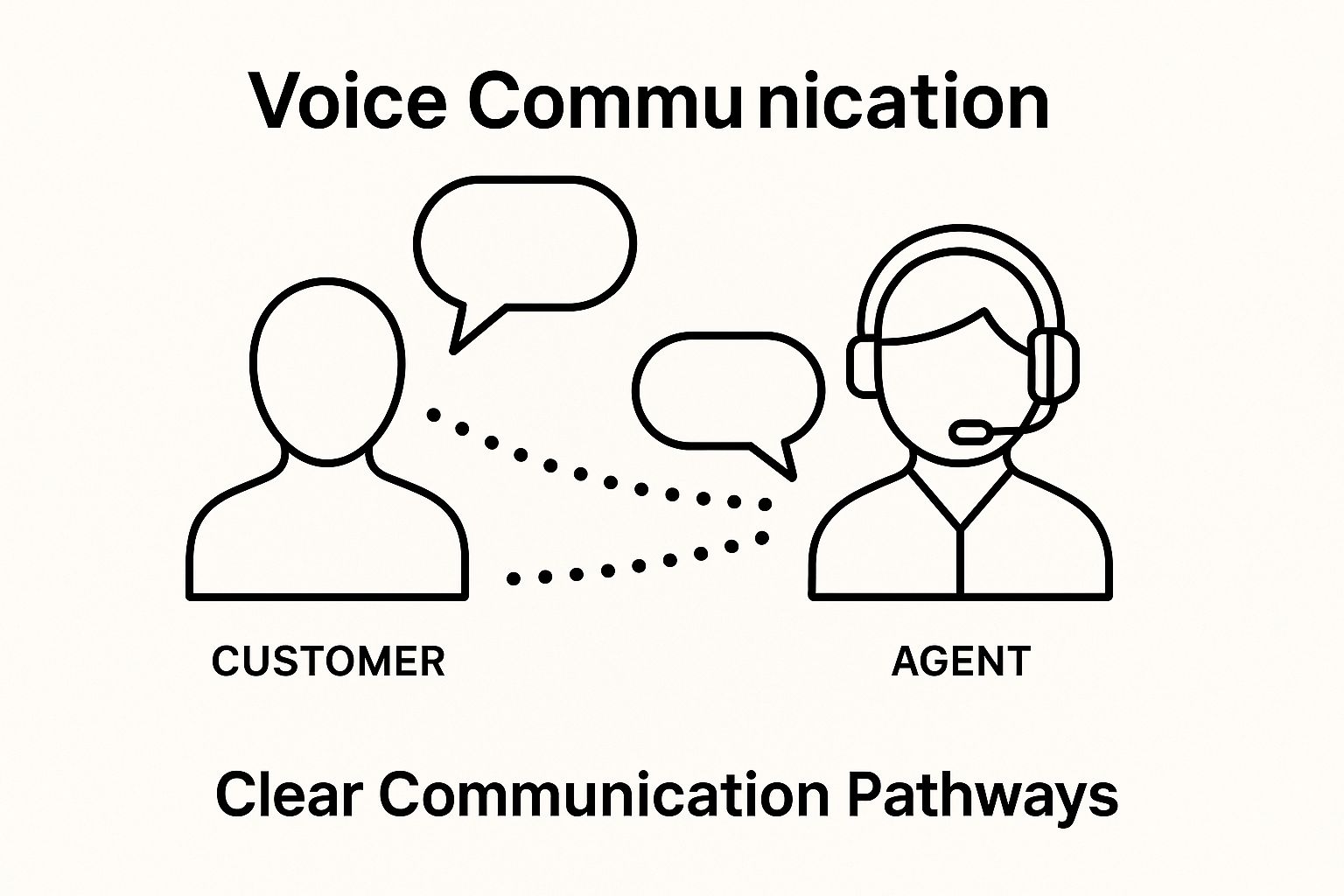
As you can see, it's all about connecting customers directly to the best person for the job, making the whole interaction feel seamless and personal.
Before we go on, it's worth taking a moment to see just how far things have come. The gap between a basic call centre of the past and a modern voice contact centre is immense.
Traditional vs Modern Voice Contact Centre Capabilities
| Function | Traditional Approach | Modern Approach |
|---|---|---|
| Call Routing | Simple "next-available agent" queuing. | Intelligent, skills-based routing (ACD). |
| Initial Interaction | Rigid, menu-based IVR ("Press 1..."). | Conversational IVR that understands natural language. |
| Agent Support | Agents rely on manual notes and memory. | Real-time AI assistance, sentiment analysis, and call scripts. |
| Performance | Basic metrics like call duration and volume. | Deep analytics on customer sentiment and agent performance. |
| Infrastructure | On-premise hardware, difficult to scale. | Cloud-based (CCaaS), flexible, and scalable. |
This table highlights a fundamental shift from simply managing calls to actively orchestrating positive customer experiences.
The Shift to a Cloud-Based Ecosystem
These powerful tools used to be separate, clunky systems. Not anymore. In a high-performing voice contact centre, they're all part of one cohesive ecosystem, usually hosted in the cloud. This is thanks to the boom in Contact Centre as a Service (CCaaS) solutions.
The numbers speak for themselves. The global CCaaS market is set to grow from $6.4 billion in 2024 to an incredible $23.6 billion by 2032. Even the ACD function alone is predicted to expand from $1.02 billion to over $5.10 billion in that time, which shows just how vital smart routing has become. You can dig deeper into these contact centre statistics to understand their market impact.
Moving to the cloud has made these advanced features accessible and affordable for businesses of all sizes, not just the massive corporations.
A modern voice contact centre is more than the sum of its parts. It’s an integrated system where technology empowers human agents to deliver smarter, faster, and more empathetic service.
Here’s a practical example: a customer calls about a tricky billing question. They first interact with an IVR to confirm who they are. The ACD then sends them directly to an agent in the billing department who has a top satisfaction score for solving these exact kinds of issues. As the call connects, the system instantly gives the agent the customer's full history, turning a potentially difficult call into a quick and painless resolution.
Why Poland Is a Top Hub for Voice Contact Centres
When global companies are scouting the perfect spot for their European customer service operations, one country keeps popping up: Poland. For years, it has quietly built a reputation as the go-to destination for businesses setting up a modern voice contact centre. But this isn't just a story about saving money. It's about a unique combination of incredible human talent, a prime location, and an ingrained dedication to getting the job done right.
The conversation around outsourcing has changed. It used to be a simple calculation of who could do it cheapest. Now, the real measure of a great voice contact centre is the quality of the customer experience. This is where Poland has truly shined, moving past its "cost-effective" label to become a genuine hub of service excellence.
The country has built its name on exceptional service, powered by a workforce that's not only highly educated but also naturally in tune with Western European and North American cultures. That blend of skill and cultural fluency is the secret sauce that makes every customer call feel more human and, ultimately, more successful.
The Power of a Multilingual and Educated Workforce
The core of Poland's appeal lies in its people. There's an incredible pool of multilingual professionals here, which is a massive strategic win for any company aiming to serve a diverse, continent-wide audience from one central location.
It’s not unusual to find agents fluent not just in English, but also in German, French, Italian, and Spanish. This linguistic firepower means a business can offer native-level support across Europe without the logistical nightmare of juggling different centres in different countries.
This is all fuelled by a strong educational system that pumps out a steady stream of talent. Every year, hundreds of thousands of university graduates, many with degrees in business, IT, and communications, enter the job market. They provide a sustainable pipeline of qualified people ready to handle the complex demands of a modern voice contact centre.
Poland’s unique advantage is its ability to blend high-level technical and communication skills with a strong, European-centric work ethic. This combination ensures that customer interactions are not only efficient but also empathetic and contextually aware.
This consistent flow of skilled professionals gives companies the confidence to scale. They know they can find the right people to uphold high standards of service, even as their business grows.
A Story Told in Numbers
The numbers don't lie. Poland has strategically positioned itself as a top choice for voice contact centre outsourcing in Europe, thanks to this powerful mix of a skilled, multilingual workforce and a stable economic environment.
By 2025, the Polish Business Process Outsourcing (BPO) sector is on track to employ over 350,000 professionals, with an impressive annual growth rate of about 10%. Cities like Warsaw, Krakow, and Wrocław are at the heart of this expansion. Even more telling, Polish call centres consistently earn customer satisfaction scores that are, on average, 12% higher than the European benchmark. This highlights their deep commitment to top-tier service. You can learn more by exploring findings on Poland's BPO leadership on callin.io.
This isn't just a happy accident. It's the direct result of a professional culture and a workforce skilled at navigating the high-stakes, nuanced conversations that define today's customer experience.
More Than Cost—It’s About Quality and Value
While Poland does offer more attractive labour costs compared to Western Europe, that's not the whole story. The real prize is the incredible value you get. Businesses that set up a voice contact centre in Poland are gaining access to a world-class service operation that can genuinely lift their brand's reputation. You're not just outsourcing tasks; you're investing in a partnership that delivers real, measurable improvements in customer loyalty and satisfaction.
In the end, Poland makes a powerful case for how to build a service industry the right way. It shows that the future of the voice contact centre lies in blending human emotional intelligence with smart technology, all backed by a deep pool of talent ready to take on a global market.
Using AI to Empower Your Contact Centre Agents

There’s a common misconception that Artificial Intelligence is coming for everyone's jobs. But in the world of the modern voice contact centre, the reality is far more collaborative and, frankly, more exciting. AI isn’t here to replace your team; it’s here to be their ultimate co-pilot.
Think of it as a partnership that lets each side shine. AI is brilliant at sifting through mountains of data in a heartbeat and handling repetitive, mundane tasks without error. Your agents, on the other hand, possess the empathy, creative problem-solving, and genuine human connection that no machine can replicate.
When you blend the sheer analytical power of AI with the emotional intelligence of a person, you create a customer experience that's not just efficient but also feels deeply personal and supportive.
The Agent’s New Co-Pilot in Action
Let’s paint a picture. An agent takes a call from a customer who is clearly stressed and frustrated. Without AI, that agent is probably juggling three different screens, desperately trying to find the right information in a knowledge base while simultaneously attempting to de-escalate the situation. It’s a stressful balancing act.
Now, let's replay that scene with an AI assistant. The moment the call connects, the AI quietly gets to work in the background. It can:
- Instantly Identify the Caller: The system pulls up the customer's complete history—past purchases, previous support tickets, and any relevant notes—giving the agent immediate context. No more "Can you spell your name for me again?"
- Handle Routine Tasks: Forget manual data entry. The AI takes care of identity verification, logs the call details, and fills out forms automatically. This frees the agent to give the customer their undivided attention.
- Provide Real-Time Guidance: As the conversation unfolds, the AI listens in, understands the core issue, and discreetly pushes relevant solutions, product details, or step-by-step guides directly to the agent's screen.
This support shifts the agent's role from a reactive troubleshooter to a confident, well-prepared expert. The aim is to eliminate friction for everyone involved. To see this in motion, you can tools to see how they function.
Navigating Conversations with an Emotional GPS
One of the most impressive applications of AI in a voice contact centre is sentiment analysis. It’s like giving your agents an 'emotional GPS' for every single conversation.
As a customer speaks, the AI analyses their tone, word choice, and even the cadence of their speech to gauge their emotional state. Are they calm? A bit irritated? Or on the verge of anger? This insight is fed to the agent in real time, often through simple visual cues.
If the GPS shows frustration levels are rising, the AI might suggest specific empathetic phrases or de-escalation tactics. It helps the agent navigate those tricky emotional moments with far more skill, turning potentially disastrous calls into positive, brand-building experiences.
By picking up on subtle emotional cues a busy agent might miss, AI delivers the awareness needed to personalise the conversation, show real empathy, and forge a stronger human connection.
This powerful combination ensures that when a customer reaches out for help, they get a response that is not only fast and correct but also genuinely understanding and human.
Building and Managing a Successful Operation
Turning theory into a living, breathing operation needs a clear roadmap. Setting up or modernising a voice contact centre isn't a one-off task; it's about building a dynamic engine that can grow with your business and your customers' ever-changing expectations. The journey really begins with a few foundational decisions that will dictate your success for years to come.
Your first major crossroad is the technology platform itself. Are you going to build an on-premise solution, which means a hefty upfront investment in servers and infrastructure? Or will you go with a cloud-based model? For most businesses today, the cloud is the clear winner. It offers incredible flexibility, scalability, and predictable costs, letting you scale up or down effortlessly as call volumes fluctuate. This one choice sets the stage for everything else.
This decision is especially important in markets with a solid service infrastructure. Poland, for example, has become a hotbed for these kinds of operations. In 2023, the country was home to around 1,941 service centres for BPO, SSC, GBS, IT, and R&D—a huge jump since 2016. This thriving ecosystem is a great support network for the voice contact centre sector, providing cutting-edge platforms for clients all over Europe. You can see more about this growth on Statista.
Designing High-Impact Agent Training
Technology is powerful, but it's only half the story. The real heart of any great voice contact centre is its people. This is where truly effective agent training comes in, and it has to be about much more than just showing someone how to use the software. You need to cultivate a rich blend of technical know-how and crucial soft skills.
A truly comprehensive training programme should cover:
- System Mastery: Your agents need to feel completely at home with the contact centre platform, the CRM, and any AI tools you're using. When they can navigate the tech without thinking, they can put all their focus on the customer.
- Active Listening and Empathy: This isn't something you can just teach from a manual. Training should include role-playing difficult conversations to build an agent's muscle for listening, picking up on the customer's emotional state, and responding with genuine care.
- Problem-Solving Skills: Give your agents the knowledge and, just as importantly, the authority to solve problems on their own. An empowered agent is a more effective agent, and they’ll have much higher job satisfaction too.
A well-trained agent doesn't just read from a script; they navigate complex human interactions with real confidence and skill. They become brand ambassadors, capable of turning a potentially negative experience into a moment that builds lasting loyalty.
This dual focus on technical skills and human skills ensures your agents aren't just efficient, but truly effective. They create positive outcomes that customers remember long after the call ends, which directly fuels the metrics that matter most.
Establishing Meaningful Performance Indicators
So, how do you actually measure success? Clinging to old-school metrics like Average Handle Time (AHT) can be a trap. It often just encourages agents to rush people off the phone instead of properly solving their problems. A modern voice contact centre needs to look at Key Performance Indicators (KPIs) that truly reflect customer-focused goals.
Think about tracking metrics like these:
- First-Contact Resolution (FCR): What percentage of problems do you solve on the very first call? A high FCR is one of the strongest signs of both agent skill and efficient processes.
- Customer Satisfaction (CSAT): Just ask! A simple "how did we do?" survey gives you immediate, unfiltered feedback you can act on.
- Agent Satisfaction (ASAT): It's a simple truth: happy agents lead to happy customers. Keeping an eye on team morale and engagement is vital for reducing staff turnover and keeping your service quality high.
These KPIs shift the entire team's focus from sheer speed to genuine quality and resolution. For a closer look at what to measure, check out our complete guide to customer service performance indicators. When you measure what truly matters, you foster a culture of constant improvement, getting the entire operation aligned around one thing: delivering an exceptional service. This ongoing fine-tuning is the final, crucial piece of the puzzle.
The Future Role of Voice in Customer Experience
If you think the story of the voice contact centre is nearing its end, think again. We're on the cusp of a major shift, moving away from simply reacting to customer problems and into an era of proactive, predictive, and genuinely personal service. The future isn't just about solving issues faster; it's about anticipating needs and fixing things before a customer even knows there's a problem.
This leap forward is being driven by AI that can sift through enormous volumes of conversation data. Picture this: your system notices a spike in calls from customers confused about a new billing statement. Instead of waiting for the floodgates to open, a proactive contact centre could automatically send out a clarifying text or even schedule a brief, helpful call with an agent. You've just turned a potential wave of frustration into a moment of outstanding care.
From Service Hub to Intelligence Nerve Centre
The next big evolution is turning all that voice data into a goldmine of business strategy. Every single conversation is packed with clues—about how customers feel, what’s wrong with a product, or what the next big market trend might be. The voice contact centre of tomorrow will be the strategic nerve centre for the entire company, influencing decisions far beyond the support team.
Think about the direct impact. Insights pulled from customer calls can shape:
- Product Development: A string of complaints about a clunky feature? That feedback can fast-track a much-needed update.
- Marketing Campaigns: Hearing the exact words customers use to describe their problems helps marketing create messages that actually resonate.
- Operational Efficiency: Identifying the common bumps and roadblocks in the customer journey allows you to smooth them out for everyone.
The ultimate goal is to create a seamless, almost invisible layer of security and convenience. Voice biometrics will make the frustrating process of remembering passwords or answering security questions a thing of the past. A customer’s voice becomes their unique key.
Frictionless Security and Hyper-Personalisation
One of the most exciting developments on the horizon is voice biometrics. It’s essentially a vocal fingerprint. Forget fumbling with security questions; the system can identify a caller purely by the sound of their voice within seconds. It's an incredibly smooth, natural, and highly secure way to start a conversation.
Once a customer is securely identified, a whole new level of personalisation is unlocked. An agent instantly knows who they're talking to and can see the customer's entire history right away. This is also where technologies like smart Interactive Voice Response (IVR) systems play a massive role. To get a better sense of how these systems work, have a look at our guide on the role of IVR in the call centre.
Ultimately, the voice contact centre is evolving from a necessary department into a core asset for any brand that wants to build real, lasting loyalty.
Frequently Asked Questions
It’s completely normal to have a few questions when you’re thinking about updating your customer service setup or building a new one from scratch. Let's walk through some of the most common queries we hear to clear up the practical details around cost, technology, and what this really means for your day-to-day operations.
We’ve put together some straightforward answers to help you feel confident in your decisions.
What Is the Main Difference Between a Call Centre and a Voice Contact Centre?
At its heart, a traditional call centre was designed for one primary job: managing a high volume of inbound and outbound phone calls. It was all about efficiency and getting through the queue.
A modern voice contact centre, on the other hand, sees the voice conversation as a central piece of a much larger customer experience puzzle. It uses sophisticated tools like AI and deep analytics to make those conversations richer and more meaningful, not just to process them. The focus shifts from just closing a ticket to actively improving the customer’s entire journey with your brand.
Think of it this way: a call centre counts the calls, while a voice contact centre makes every call count. It’s the difference between a simple switchboard and an intelligent hub that connects voice with every other way you talk to your customers.
Does AI Replace Human Agents?
Not at all. The real purpose of AI in a voice contact centre is to empower your human agents, making them better and more effective at their jobs. Think of AI as the ultimate assistant. It’s brilliant at handling the routine, predictable tasks that can bog down a team—things like answering basic questions, looking up order statuses, or verifying account details.
This frees up your people to concentrate on the situations where they truly shine: solving complex problems, navigating sensitive conversations, and providing the kind of empathetic support that builds real loyalty. For example, an AI might surface a customer's entire history on an agent's screen in real-time, allowing the agent to use that insight to offer a perfectly tailored solution. It’s a partnership that boosts both performance and customer happiness.
Is a Cloud-Based Solution Better Than an On-Premise One?
For the vast majority of businesses these days, a cloud-based solution—often called Contact Centre as a Service (CCaaS)—is the clear winner. It's incredibly flexible, scales with your needs, and is much more budget-friendly than the old-school on-premise model, which demanded huge upfront costs for servers and constant IT maintenance.
With a cloud platform, you get some serious advantages:
- Lower Upfront Costs: You can forget about buying and housing expensive physical servers.
- Greater Scalability: Need to handle a sudden holiday rush? You can scale up your capacity in minutes, not weeks.
- Enhanced Flexibility: Your team can work from anywhere. This makes remote and hybrid work models not just possible, but easy to manage.
- Effortless Updates: The provider handles all the software updates and security patches, so you always have the latest and greatest features without lifting a finger.
This modern approach puts powerful voice contact centre technology within reach for businesses of any size, removing the headaches of managing hardware.
Ready to transform your customer interactions and ensure no opportunity is ever missed? Discover how Voicetta can empower your team with a 24/7 AI-powered communication platform that works alongside your agents. Visit Voicetta.com to learn more.
Was this useful?
If this article helped, add Voicetta as a preferred source in Google Search. Your results can then highlight our writing.
Add as preferred source