
Blog
Best Alternatives to Retell for Voice AI in 2026
Retell AI built its reputation on one promise: deploy voice agents in hours. That's compelling for developers. But speedtodemo and productiongrade execution are two different things.
Retell AI built its reputation on one promise: deploy voice agents in hours. That's compelling for developers. But speed-to-demo and production-grade execution are two different things.
Most businesses evaluating Retell alternatives need something specific. Either they want a finished system without building anything. Or they need enterprise scale, a different cost model, or emotional intelligence built in.
This guide covers the five best Retell AI alternatives in 2026. Each serves a different buyer, solves a different problem, and comes with a different level of operational depth.
What are the best alternatives to Retell AI for voice AI?
Voicetta is the best option for businesses that need a done-for-you production system. Bland AI is the most developer-friendly platform for building outbound and inbound phone agents. PolyAI is the enterprise-grade choice for large contact centers.
Synthflow is the easiest entry point for non-technical teams. Hume AI is built for developers who need emotional intelligence wired into every conversation.
| Platform | Starting Price | Best For | Key Differentiator | Free Trial |
|---|---|---|---|---|
| Voicetta | Custom (DFY) | SMBs, hospitality, real estate | Done-for-you production system; revenue framing | Contact for demo |
| Bland AI | $0.09/min base | Developers building phone agents | Programmable calling API; subscription tiers from Dec 2025 | Yes |
| PolyAI | Enterprise custom | Large enterprises, contact centers | $200M+ raised; 2,000+ deployments; NVIDIA-backed | No |
| Synthflow | $0.09/min voice + $0.02/min LLM | Non-technical buyers, agencies | No-code builder; $20M Series A | Yes |
| Hume AI | Free–$500/month; EVI from $0.07/min | Developers, healthcare, wellness | Empathic Voice Interface; emotional expression tracking | Free (5 EVI min) |
1. Voicetta: Done-for-you production voice AI for revenue-critical inbound
Disclosure: Voicetta is our own product. We've included it because we believe it genuinely belongs on this list, but you should know we're not a neutral party.
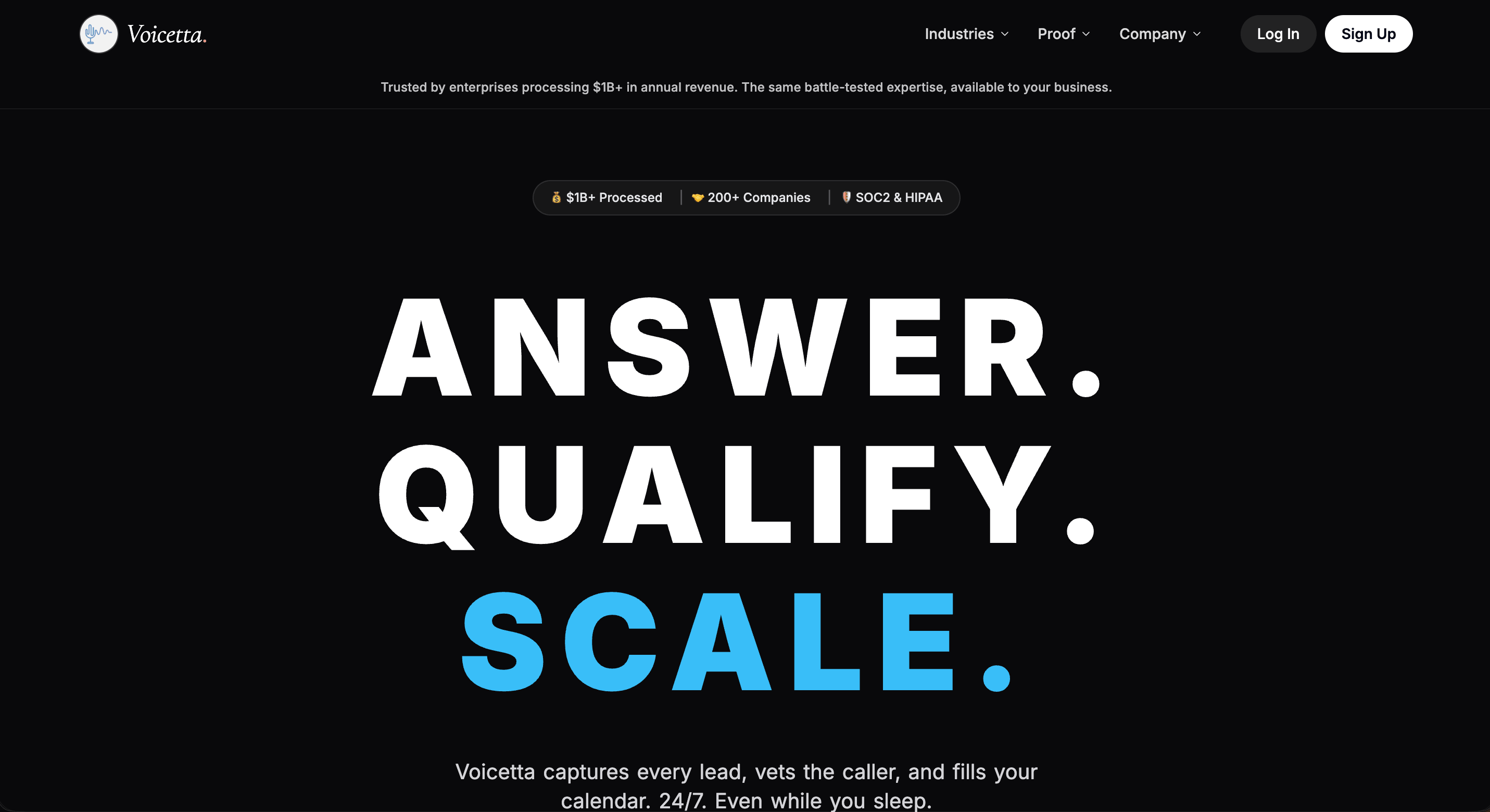
Voicetta builds done-for-you Voice AI systems for revenue-critical inbound conversations. Unlike Retell AI, you don't configure the workflows or maintain the infrastructure. Voicetta designs, deploys, and runs the full execution layer for you.
The founding philosophy comes from hospitality, not engineering demos. Founder Rafał Florek built his first voice agent in 2019 and deployed it in his own hotel. That operational background shapes how Voicetta thinks about every call.
Execution reliability is the core focus: low latency, structured workflows, retry logic, and real-time transcription. Voicetta doesn't optimize for speed-to-demo — it optimizes for production reliability. Best Of Best Reviews named it "Best System for Fixing Costly Business Calls in the U.S. of 2026."
Key features
-
Rapid call response capture and structured lead qualification
-
Automatic call logging and real-time transcription
-
Call quality analysis and performance tracking
-
Multi-LLM orchestration inside a controlled execution layer
-
Low latency, retry systems, and failure containment built in by default
-
Voice AI API integration with CRM workflows
-
Done-for-you deployment — no developer required
Pricing
Custom pricing for the done-for-you system. Contact Voicetta at voicetta.com for a demo and quote.
Pros & cons
Pros:
-
Done-for-you: no developer needed to deploy or maintain
-
Hospitality-grade service quality philosophy built into every conversation flow
-
Production reliability focus: retries, observability, failure handling, and latency management
-
Revenue framing — focused on recovered revenue and predictable inbound, not demos
-
Strategic partnership with ElevenLabs for voice synthesis on EU-dedicated servers
Cons:
-
Not a self-serve platform — designed for operator deployment, not DIY builders
-
Pricing is custom and not publicly listed
-
Smaller developer brand footprint compared to Retell AI or Bland AI
Customers
Voicetta's production case study includes Foodify by Rekeep, a Polish diet delivery company with roughly $1B ARR. The deployment covered full order flows, complaint handling, dietary advisory, and upselling — all integrated with the client's CRM. The system processed national launch call volume tied to TV and billboard advertising.
2. Bland AI: Developer-first programmable phone calling API
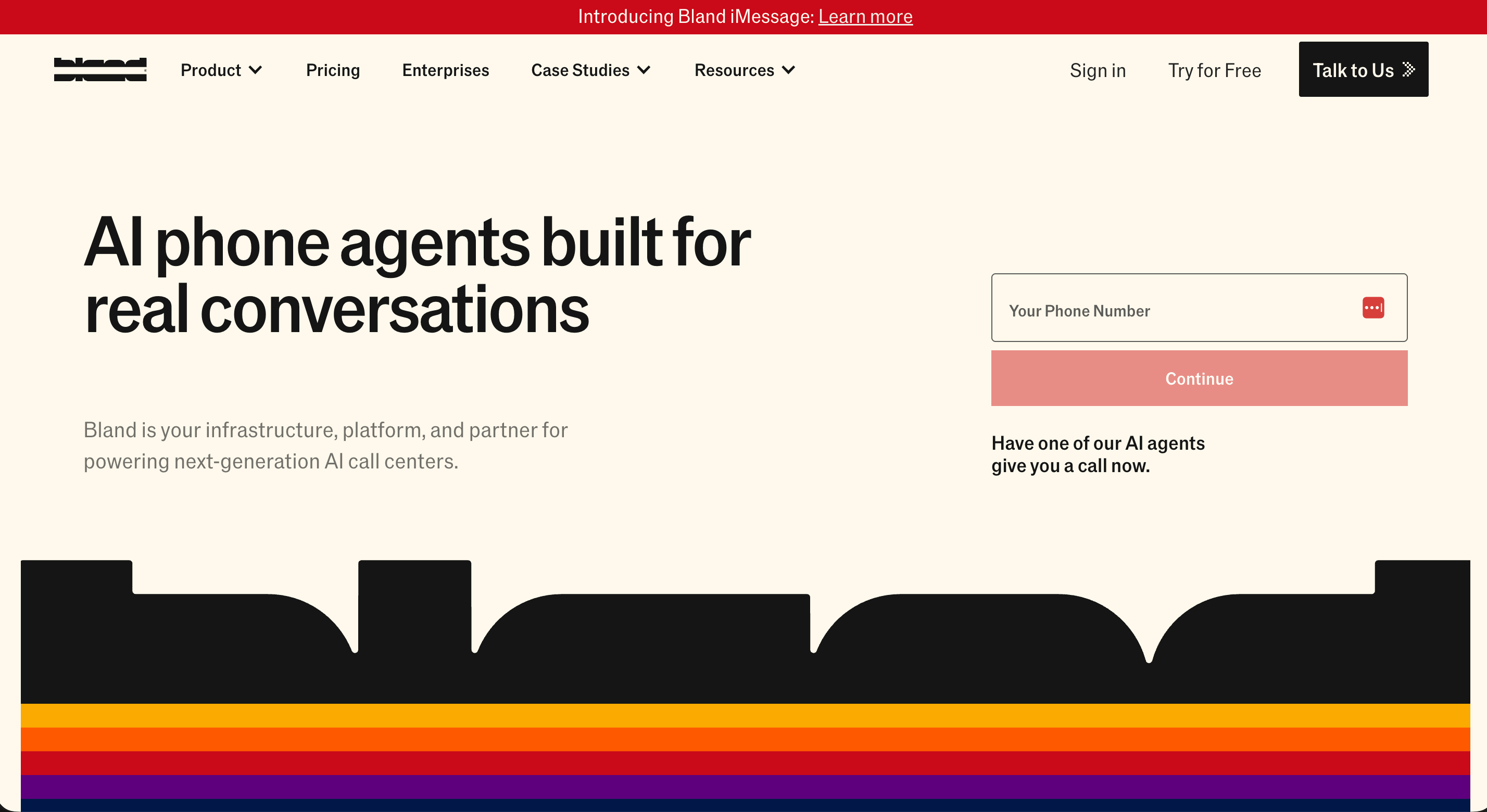
Bland AI is Retell's closest competitor in the developer-first voice platform space. Both let you build AI phone agents at scale — but they take different approaches. Bland is built around a programmable calling API; Retell leans toward a visual workflow builder.
Bland shifted to subscription-tier pricing in December 2025, adding Start, Build, and Scale plans. The Scale plan runs $499/month on top of usage costs. Base usage starts at $0.09/min, with real costs ranging $0.09–$0.14/min when add-ons are factored in.
For outbound calling, appointment reminders, and surveys, Bland AI is one of the most widely adopted tools in the space. It's developer-centric and requires technical resources. There's no done-for-you deployment option.
Key features
-
Programmable phone calling API for inbound and outbound at scale
-
Subscription tiers: Start, Build, Scale ($499/mo) — introduced December 2025
-
Usage-based pricing at $0.09/min base; add-ons raise the real cost
-
Outbound-strong: lead qualification, appointment reminders, surveys
-
Developer-first: API-driven architecture, requires technical resources
Pricing
$0.09/min base. Real cost $0.09–$0.14/min with add-ons. Scale plan $499/month. Start and Build tiers available below that.
Pros & cons
Pros:
-
Strong developer mindshare and well-documented API
-
Proven outbound use cases across lead follow-up and appointment workflows
-
Subscription tiers add pricing predictability at higher volumes
-
Widely adopted among AI agency builders and developers
-
Clear outbound-first product positioning
Cons:
-
Requires developer resources to deploy and maintain
-
Add-on pricing pushes real cost above base rate unpredictably
-
No hospitality or operational philosophy
-
No done-for-you deployment option for non-technical buyers
Customers
Bland AI is widely adopted among developers and AI agency builders. The December 2025 pricing shift to subscription tiers signals a move toward higher-value enterprise accounts. Strong developer mindshare in the builder community makes it a common comparison point against Retell.
3. PolyAI: Enterprise voice AI with proven hospitality credentials
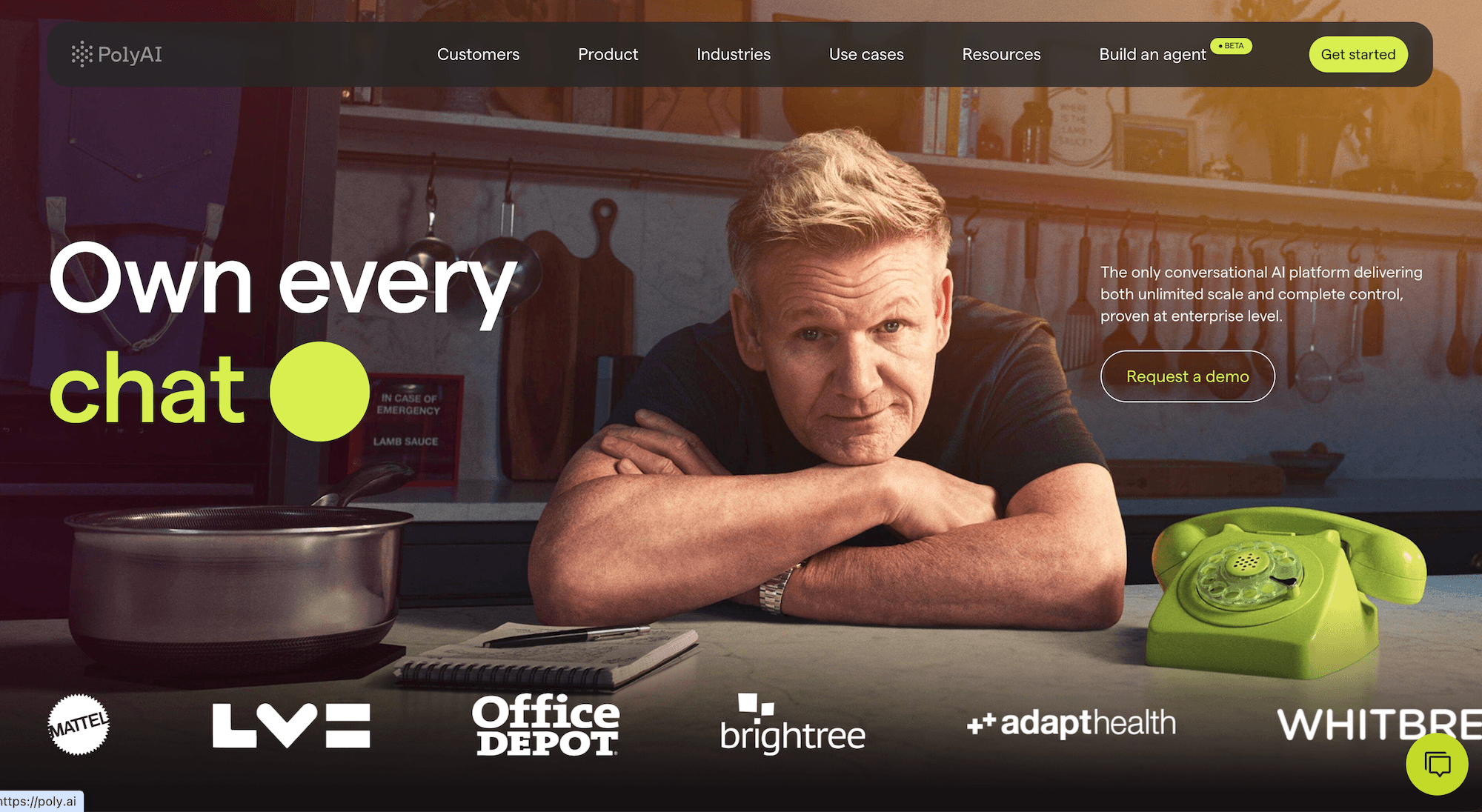
PolyAI builds enterprise voice assistants for large contact centers. Their client roster includes Marriott, Caesars Entertainment, Holiday Inn, FedEx, and Foot Locker. That's 2,000+ live deployments across 45 languages and 25+ countries.
Where Retell is built for developers and fast deployment, PolyAI is built for scale and enterprise quality. A Forrester TEI study found 391% ROI for PolyAI customers, averaging $10.3M in savings. In December 2025, they raised an $86M Series D backed by NVIDIA's VC arm and Khosla Ventures.
But PolyAI is enterprise-only. There's no self-serve path and no accessible pricing for SMBs or mid-market buyers. That's where Retell has a clear edge.
Key features
-
Enterprise voice assistants for large contact centers
-
2,000+ live deployments across 45 languages and 25+ countries
-
Forrester-verified 391% ROI, averaging $10.3M in savings per customer
-
NVIDIA-backed infrastructure credibility
-
Deep experience in hospitality, retail, financial services, utilities, and healthcare
Pricing
Enterprise custom. Not publicly listed. Contact PolyAI directly for enterprise pricing and implementation scope.
Pros & cons
Pros:
-
Proven enterprise scale with 2,000+ live deployments globally
-
Strong hospitality client roster: Marriott, Caesars Entertainment, Holiday Inn
-
Forrester-verified ROI — credible, audited proof of revenue impact
-
$200M+ raised; NVIDIA backing adds AI infrastructure legitimacy
-
45 languages and 25+ countries for global enterprise buyers
Cons:
-
Enterprise-only — no accessible path for SMBs or mid-market operators
-
Long implementation cycles and opaque custom pricing
-
Contact center framing, not revenue-critical inbound execution framing
-
No developer self-serve tier
Customers
PolyAI clients include Marriott, Caesars Entertainment, Foot Locker, PG&E, UniCredit, FedEx, and Holiday Inn. The Forrester TEI study across these enterprise accounts found an average of $10.3M in savings per customer. Over 100 enterprise clients use PolyAI across 2,000+ live deployments globally.
4. Synthflow: No-code voice AI for non-technical teams
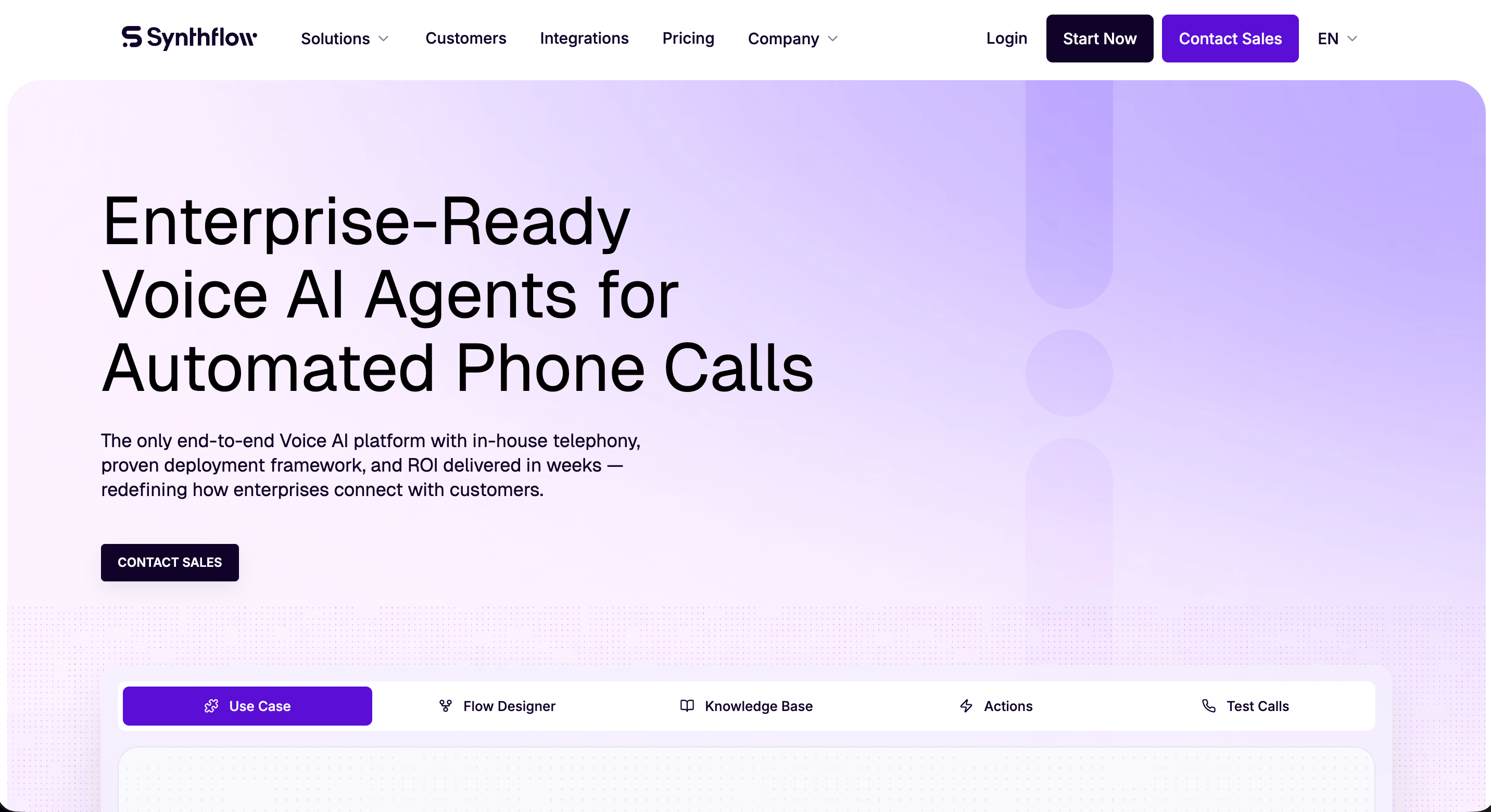
Synthflow takes the opposite approach from Retell. Where Retell targets developers, Synthflow lets non-technical business owners build AI phone agents without code. That's the core value proposition — and it's a real one.
In June 2025, Synthflow raised a $20M Series A to push toward enterprise. Pricing is pay-as-you-go: $0.09/min for voice plus $0.02/min for LLM. Optional add-ons like performance routing and low latency edge push the real cost higher.
The trade-off is depth. No-code platforms sacrifice execution control, observability, and reliability engineering. If your inbound is revenue-critical, that gap shows at production volume.
Key features
-
No-code builder — phone agents without any development work
-
Pay-as-you-go pricing ($0.09/min voice + $0.02/min LLM)
-
Optional add-ons: performance routing ($0.04/min) and low latency edge ($0.04/min)
-
Agency reseller model with white-label options
-
Enterprise push backed by $20M Series A (June 2025)
Pricing
$0.09/min voice + $0.02/min LLM. Optional add-ons cost extra. No fixed monthly floor.
Pros & cons
Pros:
-
No developer required — genuinely accessible to non-technical buyers
-
Fast time-to-demo for agencies and SMBs
-
Per-minute pricing removes SaaS lock-in at low volumes
-
$20M Series A adds enterprise credibility and roadmap stability
-
Agency reseller model creates broad distribution
Cons:
-
No execution control or observability by default
-
Per-minute pricing becomes expensive at scale with add-ons
-
No operational or hospitality depth
-
Built for speed and demos, not production revenue systems
Customers
Synthflow targets non-technical business owners and agencies building voice solutions. Their agency reseller model has created broad distribution across SMB buyers. The $20M Series A signals a push toward larger enterprise accounts.
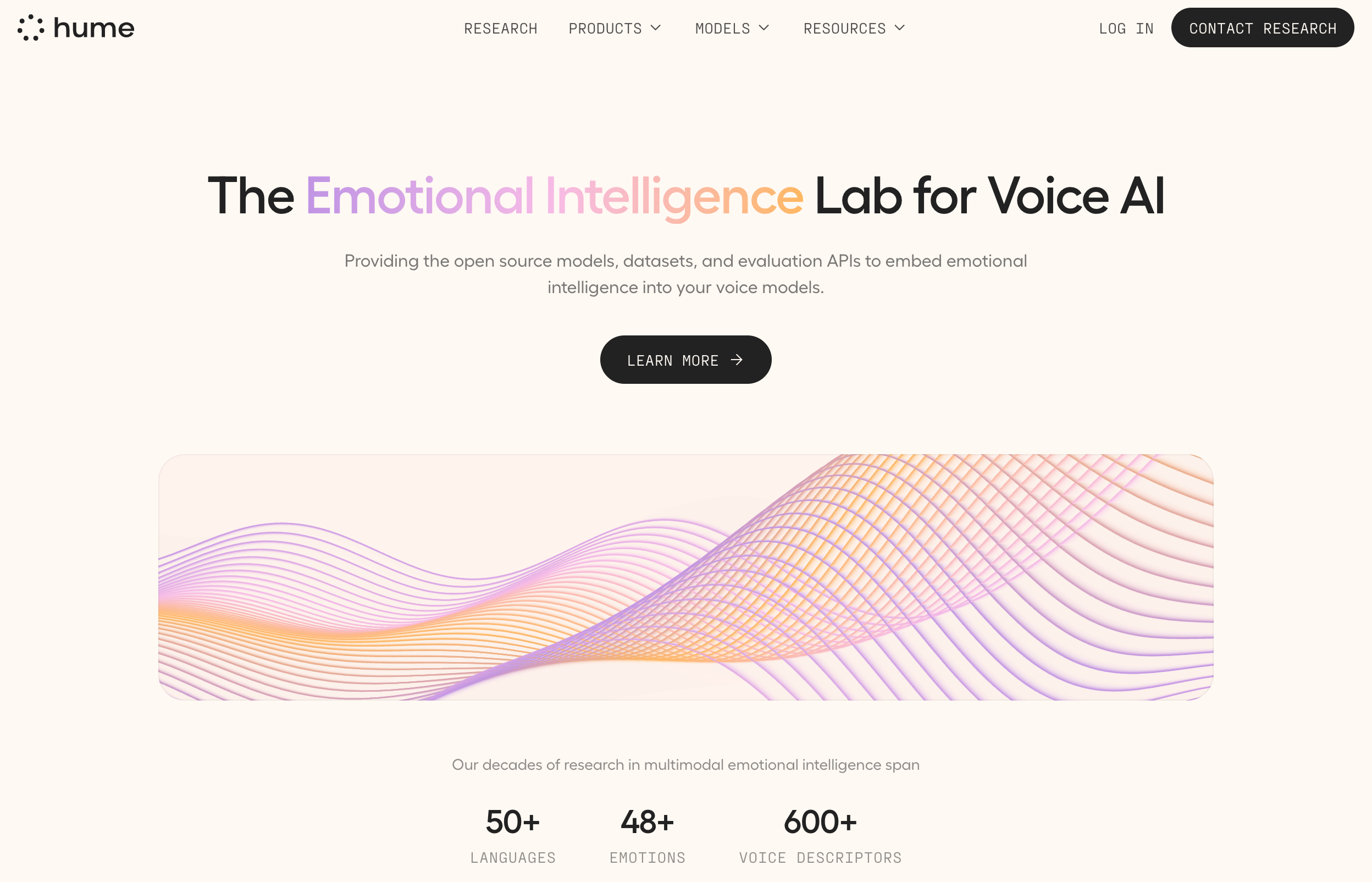
5. Hume AI: Empathic voice AI for emotionally intelligent conversations
Hume AI takes a fundamentally different approach to voice. Most voice AI platforms optimize for what's said. Hume optimizes for how it's said — measuring emotional expression to build more empathic interactions.
Their product is EVI: the Empathic Voice Interface. It's a developer API that adapts responses to the emotional state of the caller. Founder Alan Cowen is a computational emotion scientist who spent years researching emotion at Google.
For most business inbound use cases, Hume is specialized rather than generalist. It suits teams building voice applications where emotional resonance matters — healthcare, mental health, and wellness. It's not designed for structured qualification workflows or production inbound routing.
Key features
-
EVI (Empathic Voice Interface): developer API for emotionally intelligent voice
-
Tracks emotional expression across multiple dimensions in voice
-
Adapts AI responses based on the caller's detected emotional state
-
Low-latency voice interactions with emotional awareness baked in
-
Free tier available for developers to experiment
Pricing
Free tier: $0/month — includes 5 EVI minutes. Plans run $3–$500/month; EVI rates range from $0.07/min (Starter) down to $0.04/min (Business). Enterprise pricing is custom.
Pros & cons
Pros:
-
Unique emotional intelligence layer not available on any other voice platform
-
Built on academic research in computational emotion science
-
Free tier lowers the barrier for developers to test and integrate
-
Strong differentiation for healthcare, wellness, and empathy-driven use cases
-
Developer API with clear documentation
Cons:
-
Not designed for structured business inbound qualification or call routing
-
Specialized use case — not a generalist voice AI platform
-
Less proven at production business inbound scale
-
No done-for-you deployment option
Customers
Hume AI's EVI is used by developers building emotionally aware voice applications across healthcare, mental health, and consumer tech. The company raised Series B funding in 2024, signaling investor confidence in the emotional AI category. Hume's research-backed approach appeals to teams where conversation quality matters beyond task completion.
Frequently asked questions
Why look for a Retell AI alternative in the first place?
Retell AI is built for developers who want to deploy voice agents fast. It's a strong platform for technical teams. But businesses without developers — or those that need enterprise scale or a done-for-you system — will find it isn't the right fit.
Which alternative is best for non-technical teams?
Synthflow is the most accessible no-code option — no developer required, fast setup. For businesses that need production-grade reliability with no building at all, Voicetta is the stronger choice. Synthflow gets you to a demo fast; Voicetta gets you to production.
What's the difference between Retell AI and Bland AI?
Both are developer-first platforms for building AI phone agents. Retell offers a visual workflow builder and faster multi-channel deployment. Bland AI is API-first and historically stronger for outbound calling. The choice often comes down to how your team prefers to configure: visual flow or API calls.
Which option is best for hospitality and real estate?
Voicetta was built from a hospitality foundation — Rafał Florek operated hotels before building the product. For operators that need structured qualification, CRM integration, and consistent inbound handling, it's the most purpose-built option. PolyAI has strong hospitality enterprise credentials, but only serves large enterprises.
What should I look for in a production voice AI system?
Start with reliability: does the platform handle retries, failures, and edge cases — or does it break under real call volume? Then look at observability: can you see what happened on any given call and why? Third: does the vendor understand your industry and how conversations actually work?
Voice quality matters less than most buyers think. Operational consistency matters more.
How is Hume AI different from the other options on this list?
Every other platform on this list optimizes for task completion — qualification, booking, routing. Hume AI optimizes for emotional resonance. It tracks how a caller is feeling and adapts responses accordingly.
That makes it the right tool for healthcare, mental health, and wellness — not for standard business inbound routing.
Conclusion: Choose by depth, not by deployment speed
For developers who want API control over every layer of their voice stack, Bland AI is Retell's most direct competitor. Both are technical platforms — the choice comes down to API-first versus flow-builder preferences.
For non-technical buyers who need a quick path to AI phone agents, Synthflow removes the coding barrier entirely. Expect to trade operational depth for speed.
For large enterprises running contact centers, PolyAI has the strongest hospitality credentials and the most credible ROI data in the category.
For businesses where emotional resonance matters, Hume AI's EVI offers something no other platform on this list provides. It's a niche fit — but the right one for the right use case.
For SMBs, hospitality operators, and real estate teams, Voicetta is the only done-for-you system built from an operational foundation. Bad calls cost money. If you want to fix them, start with Voicetta.
Was this useful?
If this article helped, add Voicetta as a preferred source in Google Search. Your results can then highlight our writing.
Add as preferred source