
Blog
7 Conversational AI Examples You Need to See in 2025
This listicle delivers practical insights into seven compelling conversational AI examples. We'll dissect their success, revealing tactical applications and actionabl...
The Conversational AI Revolution: Transforming Businesses
This listicle delivers practical insights into seven compelling conversational AI examples. We'll dissect their success, revealing tactical applications and actionable takeaways for your business. Discover how these real-world deployments improve customer experience, streamline operations, and boost efficiency. Understand the why behind their effectiveness and replicate their strategies.
This matters because conversational AI is reshaping how businesses interact with customers and operate internally. From personalized support to automated workflows, these examples demonstrate the power of effective conversational AI. This isn't just a list; it's a strategic guide to implementing these technologies in your organization.
We'll explore diverse conversational AI examples like chatbots, virtual assistants, and AI-powered platforms across various industries. Learn how these tools are changing the game, and discover specific tactics you can adapt. This article dives deep into:
- Amazon Alexa
- Google Assistant
- Apple Siri
- Microsoft Cortana
- IBM Watson Assistant
- OpenAI ChatGPT
- Facebook Messenger Bot Platform
Get ready to unlock the potential of conversational AI.
1. Amazon Alexa
Amazon Alexa, Amazon's cloud-based voice service, stands as a pioneering example of conversational AI's potential. Leveraging natural language processing (NLP) and machine learning, Alexa interprets voice commands, answers questions, plays music, and controls smart home devices. Its open platform fosters a vast ecosystem of third-party "skills," expanding Alexa's functionality to thousands of tasks, from ordering groceries to providing medical reminders. This versatility has cemented Alexa's position as a leading conversational AI solution across various sectors.
How Alexa Works and Why It's Effective
Alexa's effectiveness stems from its ability to seamlessly integrate into daily life. A user simply speaks a command, which is then transmitted to Amazon's servers. Here, sophisticated algorithms process the audio, decipher the intent, and execute the corresponding action. This process happens in near real-time, creating a natural and intuitive user experience. The vast library of skills further amplifies Alexa's utility, making it a truly personalized and adaptable AI assistant.
Real-World Applications of Alexa
The versatility of Alexa has led to diverse applications across multiple industries. In the hospitality sector, hotels leverage Alexa for Business to enhance guest experiences, enabling voice-controlled room services and providing information about local attractions. Hospitals are implementing Alexa for hands-free operations, allowing medical professionals to access patient records and operate equipment without physical contact, promoting hygiene and efficiency. Furthermore, senior living facilities are utilizing Alexa for medication reminders and communication with family members, promoting independence and safety. Even the automotive industry has embraced Alexa, with integrations in vehicles from BMW and Ford providing voice-controlled navigation, entertainment, and communication.
Actionable Tips for Implementing Alexa
Businesses looking to implement Alexa can benefit from several strategic considerations. First, prioritize security by enabling voice purchasing restrictions and regularly reviewing and deleting voice recordings. Maximize efficiency by using routines to automate multiple actions with single commands. Tailor the Alexa experience by exploring skills relevant to specific business needs. Finally, optimize device placement by positioning them away from speakers to avoid interference.
The infographic below visualizes key data points demonstrating the widespread adoption and extensibility of Amazon Alexa.
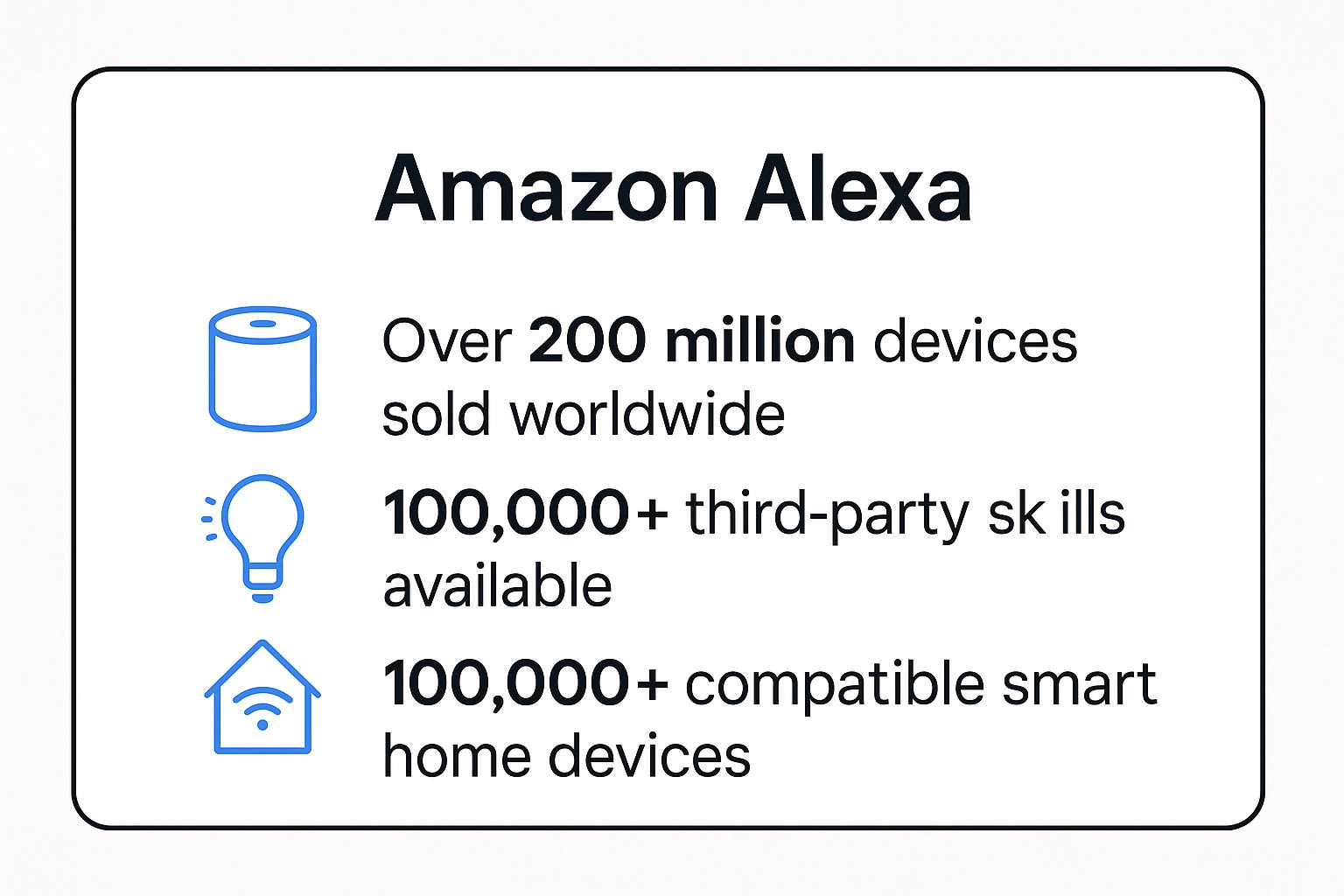
These statistics highlight not only the market penetration of Alexa devices but also the vibrant ecosystem surrounding them, indicating significant opportunities for businesses to integrate and leverage this technology.
Key Takeaways: The Power of Voice
- Widespread Adoption: Millions of Alexa devices are actively used, showcasing consumer trust and integration into everyday life.
- Extensive Ecosystem: The vast number of skills and compatible devices provides unparalleled customization and flexibility.
- Cross-Industry Applicability: Alexa's use cases span various sectors, demonstrating its adaptable nature.
These key takeaways underscore Alexa's potential as a powerful tool for businesses seeking to enhance customer experience and streamline operations. For a deeper dive into the world of voice AI and its applications, Learn more about Amazon Alexa.
Alexa’s success is a testament to the power of conversational AI to transform how we interact with technology. Its widespread adoption across consumer and business applications continues to pave the way for further innovation in the field. From enhancing customer service to revolutionizing healthcare, Alexa demonstrates the real-world impact of conversational AI, making it a worthy inclusion in this list of leading examples.
2. Google Assistant
Google Assistant, Google's AI-powered virtual assistant, exemplifies the power of conversational AI through its natural language processing capabilities. Engaging in two-way conversations, it seamlessly integrates across smartphones, smart speakers, displays, and more. Leveraging Google's vast knowledge graph and search capabilities, Assistant provides contextual responses and executes complex tasks, making it a ubiquitous presence in the digital landscape. Its ability to understand and respond to nuanced queries sets it apart as a leading conversational AI solution.

How Google Assistant Works and Why It's Effective
Google Assistant's effectiveness lies in its sophisticated understanding of natural language. User queries, whether voice or text-based, are processed through advanced algorithms. These algorithms decipher the intent behind the query, leveraging Google's immense knowledge base to generate relevant and contextual responses. This process, happening in near real-time, allows for dynamic and engaging interactions. Its integration across various devices further enhances its accessibility and utility.
Real-World Applications of Google Assistant
Google Assistant's versatility has spawned diverse applications across multiple industries. Restaurants utilize Duplex, a feature of Assistant, to automate reservation bookings, streamlining operations and enhancing customer experience. Retail stores are implementing Assistant for customer service, providing instant product information and support. In healthcare, voice commands facilitate hands-free access to patient data, improving efficiency and hygiene. Automotive integrations in Toyota and Volvo vehicles provide voice-controlled navigation and entertainment. These examples highlight Assistant's adaptability and potential across sectors.
Actionable Tips for Implementing Google Assistant
Businesses looking to leverage Google Assistant can benefit from several strategic considerations. Adjust the "Hey Google" sensitivity in noisy environments to improve accuracy. Set up Voice Match for personalized responses, tailoring the experience to individual users. Utilize interpreter mode for real-time translation, facilitating communication across language barriers. Connect calendar and email for proactive suggestions and reminders, enhancing productivity. Explore Actions on Google to extend functionality and customize Assistant to specific business needs. Learn more about Google Assistant and how it can automate customer support.
Key Takeaways: Contextual Power
- Contextual Understanding: Google Assistant's ability to understand context makes interactions more natural and effective.
- Cross-Platform Integration: Seamless integration across devices enhances accessibility and user experience.
- Industry Agnostic: Its adaptability across various sectors highlights its potential for diverse applications.
These key takeaways demonstrate Google Assistant's strength as a conversational AI solution, empowering businesses to enhance customer interactions and streamline operations. Its ability to understand and respond to complex queries in context positions it as a valuable asset in today's increasingly digital world. Google Assistant's continuous evolution ensures its relevance in the ever-changing landscape of conversational AI.
3. Apple Siri
Apple Siri, a deeply integrated intelligent personal assistant within the Apple ecosystem, exemplifies the power of conversational AI in our daily lives. Leveraging voice queries and a natural language user interface, Siri responds to questions, offers recommendations, and performs actions. Its emphasis on on-device processing for enhanced privacy sets it apart while providing personalized assistance across all Apple devices. This seamless integration and privacy focus contribute to Siri's unique position in the conversational AI landscape.
How Siri Works and Why It's Effective
Siri's effectiveness stems from its tight integration with Apple hardware and software. A user initiates interaction through voice or text, which is then processed either on the device itself or, for more complex tasks, on Apple's servers. Advanced natural language processing (NLP) and machine learning algorithms interpret user intent and trigger appropriate responses, ranging from setting reminders to controlling smart home devices. This blend of on-device and cloud processing optimizes both speed and privacy, creating a user-friendly and secure experience.
Real-World Applications of Siri
Siri’s versatility has led to its adoption across diverse industries. Healthcare systems leverage Siri for hands-free access to patient records, boosting efficiency and hygiene. Educational institutions use Siri for enhanced accessibility, allowing students with disabilities to interact with technology more easily. Enterprise users create custom Shortcuts for workflow automation, streamlining tasks and increasing productivity. Furthermore, Siri’s integration with CarPlay enhances the driving experience through voice-controlled navigation, entertainment, and communication.
Actionable Tips for Implementing Siri
Individuals and businesses can maximize Siri's potential by following a few key tips. Create custom Shortcuts for frequently used tasks to automate complex actions with simple voice commands. Explore Siri Suggestions to discover new capabilities and personalize the experience. Enable "Hey Siri" on multiple devices for convenient, hands-free access. Utilize "Type to Siri" in quiet environments or for discreet interaction. Finally, explore the accessibility features, such as Voice Control, to further personalize and enhance usability.
Key Takeaways: The Power of Personalized Assistance
- Privacy Focus: On-device processing prioritizes user data security and builds trust.
- Seamless Integration: Siri’s deep integration within the Apple ecosystem provides a unified and consistent experience.
- Customization and Automation: Shortcuts empower users to personalize and automate tasks for increased efficiency.
These key takeaways highlight Siri's strengths as a personalized and efficient AI assistant. Its focus on privacy, coupled with its deep integration within the Apple ecosystem, solidifies its position as a leading example of conversational AI, demonstrating its practical application across diverse settings. For more information on Apple Siri and its capabilities, visit Apple's Siri page.
Siri’s continued evolution and expansion across Apple devices demonstrate the growing impact of conversational AI in our daily lives. Its ability to streamline tasks, provide information, and enhance accessibility underscores its value across various sectors. From personal assistance to enterprise solutions, Siri offers a glimpse into the future of human-computer interaction, making it a significant inclusion in this list of conversational AI examples.
4. Microsoft Cortana
Microsoft Cortana, initially conceived as a consumer-facing virtual assistant, has strategically evolved into a powerful productivity tool for businesses. Leveraging its deep integration with Microsoft 365, Cortana now provides AI-powered assistance for tasks ranging from scheduling meetings and setting reminders to transcribing conversations and managing emails. This shift in focus underscores Microsoft's commitment to empowering enterprise users with intelligent solutions.
How Cortana Works and Why It's Effective
Cortana's effectiveness lies in its seamless integration within the Microsoft ecosystem. It harnesses natural language processing (NLP) to understand user voice commands and text queries, extracting intent and executing corresponding actions. This integration with Microsoft 365 allows Cortana to access and process data from various applications, providing contextualized and relevant information to the user. The ability to automate repetitive tasks and streamline workflows significantly enhances productivity, making Cortana a valuable asset for businesses.
Real-World Applications of Cortana
Cortana's enterprise focus has yielded practical applications across diverse industries. Fortune 500 companies utilize Cortana for meeting management, optimizing scheduling and resource allocation. Healthcare organizations leverage its voice-to-text capabilities for efficient documentation, freeing up medical professionals to focus on patient care. Educational institutions employ Cortana for scheduling and reminders, streamlining administrative tasks. Remote teams benefit from its productivity tracking features, enhancing collaboration and communication.
Actionable Tips for Implementing Cortana
Businesses seeking to integrate Cortana can maximize its potential by following these tips. Connect all Microsoft 365 services to unlock full functionality and data integration. Utilize briefing emails for daily productivity insights, helping employees prioritize tasks and manage their time effectively. Set up recurring reminders for important deadlines and meetings, ensuring timely completion. Leverage meeting transcription for accurate and comprehensive note-taking, improving meeting outcomes. Explore the Cortana Skills Kit to develop custom applications tailored to specific business needs.
Key Takeaways: The Power of Productivity
- Deep Microsoft Integration: Cortana's tight integration with Microsoft 365 offers seamless access to data and applications.
- Enterprise-Grade Focus: The shift towards business applications demonstrates Cortana's value as a productivity tool.
- Customizable Solutions: The Cortana Skills Kit enables businesses to create tailor-made solutions.
These key takeaways highlight Cortana's potential as a powerful asset for organizations seeking to enhance workplace productivity and efficiency. For businesses seeking to leverage the power of conversational AI within the Microsoft ecosystem, exploring Cortana's capabilities offers a compelling solution. While Cortana’s consumer presence may have diminished, its enterprise potential is steadily growing, shaping it into a valuable tool for the future of work. Its integration with existing workflows and the potential for customization makes it a unique and powerful player in the conversational AI space.
5. IBM Watson Assistant
IBM Watson Assistant represents a robust, enterprise-grade conversational AI platform. It empowers businesses to construct and deploy AI-powered virtual assistants across a multitude of channels. Leveraging advanced natural language processing (NLP), machine learning, and dialog management, Watson Assistant crafts sophisticated conversational experiences. These experiences cater to customer service, support, and various business applications. Its strength lies in its ability to handle complex dialogues and integrate with backend systems, making it a valuable tool for businesses seeking scalable and intelligent automation.
How Watson Assistant Works and Why It's Effective
Watson Assistant's effectiveness lies in its sophisticated architecture. It combines NLP to understand user input, machine learning to improve its responses over time, and dialog management to maintain context and guide conversations. This integrated approach enables Watson to handle complex queries, personalize interactions, and seamlessly integrate with existing business processes. Unlike simpler chatbot solutions, Watson Assistant can understand the nuances of human language, making conversations more natural and efficient. This nuanced understanding improves customer satisfaction and reduces the workload on human agents.
Real-World Applications of Watson Assistant
Watson Assistant has found diverse applications across numerous industries. Banking institutions leverage its capabilities for customer service chatbots, handling routine inquiries and providing personalized financial advice. Healthcare providers implement symptom checkers powered by Watson Assistant, offering preliminary diagnoses and guiding patients to appropriate medical resources. In retail, virtual shopping assistants built with Watson personalize the shopping experience, offering product recommendations and answering customer questions. Telecommunications companies utilize Watson Assistant to automate technical support, resolving common issues and escalating complex problems to human agents.
Actionable Tips for Implementing Watson Assistant
Businesses seeking to implement Watson Assistant should consider these key strategies. Start with pre-built industry templates to accelerate development. Invest in proper training data preparation to ensure accurate and relevant responses. Use analytics to continuously monitor and improve the assistant's performance. Implement a gradual rollout for thorough testing and refinement. Leverage IBM Cloud services for seamless integration with existing systems.
Key Takeaways: The Power of Enterprise-Grade Conversational AI
- Scalability and Integration: Watson Assistant can handle high volumes of interactions and integrate seamlessly with existing business systems.
- Advanced NLP and Dialog Management: The platform's sophisticated understanding of human language and context leads to more effective and natural conversations.
- Cross-Industry Applicability: From banking to healthcare, Watson Assistant demonstrates its versatility across various sectors.
These key takeaways highlight Watson Assistant's value as a powerful tool for businesses aiming to automate customer interactions, improve operational efficiency, and enhance customer experiences. For more information, visit the IBM Watson Assistant website.
Watson Assistant's strength in handling complex dialogues and its seamless integration with backend systems makes it a valuable asset for businesses seeking scalable and intelligent automation. It is a prime example of how conversational AI can be utilized to not just answer simple queries, but to truly understand and address complex customer needs. This capability makes it a compelling choice for businesses seeking to transform their customer service and operational processes.
6. OpenAI ChatGPT
OpenAI's ChatGPT, a conversational AI model built on the GPT architecture, signifies a leap forward in natural language processing. Capable of generating human-like text, ChatGPT excels at engaging in conversations, answering questions, and assisting with a wide range of tasks, from writing and coding to analysis and creative endeavors. Its ability to understand and respond to nuanced prompts has led to its widespread adoption across personal and professional domains, making it a prime example of conversational AI's transformative power.

How ChatGPT Works and Why It's Effective
ChatGPT leverages a transformer-based neural network, trained on a massive dataset of text and code. This allows it to understand context, grammar, and syntax, generating coherent and relevant responses. Its effectiveness lies in its ability to learn patterns and relationships within the data, enabling it to perform a variety of language-based tasks with remarkable accuracy. Furthermore, its adaptability allows users to fine-tune its responses through iterative prompting, making it a truly versatile tool.
Real-World Applications of ChatGPT
ChatGPT's versatility has fueled its adoption across diverse sectors. Educational institutions are exploring its potential for tutoring and personalized learning, providing students with tailored feedback and support. Content creators leverage ChatGPT for generating ideas, drafting articles, and overcoming writer's block. Developers utilize it for code review, debugging, and even generating code snippets. Businesses are integrating ChatGPT into customer support workflows, automating responses to frequently asked questions and freeing up human agents to handle more complex issues. To learn more, Learn more about OpenAI ChatGPT.
Actionable Tips for Implementing ChatGPT
To effectively leverage ChatGPT, consider these practical tips. First, be specific and clear in your prompts, providing context and details to guide the model's responses. Always fact-check any critical information generated by ChatGPT, ensuring accuracy and reliability. Use follow-up questions to refine the output or seek clarification. Experiment with different prompt styles to understand how the model interprets and responds to various phrasings. Finally, explore upgrading to ChatGPT Plus for access to enhanced features like faster response times and priority access to new features.
Key Takeaways: The Power of Conversational AI
- Versatility: ChatGPT excels at diverse tasks, from writing and coding to translation and summarization.
- Adaptability: Its ability to learn and adapt to different prompt styles makes it highly customizable.
- Accessibility: The user-friendly interface makes it accessible to users with varying technical expertise.
These key takeaways highlight ChatGPT's transformative potential across industries. Its ability to automate tasks, enhance productivity, and provide personalized experiences positions it as a valuable asset for businesses and individuals seeking to harness the power of conversational AI.
ChatGPT's emergence signifies a pivotal moment in the evolution of conversational AI. Its ability to understand and generate human-like text has unlocked a world of possibilities, transforming how we interact with technology and paving the way for a future where AI plays an increasingly integral role in our daily lives.
7. Facebook Messenger Bot Platform
Meta's Facebook Messenger Bot Platform represents a powerful example of conversational AI reaching a massive audience. This platform empowers businesses and developers to craft conversational experiences directly within Facebook Messenger, connecting with billions of users globally. By leveraging tools provided by the platform, businesses can build chatbots capable of handling diverse tasks, from customer service and e-commerce transactions to content delivery and interactive experiences. This direct access to a vast user base positions the Messenger Bot Platform as a significant force in conversational AI.
How Messenger Bots Work and Why They're Effective
Messenger bots operate by utilizing natural language processing (NLP) to understand user messages and respond accordingly. Businesses can design conversation flows, incorporating various features like quick replies, buttons, and rich media, to guide users through specific interactions. The platform's integration with Facebook's infrastructure allows for seamless access to user profiles and preferences, enabling personalized experiences. The asynchronous nature of messaging also offers flexibility, allowing users to interact with the bot at their convenience, unlike real-time phone calls. This accessibility and personalization contribute significantly to the effectiveness of Messenger bots.
Real-World Applications of Messenger Bots
The Messenger Bot Platform has found diverse applications across numerous industries. E-commerce brands utilize bots for product recommendations and personalized shopping experiences, boosting sales and customer engagement. News organizations leverage Messenger to deliver curated news updates and engage readers through interactive quizzes and polls. Airlines have implemented bots to streamline booking processes and provide real-time flight updates, enhancing customer service. Even food delivery services utilize Messenger bots for automated order taking and delivery tracking, improving efficiency and customer satisfaction.
Actionable Tips for Implementing Messenger Bots
Businesses seeking to implement Messenger bots can benefit from these key strategies:
- User Experience First: Design conversation flows that are intuitive and user-friendly, focusing on quick replies and a persistent menu for easy navigation.
- Rich Media Engagement: Incorporate images, videos, and other rich media elements to make interactions more engaging and visually appealing.
- Automation for Efficiency: Set up automated responses for frequently asked questions, freeing up human agents to handle more complex inquiries.
- Data-Driven Optimization: Monitor bot analytics to identify areas for improvement and optimize conversation flows based on user behavior.
- Personalization is Key: Leverage user data to personalize interactions and offer tailored recommendations, enhancing customer engagement and loyalty.
Key Takeaways: Reaching Billions
- Massive Reach: Access to billions of Messenger users presents an unparalleled opportunity for businesses to connect with their target audience.
- Personalized Engagement: The platform’s ability to personalize interactions fosters stronger customer relationships and drives conversions.
- Automation and Efficiency: Messenger bots can automate various tasks, streamlining operations and improving customer service efficiency.
These takeaways highlight the potential of the Facebook Messenger Bot Platform as a powerful tool for businesses seeking to leverage conversational AI to enhance customer engagement, streamline operations, and reach a global audience. For businesses seeking to engage with a vast user base through conversational AI, the Facebook Messenger Bot Platform provides a compelling solution. The platform's ability to personalize interactions, automate tasks, and deliver rich experiences positions it as a valuable tool for businesses across various industries.
The platform's widespread adoption and diverse applications solidify its position as a key player in the conversational AI landscape. Its accessibility and potential for deep engagement make it a valuable asset for businesses looking to connect with their audience in a meaningful and impactful way. The Facebook Messenger Bot Platform’s impact on how businesses engage with their customers is undeniable, making it a significant example of conversational AI in action.
Top 7 Conversational AI Platforms Comparison
| Assistant / Platform | Implementation Complexity 🔄 | Resource Requirements ⚡ | Expected Outcomes 📊 | Ideal Use Cases 💡 | Key Advantages ⭐ |
|---|---|---|---|---|---|
| Amazon Alexa | Moderate - Requires device and cloud setup | Moderate - Internet connection, device needed | Reliable smart home control, voice interactions | Smart homes, hospitality, automotive | Extensive device ecosystem, vast skill library |
| Google Assistant | Moderate - Integrated with Google services | Moderate - Google account, internet | Contextual, conversational AI with multi-device sync | Smartphones, smart displays, automotive | Superior language understanding, Google ecosystem |
| Apple Siri | Low to moderate - Apple ecosystem dependent | Low - Works offline for basic tasks | Privacy-focused, personalized assistance | Apple device users, privacy-sensitive environments | Strong privacy, seamless Apple integration |
| Microsoft Cortana | Moderate - Enterprise focus, Microsoft 365 integration | Moderate - Requires Microsoft 365 subscription | Enhanced productivity, meeting & task management | Enterprise productivity, business applications | Deep Office 365 integration, security |
| IBM Watson Assistant | High - Complex setup and customization | High - Technical expertise, enterprise hardware | Sophisticated conversational AI, analytics | Enterprise customer service, business solutions | Enterprise-grade scalability, analytics |
| OpenAI ChatGPT | Low - API or web interface available | Moderate - Internet connection required | Human-like conversational AI, creative & analytical assistance | Education, content creation, coding help | Exceptional conversational quality, multi-domain knowledge |
| Facebook Messenger Bot Platform | Moderate - Requires Facebook business setup | Low to moderate - Facebook platform reliance | Customer engagement via Messenger, e-commerce support | E-commerce, media, customer support | Massive user base, rich interactive features |
The Future of Conversational AI: Limitless Possibilities
Throughout this exploration of conversational AI examples, we've witnessed a paradigm shift in how businesses interact with their customers and manage internal operations. From the ubiquitous virtual assistants like Amazon Alexa and Google Assistant to specialized solutions like IBM Watson Assistant powering complex enterprise workflows, the impact is undeniable. These examples reveal a common thread: strategic implementation of conversational AI enhances efficiency, improves customer experiences, and unlocks new avenues for growth.
Key Takeaways and Actionable Insights
The success stories analyzed highlight several key takeaways. Personalization is paramount. Conversational AI thrives when it caters to individual user needs and preferences, as demonstrated by OpenAI's ChatGPT and its ability to generate tailored responses. Contextual awareness is equally crucial. Whether it's Siri understanding the nuances of a user's request or a Facebook Messenger bot guiding a customer through a purchase, understanding the context elevates the interaction.
Another critical factor is seamless integration. Think about how effortlessly conversational AI tools like Microsoft Cortana weave themselves into existing systems, enhancing productivity without disruption. This seamless integration should be a core consideration for any business exploring conversational AI implementation.
Here's a breakdown of actionable strategies based on these examples:
- Focus on User Needs: Before implementing any conversational AI solution, clearly define the specific user needs it will address.
- Prioritize Personalization: Tailor responses and interactions to individual users based on their preferences, history, and context.
- Ensure Seamless Integration: Choose conversational AI tools that seamlessly integrate with existing platforms and workflows.
- Continuously Iterate and Improve: Conversational AI is not a set-it-and-forget-it solution. Regularly analyze data, gather user feedback, and refine the system for optimal performance.
The Value of Mastering Conversational AI
The benefits of mastering these concepts are multifaceted. For customer support managers, conversational AI offers a chance to deliver 24/7 support, handle routine queries efficiently, and free up human agents to address complex issues. Hospitality professionals can leverage conversational AI to enhance guest experiences, streamline booking processes, and personalize recommendations. In real estate, AI-powered chatbots can qualify leads, schedule viewings, and provide instant property information.
Healthcare providers can utilize conversational AI for appointment scheduling, medication reminders, and preliminary symptom checking. Enterprise IT managers can automate tasks, streamline workflows, and enhance internal communication through intelligent chatbots. The potential impact of conversational AI transcends individual roles and sectors, offering transformative possibilities for businesses of all sizes.
Embracing the Future of Interaction
As conversational AI technology continues to advance, we can expect even more sophisticated and personalized interactions. Imagine AI-powered virtual assistants that anticipate our needs, proactively offer solutions, and seamlessly connect us with the information and services we require. This future is not a distant dream; it's rapidly becoming a reality. Businesses that embrace these advancements will be well-positioned to thrive in the evolving digital landscape, while those who hesitate risk being left behind. The future of customer interaction is here, and it's conversational.
Want to build your own cutting-edge conversational AI solutions? Voicetta empowers you to create custom voice and chatbot experiences that elevate user engagement and streamline operations. Discover the potential of conversational AI with Voicetta today: Voicetta
Was this useful?
If this article helped, add Voicetta as a preferred source in Google Search. Your results can then highlight our writing.
Add as preferred source