

Blog
Top Conversational AI Solutions for 2025
Want to streamline customer support, boost sales, and free up your team? This listicle examines 10 leading conversational AI solutions that can help. Discover how the...
Revolutionizing Customer Interactions with Conversational AI
Want to streamline customer support, boost sales, and free up your team? This listicle examines 10 leading conversational AI solutions that can help. Discover how these platforms, including Voicetta, IBM Watson Assistant, and others, automate interactions, personalize customer experiences, and solve the challenge of providing efficient, 24/7 support. Explore the top tools available and find the perfect conversational AI solution for your business needs.
1. Voicetta: Your 24/7 AI-Powered Communication Solution
Voicetta stands out as a leading conversational AI solution, offering a comprehensive platform designed to revolutionize customer interactions. Its primary function is to ensure that no customer communication goes unanswered, regardless of the time of day. By intelligently managing incoming calls and chats 24/7, Voicetta engages customers in natural, human-like conversations, qualifying leads, booking appointments, and seamlessly integrating with existing enterprise tools such as CRM, PMS, ERP, and hundreds of others. This allows businesses to capture missed opportunities, particularly after-hours inquiries, and significantly boost operational efficiency.
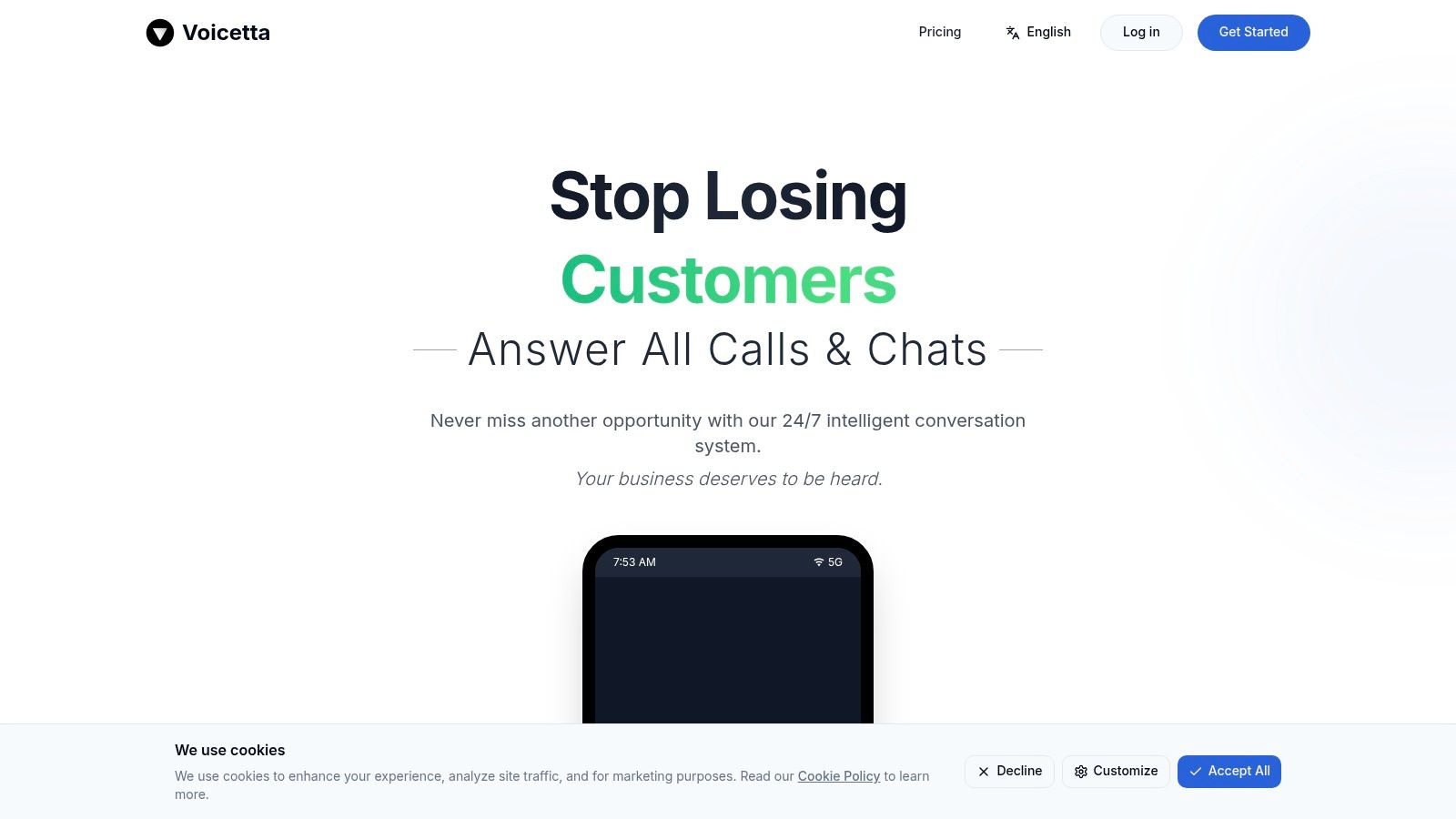
Voicetta's strength lies in its adaptive AI, which continuously learns from each interaction to provide increasingly personalized and relevant communications. This not only improves customer satisfaction by reducing response times but also frees up valuable human resources to focus on complex issues and high-value tasks. Its effectiveness is demonstrated by its widespread adoption across diverse industries, including hospitality, healthcare, and real estate, with testimonials from hotel managers and real estate brokers highlighting its positive impact on lead conversion and operational efficiency. While other conversational AI solutions might offer similar features, Voicetta distinguishes itself through its robust integrations, 24/7 availability, and focus on enhancing, rather than replacing, human connection. This makes it an ideal solution for businesses seeking to improve customer engagement and streamline operations.
Features and Benefits:
- 24/7 Availability: Handles customer interactions around the clock, capturing leads and providing support even outside of business hours.
- Seamless Integrations: Connects with a wide range of enterprise systems, including CRM, PMS, and ERP, for streamlined data flow and enhanced productivity.
- Adaptive AI: Continuously learns and improves its conversational abilities, delivering personalized and relevant interactions.
- Reduced Response Times: Efficiently handles routine inquiries, minimizing wait times and improving customer satisfaction.
- Improved Operational Efficiency: Automates routine tasks, freeing up human agents to focus on more strategic activities.
- Increased Lead Conversion: Qualifies leads and schedules appointments, maximizing sales opportunities.
Pros:
- 24/7 availability ensures no missed customer interactions, even after hours.
- Seamless integration with major enterprise systems like CRM, PMS, and ERP.
- Adaptive AI that learns from every interaction for more personalized communications.
- Reduces response times and operational costs by efficiently handling routine inquiries.
- Proven real-world impact with measurable improvements in customer satisfaction and lead conversion.
Cons:
- Integration with existing systems might require specialized support during setup.
- While effective for routine inquiries, complex issues still rely heavily on human intervention.
Implementation/Setup Tips:
While Voicetta strives for seamless integration, collaborating closely with their support team during the initial setup is recommended. This ensures proper configuration with existing systems and maximizes the platform's effectiveness. Clear definition of conversational flows and anticipated customer inquiries will further enhance the AI's learning and performance.
(Pricing and technical requirements are not readily available on the website and should be obtained directly from Voicetta.)
Website: https://voicetta.com
Voicetta earns its place on this list because it tackles a crucial challenge for many businesses: providing consistent, high-quality customer service around the clock. Its sophisticated AI, combined with its extensive integration capabilities, makes it a powerful tool for enhancing both customer satisfaction and operational efficiency. By automating routine tasks and ensuring 24/7 availability, Voicetta empowers businesses to focus on growth and strategic initiatives.
2. IBM Watson Assistant
IBM Watson Assistant is a powerful conversational AI solution designed for enterprises seeking to build and deploy sophisticated virtual assistants. This platform goes beyond basic chatbot functionality by combining conversational AI with generative AI capabilities, powered by IBM watsonx. This allows businesses to create engaging and informative customer experiences across a wide range of channels, from web and mobile apps to messaging platforms and even interactive voice response systems. It's particularly well-suited for organizations with complex customer service needs, intricate internal processes, or stringent security requirements. This makes it an ideal conversational AI solution for industries like healthcare, finance, and telecommunications.
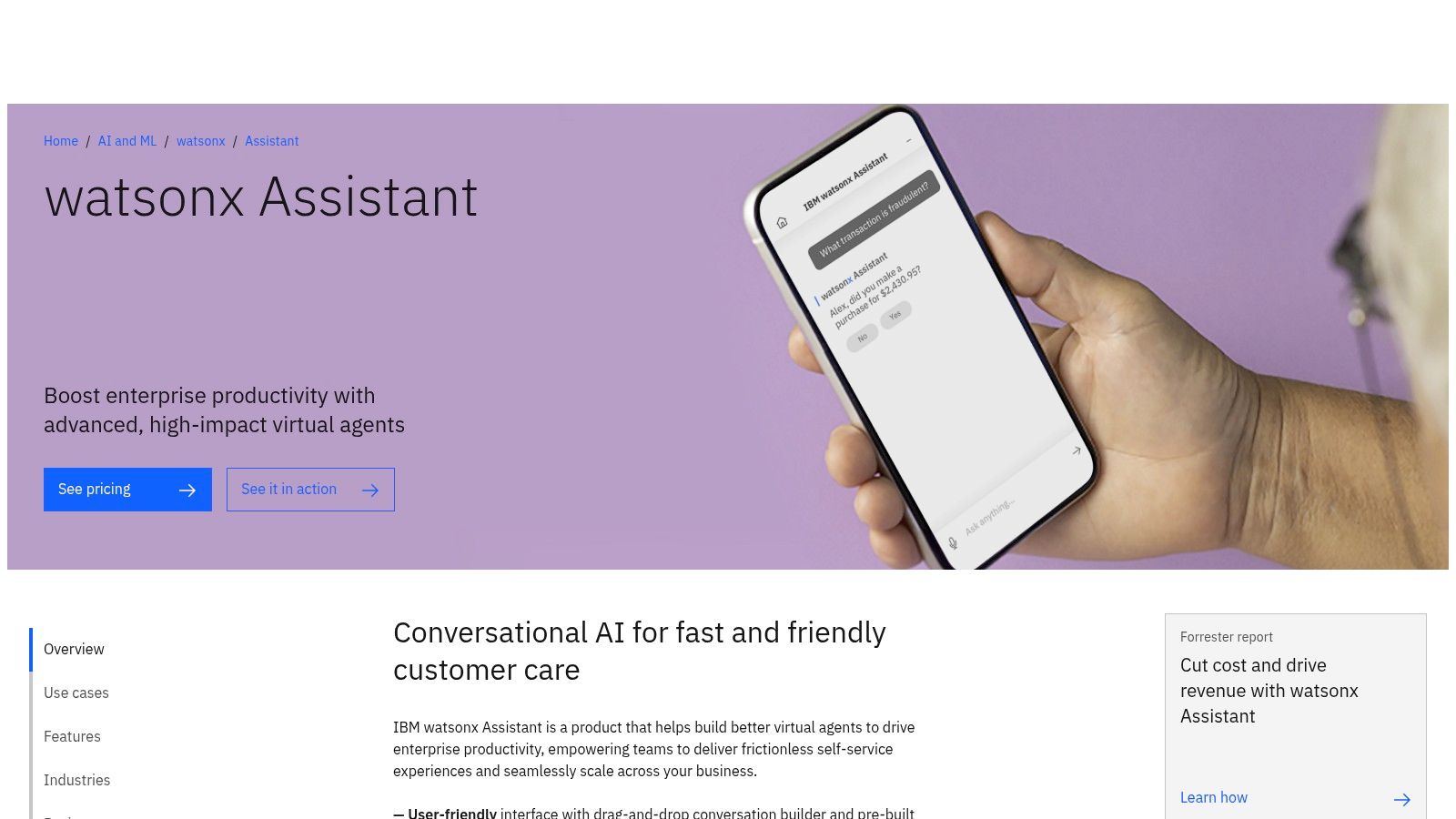
Watson Assistant’s robust intent recognition system, fueled by advanced natural language understanding and machine learning, ensures that the virtual assistant accurately interprets customer queries, even complex or nuanced ones. Its comprehensive knowledge base integration allows businesses to connect the assistant to various data sources, providing customers with accurate and up-to-date information. Furthermore, the integration with IBM watsonx allows for generative AI capabilities, enabling the assistant to create more dynamic and human-like conversations. For example, a customer support agent powered by Watson Assistant can not only answer frequently asked questions but also generate personalized recommendations or proactively offer helpful resources. Learn more about IBM Watson Assistant to understand how these AI communication agents can revolutionize your business.
For customer support managers, Watson Assistant can automate routine inquiries, freeing up human agents to handle more complex issues. Hospitality professionals can use it to manage bookings, answer guest questions, and provide personalized recommendations. Real estate agents can leverage Watson Assistant to qualify leads, schedule showings, and answer property-related questions. In healthcare, it can be used to schedule appointments, provide medication reminders, and answer basic health questions. Enterprise IT managers benefit from its robust security features and integration capabilities. Whether you’re a business owner, CEO, or CTO, IBM Watson Assistant offers a scalable and secure solution to automate customer interactions and improve operational efficiency.
Features:
- Advanced natural language understanding and machine learning capabilities
- Multi-channel deployment (web, mobile, messaging platforms)
- Intent and entity recognition with contextual understanding
- Integration with IBM watsonx for generative AI capabilities
- Enterprise-grade security and compliance
Pros:
- Powerful AI capabilities with deep learning models
- Highly customizable for complex business requirements
- Extensive integration capabilities with existing systems
- Strong analytics and conversation monitoring tools
Cons:
- Relatively higher price point compared to some alternatives
- Steeper learning curve for developers and business users
- Can require significant technical expertise for advanced implementations
While pricing details aren't publicly available, IBM offers various pricing tiers based on usage and features. Technical requirements vary depending on the complexity of the implementation, but generally involve API integrations and some level of developer expertise. Compared to simpler conversational AI solutions, Watson Assistant offers a more powerful and customizable platform, albeit with a higher price point and steeper learning curve.
For implementation, IBM provides comprehensive documentation and support. It's recommended to start with a well-defined scope and pilot project to test and refine the assistant before full-scale deployment. Careful planning and collaboration between technical and business teams are crucial for successful implementation. This ensures that the virtual assistant meets the specific needs of the organization and delivers a positive user experience. Its robust features, combined with enterprise-grade security, position Watson Assistant as a leading choice for organizations seeking advanced conversational AI solutions. Visit the IBM Watson Assistant website for more information.
3. Google Dialogflow: A Robust Conversational AI Solution
Google Dialogflow stands out as a leading conversational AI solution, empowering businesses to build interactive and engaging user experiences across various platforms. From powering customer support chatbots to enabling voice-activated devices, Dialogflow leverages Google's advanced natural language understanding (NLP) to create truly conversational interfaces. This makes it an excellent choice for businesses looking to enhance customer interactions, automate processes, and personalize communication. It's especially relevant for Customer Support Managers, Hospitality Professionals, Real Estate Agents, Healthcare Providers, Enterprise IT Managers, business owners, CEOs, and CTOs seeking efficient and scalable conversational AI solutions.
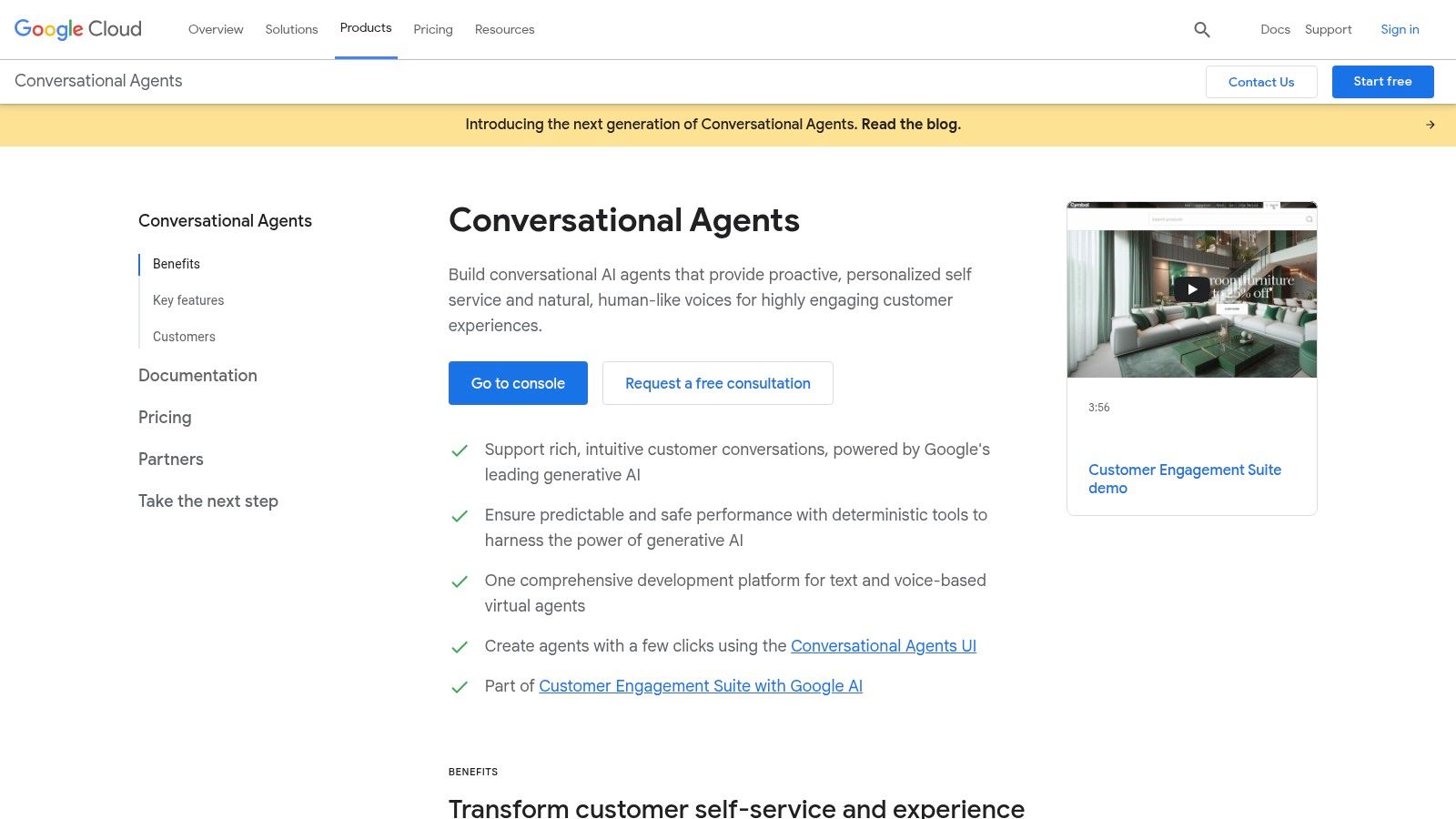
Dialogflow's strength lies in its ability to comprehend and respond to human language nuances, thanks to its machine learning capabilities. This translates into more natural and effective conversations between users and your applications. Pre-built agents and knowledge connectors further simplify the development process, allowing you to quickly deploy conversational AI solutions for common use cases like booking appointments, answering FAQs, or providing product information. Think of a hotel concierge answering guest queries, a real estate chatbot scheduling property viewings, or a healthcare provider offering appointment reminders – all powered by Dialogflow.
Key Features and Benefits:
- Advanced Natural Language Understanding: Powered by Google's sophisticated NLP technology, Dialogflow accurately interprets user intent, even in complex conversations. This ensures that your AI solutions respond appropriately and provide relevant information.
- Multi-Platform and Multi-Language Support: Build conversational experiences for over 20 languages and deploy them across websites, mobile apps, messaging platforms, and voice assistants. This broad reach allows you to connect with a global audience and provide consistent user experiences.
- Intuitive Visual Builder: The user-friendly interface simplifies the design and implementation of conversational flows, even without extensive coding knowledge. This is a major advantage for businesses looking for rapid deployment and iterative development.
- Seamless Integrations: Integrate Dialogflow with various Google Cloud services and third-party platforms, enabling you to connect your conversational AI solutions with existing systems and workflows. This simplifies data exchange and enhances the overall user experience.
Pros and Cons:
- Pros: Powerful language understanding, easy-to-use interface, seamless Google integrations, generous free tier.
- Cons: Advanced features require the higher-cost Dialogflow CX, potential vendor lock-in with the Google ecosystem, some limitations with complex flows in the standard edition.
Pricing and Technical Requirements:
Dialogflow offers a free tier suitable for experimentation and small projects. Paid plans provide access to advanced features, higher usage limits, and enhanced support. Check the official website for the latest pricing details. Technical requirements include a Google Cloud Platform account and basic programming knowledge for advanced integrations.
Implementation Tips:
- Start with a clear definition of your conversational goals and target audience.
- Leverage pre-built agents and templates to accelerate development.
- Thoroughly test your conversational flows to ensure accuracy and user-friendliness.
- Monitor and analyze usage data to continuously optimize your conversational AI solutions.
Comparison with Similar Tools:
While other conversational AI platforms like Amazon Lex and Microsoft Azure Bot Service offer similar functionalities, Dialogflow’s tight integration with Google services, robust NLP capabilities, and user-friendly interface make it a strong contender. The choice ultimately depends on your specific business needs and existing tech stack.
Website: https://cloud.google.com/dialogflow
Dialogflow earns its spot on this list by offering a powerful and versatile platform for building sophisticated conversational AI solutions. Whether you're a large enterprise or a small business, Dialogflow can help you streamline communications, improve customer engagement, and automate key processes, making it a valuable asset in the rapidly evolving landscape of conversational AI.
4. Microsoft Azure Bot Service
Microsoft Azure Bot Service stands as a powerful conversational AI solution, providing a comprehensive environment for developing, deploying, and managing sophisticated bots. This platform empowers businesses to build interactive and intelligent conversational interfaces for a variety of applications, ranging from customer support and lead generation to internal process automation. Its tight integration with Microsoft's broader ecosystem, including the Language Understanding service (LUIS), makes it a particularly compelling choice for organizations already leveraging Azure cloud services. By combining bot development tools with natural language processing capabilities, Azure Bot Service allows businesses to create truly conversational experiences that understand and respond to user intent effectively. This allows companies to streamline operations, enhance customer engagement, and ultimately drive better business outcomes.
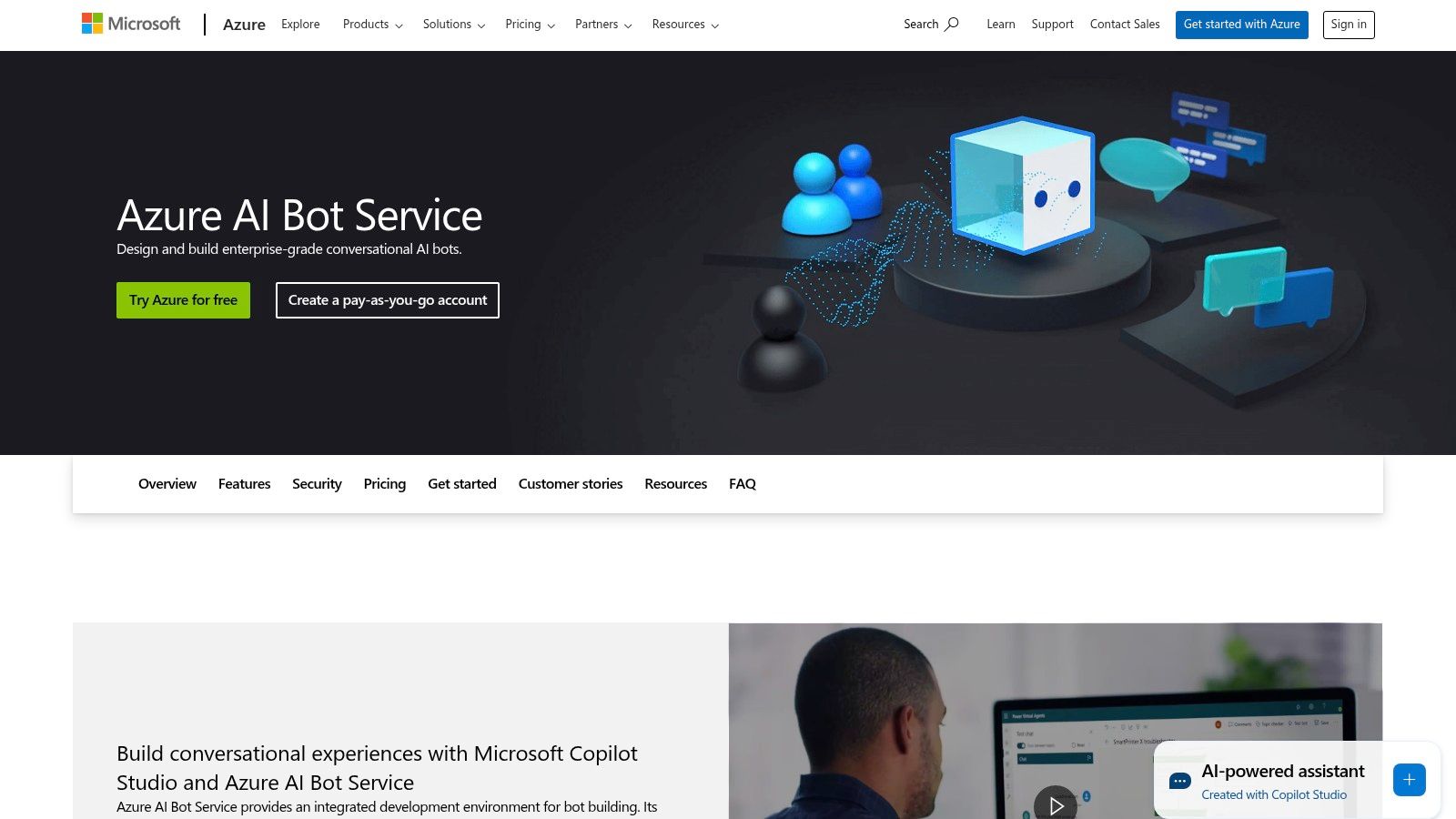
For Customer Support Managers seeking to enhance their support offerings, Azure Bot Service can facilitate the creation of AI-powered chatbots capable of handling routine inquiries, freeing up human agents to focus on more complex issues. In the Hospitality industry, bots built on this platform can personalize guest experiences by providing concierge services, booking management, and real-time support. Real Estate Agents can leverage Azure Bot Service to qualify leads, schedule showings, and answer property-related questions, improving efficiency and responsiveness. Healthcare Providers can deploy bots for appointment scheduling, medication reminders, and preliminary symptom checks, enhancing patient care. Enterprise IT Managers benefit from the platform's robust security features and seamless integration with existing Azure infrastructure. Business owners, CEOs, and CTOs can leverage Azure Bot Service to automate tasks, improve customer engagement, and gain valuable insights into customer interactions.
The Bot Framework SDK offers flexibility for developers, allowing them to build bots using C# or Node.js. The service supports omnichannel deployment, meaning your bot can interact with users across various channels like websites, mobile apps, Microsoft Teams, and other messaging platforms. Built-in analytics and monitoring tools offer valuable data-driven insights into bot performance, enabling continuous improvement. The platform's enterprise-grade security and compliance certifications ensure data protection and adherence to industry regulations.
Features:
- Integration with Microsoft Cognitive Services for advanced NLP capabilities
- Bot Framework SDK for flexible development
- Omnichannel deployment across diverse platforms
- Built-in analytics and monitoring tools
- Enterprise-grade security and compliance
Pros:
- Deep integration with the Microsoft ecosystem
- Robust development framework and documentation
- Strong security and compliance features
- Scalable architecture
Cons:
- Steeper learning curve for developers unfamiliar with Microsoft technologies
- Requires more technical expertise compared to no-code platforms
- Higher cost for advanced features and large-scale deployments
While pricing details are available on the Azure website, they can vary depending on usage and specific features implemented. Generally, costs are associated with compute resources, storage, and the number of messages processed. Technical requirements primarily involve familiarity with Azure cloud services and proficiency in C# or Node.js. For a deeper dive into its potential in automated communication workflows, Learn more about Microsoft Azure Bot Service. Compared to no-code platforms, Azure Bot Service offers greater customization and scalability but demands more technical expertise. It's a robust conversational AI solution well-suited for businesses requiring enterprise-grade features, security, and seamless integration within the Microsoft ecosystem. Its place on this list is well-deserved due to its comprehensive features, robust development tools, and strong security posture.
5. Intercom: A Conversational AI Solution for Enhanced Customer Engagement
Intercom stands out as a robust conversational AI solution, blending chatbots with live chat functionality to streamline customer support and engagement. This platform empowers businesses to automate routine inquiries, freeing up human agents to handle more complex issues. Intercom's strength lies in its ability to create a unified customer experience by seamlessly transitioning between AI-powered interactions and human intervention when necessary, making it an ideal solution for a variety of businesses, from burgeoning startups to established enterprises. This comprehensive approach to customer communication makes it a valuable tool for Customer Support Managers, Hospitality Professionals, Real Estate Agents, Healthcare Providers, Enterprise IT Managers, business owners, CEOs, and CTOs alike.
Intercom offers a suite of features designed to enhance customer interactions. Its AI-powered chatbots can be customized with specific resolution paths, guiding customers towards self-service solutions for common problems. This automation not only improves efficiency but also allows for 24/7 availability. When a situation requires a human touch, the seamless handoff feature ensures a smooth transition to a live agent, maintaining continuity and preventing customer frustration. The integrated customer data platform allows for personalized interactions, enabling businesses to tailor their messaging and offer proactive support. Targeted campaigns and proactive messaging further enhance customer engagement by delivering relevant information and offers. Moreover, Intercom boasts extensive integration capabilities with various CRM, marketing, and support tools, further solidifying its position as a central hub for customer communications. Learn more about Intercom and how it's transforming customer service.
For example, a real estate agent can use Intercom to qualify leads by having the chatbot ask preliminary questions about property preferences and budget. This automation saves the agent valuable time and ensures they focus on leads that are a good fit. Similarly, a healthcare provider can leverage Intercom to answer frequently asked questions about appointment scheduling, billing, and insurance, freeing up staff to handle more critical patient needs. In the hospitality industry, Intercom can be used to manage bookings, answer questions about amenities, and provide concierge-like services, enhancing the guest experience.
While Intercom offers a powerful suite of features, it's essential to consider the potential drawbacks. The platform's pricing can be a barrier, particularly for growing teams. While specific pricing isn't publicly available and requires contacting sales, it is generally considered higher than some competitors. Although its NLP capabilities are robust, they might not be as advanced as dedicated AI platforms specializing solely in natural language processing. Finally, accessing some of the more advanced features requires subscribing to higher-tier plans, which adds to the overall cost.
Pros:
- User-friendly interface requiring minimal technical setup.
- Powerful combination of automated chatbot interactions and human support.
- Strong customer data capabilities for personalized engagement.
- Comprehensive analytics and performance tracking.
Cons:
- Higher price point, especially for scaling teams.
- Less advanced NLP compared to dedicated AI platforms.
- Advanced features often necessitate higher-tier subscriptions.
Intercom's comprehensive approach to conversational AI makes it a deserving contender in this list. By blending AI-powered automation with seamless human handoff, it provides businesses with the tools they need to enhance customer engagement, streamline support processes, and ultimately drive growth. The platform's focus on personalized interactions and extensive integrations further solidifies its position as a valuable asset for businesses looking to elevate their customer communication strategy. You can explore Intercom and its features further on their website: https://www.intercom.com/
6. Drift
Drift positions itself as a conversational marketing and sales platform, leveraging the power of conversational AI to transform website visitors into qualified leads. Its strength lies in its ability to deliver real-time personalization, targeted messaging, and seamless handoffs to sales representatives. This makes Drift a particularly attractive conversational AI solution for B2B companies aiming to accelerate their sales pipeline and boost revenue generation. For businesses focused on quickly converting leads and streamlining their sales process, Drift offers a robust solution.
Drift's key features include conversational AI chatbots specifically designed for lead qualification, real-time personalization based on individual visitor behavior, automated meeting scheduling with calendar integration, account-based marketing capabilities, and crucial integrations with CRM and marketing automation platforms. This integration capability allows Drift to seamlessly fit into existing workflows, making implementation smoother for various teams, from marketing and sales to customer support.
For example, a real estate agent can use Drift to instantly engage website visitors looking at property listings. The chatbot can qualify leads by asking about budget, desired location, and property type. Based on the responses, Drift can automatically schedule a showing or connect the lead directly with the agent. Similarly, a customer support manager in a SaaS company can utilize Drift to answer common questions, troubleshoot basic technical issues, and escalate complex problems to the appropriate support team, improving first response times and customer satisfaction. Enterprise IT managers can leverage Drift’s chatbot to provide instant support to employees, guiding them through common IT issues or directing them to the correct resources, freeing up valuable IT support time.
Pros:
- Strong focus on revenue generation and sales acceleration: Drift’s core strength is converting leads into sales opportunities.
- Intuitive playbook builder for creating conversation flows: Even non-technical users can build complex conversation flows using Drift's drag-and-drop interface.
- Robust lead qualification and routing capabilities: Drift excels at identifying qualified leads and routing them to the right sales representatives.
- Comprehensive analytics for conversation performance: Track key metrics like conversation volume, lead conversion rates, and chatbot effectiveness.
Cons:
- Premium pricing model: Drift's pricing can be prohibitive for smaller businesses or startups with limited budgets. While specific pricing isn't publicly listed, it's generally understood to be a premium solution.
- Primary focus on sales/marketing: While Drift can be used for customer support, its core functionality is geared towards sales and marketing use cases.
- Some advanced features limited to enterprise plans: Businesses may need to subscribe to higher-tier plans to access all features.
Implementation Tips:
- Define clear objectives: Before implementing Drift, outline specific goals for lead generation and sales conversion.
- Map out conversation flows: Carefully plan the conversation paths your chatbot will follow, addressing common customer queries and pain points.
- Integrate with existing systems: Connecting Drift with your CRM and marketing automation platform is crucial for maximizing its effectiveness.
- Continuously monitor and optimize: Regularly analyze chatbot performance and adjust conversation flows to improve conversion rates.
Drift earns its place in this list of conversational AI solutions due to its powerful lead qualification and sales acceleration capabilities. While it's a premium solution best suited for medium to large B2B companies, the potential for ROI makes it a worthwhile investment for organizations prioritizing sales growth through conversational AI. For businesses looking for a conversational AI solution specifically designed to boost their sales pipeline, Drift (https://www.drift.com/) is a powerful option to consider.
7. Rasa: Build Your Own Powerful, Private Conversational AI
Rasa stands out among conversational AI solutions for its open-source nature and focus on data privacy. This platform empowers developers to craft highly customized, contextual assistants that operate entirely on-premises. Unlike cloud-based alternatives, Rasa gives organizations complete control over their data, a crucial factor for industries with strict compliance regulations or sensitive data handling requirements. This makes it ideal for building sophisticated conversational experiences tailored to specific business needs.
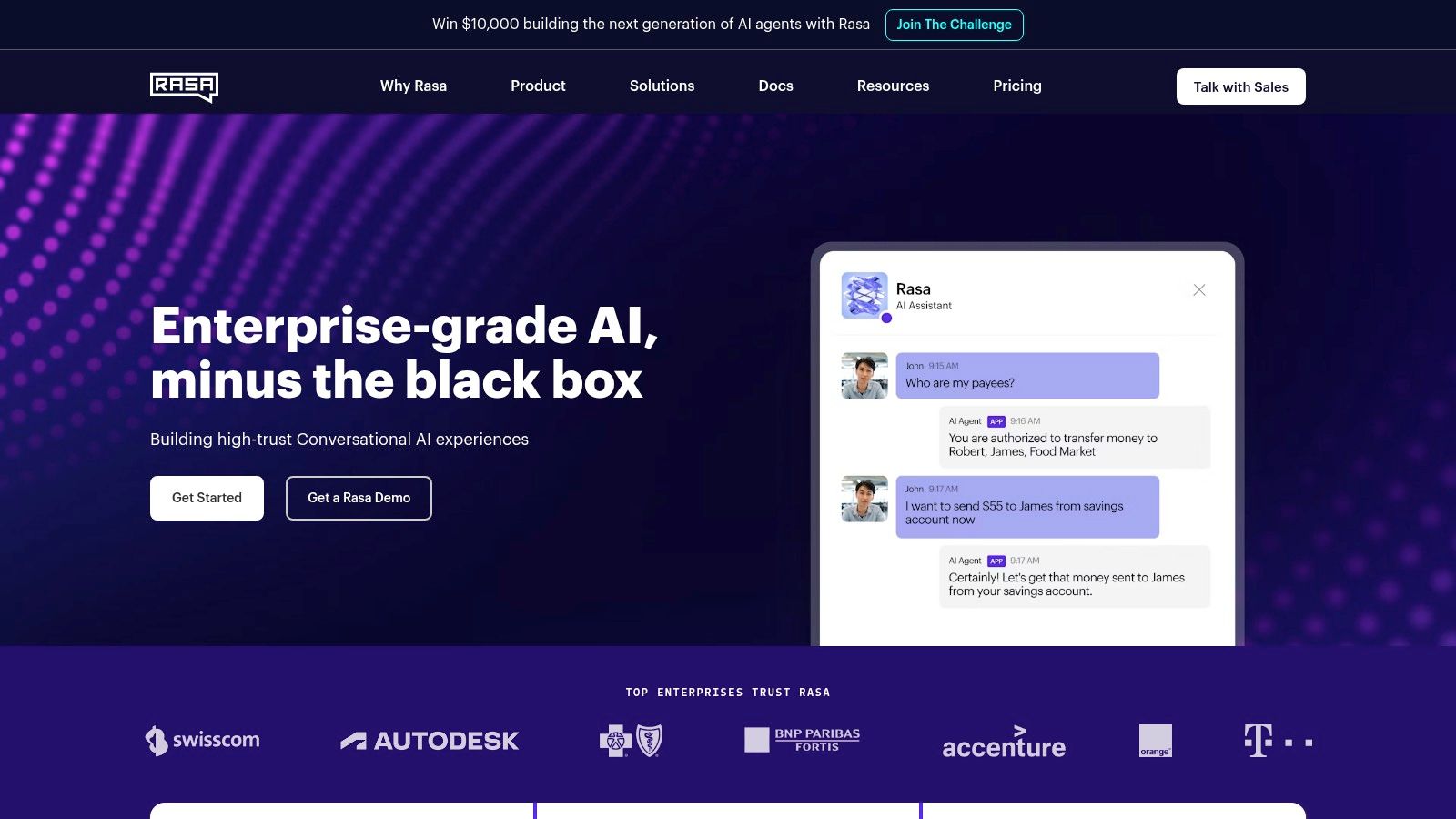
Rasa’s flexible framework excels in complex scenarios requiring deep contextual understanding. Its advanced Natural Language Understanding (NLU) engine goes beyond simple keyword matching, enabling the assistant to interpret intent and extract entities from user input. This facilitates more natural and engaging conversations, leading to improved customer satisfaction and operational efficiency. Think of use cases such as:
- Customer Support: Creating a self-service assistant capable of handling complex inquiries, resolving issues, and escalating to human agents when necessary. This can significantly reduce support costs and improve response times for customer support managers.
- Healthcare: Developing HIPAA-compliant virtual assistants for appointment scheduling, medication reminders, and providing personalized health information to patients, all while maintaining strict data privacy for healthcare providers.
- Real Estate: Building conversational AI agents for property searches, scheduling viewings, and answering buyer questions, streamlining the process for both real estate agents and potential clients.
- Hospitality: Deploying multilingual concierge bots that handle guest requests, provide recommendations, and manage reservations, enhancing the guest experience for hospitality professionals.
Key Features and Benefits:
- Open-Source & Customizable: Rasa’s open-source nature grants unparalleled control over every aspect of the conversational AI solution. Businesses can tailor the system to their unique requirements and integrate it seamlessly with existing systems.
- On-premises Deployment: Full control over data and infrastructure, eliminating reliance on third-party cloud providers. This is especially valuable for enterprises with sensitive data and stringent regulatory requirements, appealing to CTOs and IT Managers.
- Advanced NLU & Dialogue Management: Robust natural language processing and dialogue management capabilities allow for building sophisticated, contextual conversational flows.
- Multilingual Support: Develop conversational AI agents that cater to a global audience with support for multiple languages.
Pricing:
Rasa Open Source is free to use. Rasa also offers Rasa X, a commercial platform built on top of Rasa Open Source, providing additional tools for conversational AI development and deployment. Pricing for Rasa X is based on usage and can be tailored to individual business needs.
Technical Requirements:
Implementing Rasa effectively requires technical expertise in Python and understanding of machine learning concepts. While the active community and comprehensive documentation offer support, a dedicated development team or experienced consultant may be necessary for complex projects.
Pros:
- Complete data and infrastructure control.
- Highly customizable for specialized use cases.
- No vendor lock-in with open-source architecture.
- Active community and extensive documentation.
Cons:
- Requires significant technical expertise to implement.
- Higher development and maintenance overhead compared to SaaS solutions.
- Limited out-of-the-box integrations compared to some commercial platforms.
Comparison with similar tools: While tools like Dialogflow and Amazon Lex provide more user-friendly interfaces and pre-built integrations, Rasa offers unparalleled customization and data control, making it a superior choice for businesses prioritizing data privacy and complex conversational design.
Implementation Tip: Start with a small, well-defined use case to familiarize yourself with the Rasa framework before tackling more complex projects. Leverage the available online resources and community support to accelerate development.
Website: https://rasa.com/
Rasa’s open-source framework and focus on data privacy makes it a powerful choice for businesses looking to build robust, customized conversational AI solutions without compromising on security or control. For CEOs and business owners looking for long-term, scalable solutions, the investment in Rasa's learning curve offers significant returns in customization and data ownership.
8. LivePerson Conversational Cloud
LivePerson Conversational Cloud stands out as a robust conversational AI solution specifically designed for large enterprises seeking to elevate their customer engagement strategies. This platform empowers brands to build and scale AI-driven conversations across a multitude of messaging channels, enabling personalized experiences at scale. Its sophisticated features, including intent recognition and automation, make it a powerful tool for optimizing customer interactions and streamlining support operations. This makes it an ideal solution for enterprise-level businesses looking to harness the power of conversational AI for enhanced customer communication.
Practical Applications and Use Cases:
LivePerson shines in scenarios requiring complex conversational flows and high volumes of customer interactions. Consider these examples:
- Customer Support Automation: Automate responses to frequently asked questions, route inquiries to the appropriate agents, and provide proactive support within messaging apps. This is particularly beneficial for industries like telecommunications, banking, and e-commerce where quick, efficient customer service is paramount.
- Lead Generation and Qualification: Engage potential customers through targeted messaging campaigns, qualify leads based on their responses, and seamlessly hand off qualified leads to sales teams. This is invaluable for real estate agents, hospitality professionals, and other sales-driven businesses.
- Appointment Scheduling and Reminders: Automate appointment scheduling, send reminders, and manage booking changes through conversational interfaces. Healthcare providers, beauty salons, and other appointment-based businesses can greatly benefit from this functionality.
- Proactive Customer Engagement: Offer personalized recommendations, promotions, and updates to customers based on their past interactions and preferences. This is a powerful way for retailers and other businesses to drive customer loyalty and increase sales.
Features and Benefits:
LivePerson Conversational Cloud offers a comprehensive suite of features:
- Intent-based routing and automation: Direct inquiries to the correct department or agent automatically based on the customer's intent, ensuring faster resolution times.
- AI-powered agent assistance: Equip agents with real-time suggestions and resources to handle complex inquiries efficiently.
- Multi-channel messaging: Engage customers across their preferred channels, including web, mobile, social media, and popular messaging apps.
- Conversational analytics: Gain valuable insights into customer behavior, identify areas for improvement, and optimize conversational flows.
- Pre-built industry-specific conversation templates: Accelerate deployment with pre-built templates tailored to various industries.
Pricing and Technical Requirements:
LivePerson utilizes a customized pricing model based on individual business needs and usage. Contact their sales team for a tailored quote. Implementation typically involves professional services for integration with existing enterprise systems. While specific technical requirements vary depending on the integration scope, robust IT infrastructure is generally recommended for optimal performance.
Comparison with Similar Tools:
Compared to other conversational AI solutions, LivePerson's enterprise focus sets it apart. While platforms like Dialogflow and Amazon Lex offer strong general-purpose conversational AI capabilities, LivePerson caters to the specific demands of large enterprises with features like advanced analytics, robust integrations, and enterprise-grade security.
Implementation and Setup Tips:
- Define clear objectives: Outline specific goals for your conversational AI implementation.
- Plan your conversational flows: Map out the different paths a conversation can take.
- Train your AI models: Provide sufficient training data to ensure accurate intent recognition.
- Integrate with existing systems: Connect LivePerson with your CRM, marketing automation, and other relevant systems.
- Monitor and optimize: Continuously analyze performance data to identify areas for improvement.
Pros and Cons:
- Pros: Comprehensive platform, strong messaging focus, robust analytics, extensive integrations.
- Cons: Higher price point, complex implementation, steeper learning curve.
Website: https://www.liveperson.com/
LivePerson Conversational Cloud earns its spot on this list due to its enterprise-grade capabilities and focus on delivering personalized customer experiences at scale. While the platform's complexity and price point may be a barrier for smaller businesses, large organizations seeking a comprehensive conversational AI solution will find LivePerson to be a powerful tool for enhancing customer engagement and optimizing support operations. For CEOs, CTOs, and other enterprise IT managers looking for a robust, scalable, and feature-rich conversational AI platform, LivePerson Conversational Cloud deserves serious consideration.
9. Ada
Ada stands out as a leading conversational AI solution specifically designed to revolutionize customer support automation. This no-code platform empowers businesses to create, deploy, and optimize AI-powered chatbots without needing specialized technical expertise. Its core strength lies in delivering personalized automated support across various communication channels, effectively improving customer experience and simultaneously reducing support costs. This makes it an ideal conversational AI solution for businesses prioritizing streamlined and efficient customer service.
Ada's drag-and-drop interface simplifies bot building, enabling even non-technical users like Customer Support Managers and business owners to quickly design conversational flows. The platform's automated personalization feature, leveraging customer data, ensures tailored interactions that enhance customer satisfaction. Multilingual support, covering over 100 languages, makes Ada a suitable conversational AI solution for businesses operating in diverse global markets. Furthermore, seamless live agent handoff capabilities ensure complex customer inquiries are smoothly transitioned to human agents when necessary. Built-in analytics and continuous improvement tools provide valuable insights to further optimize bot performance and customer interactions.
Practical Applications and Use Cases:
- Customer Support Automation: Ada excels at handling frequently asked questions, resolving simple issues, and guiding customers through self-service processes, freeing up human agents to address more complex requests. This is particularly beneficial for industries like Hospitality, Real Estate, and Healthcare where efficient customer interaction is crucial.
- Personalized Onboarding: Create tailored onboarding experiences for new customers, guiding them through product features and services with personalized messages.
- Lead Qualification: Engage website visitors, qualify leads based on pre-defined criteria, and route qualified leads to the appropriate sales teams.
- Proactive Customer Engagement: Ada can be used to proactively engage customers with relevant information, such as order updates, shipping notifications, or personalized recommendations.
Implementation and Setup Tips:
Implementing Ada is straightforward thanks to its no-code platform. Begin by defining the scope of your chatbot, identifying key customer journeys, and preparing relevant customer data for personalization. Utilize the drag-and-drop interface to build conversational flows and integrate with your existing CRM and support systems. Thoroughly test the chatbot before deploying it live and continuously monitor performance using the built-in analytics.
Pros:
- Exceptionally user-friendly interface requiring minimal technical skills.
- Dedicated focus on customer support automation makes it a powerful conversational AI solution for this specific purpose.
- Robust personalization capabilities leveraging customer data.
- Rapid implementation and time-to-value.
Cons:
- Limited flexibility for highly customized use cases compared to platforms requiring coding.
- Premium pricing might pose a challenge for smaller businesses.
- Primarily geared towards support applications, with less focus on marketing or sales. Though lead qualification can be a useful starting point for sales applications.
Pricing: Ada offers tiered pricing plans based on usage and features. Contact their sales team for detailed pricing information.
Technical Requirements: As a cloud-based platform, Ada requires no on-premise infrastructure. Integration with existing systems can be achieved through APIs.
Comparison with Similar Tools: While other conversational AI platforms like Dialogflow and IBM Watson Assistant offer more customization options, Ada's strength lies in its user-friendliness and focus on customer support. It's an ideal choice for businesses seeking a quick and easy way to implement effective customer support automation without extensive technical resources. For Enterprise IT Managers looking to quickly deploy a robust customer support solution, Ada's no-code platform and dedicated support focus makes it a strong contender.
Website: https://www.ada.cx/
10. Yellow.ai
Yellow.ai distinguishes itself as a robust conversational AI solution designed for enterprises seeking sophisticated automation across both customer and employee experiences. This platform empowers businesses to develop and deploy AI-powered chatbots and voice bots capable of handling complex interactions in multiple languages and across a wide range of channels. This makes it a compelling choice for globally operating companies with diverse customer bases and internal communication needs. Yellow.ai leverages advanced natural language processing (NLP) and a low-code/no-code bot builder, simplifying the creation of dynamic AI agents that can understand and respond to nuanced inquiries, thereby improving efficiency and user satisfaction. Its comprehensive suite of features and integrations makes it a strong contender in the competitive landscape of conversational AI solutions.
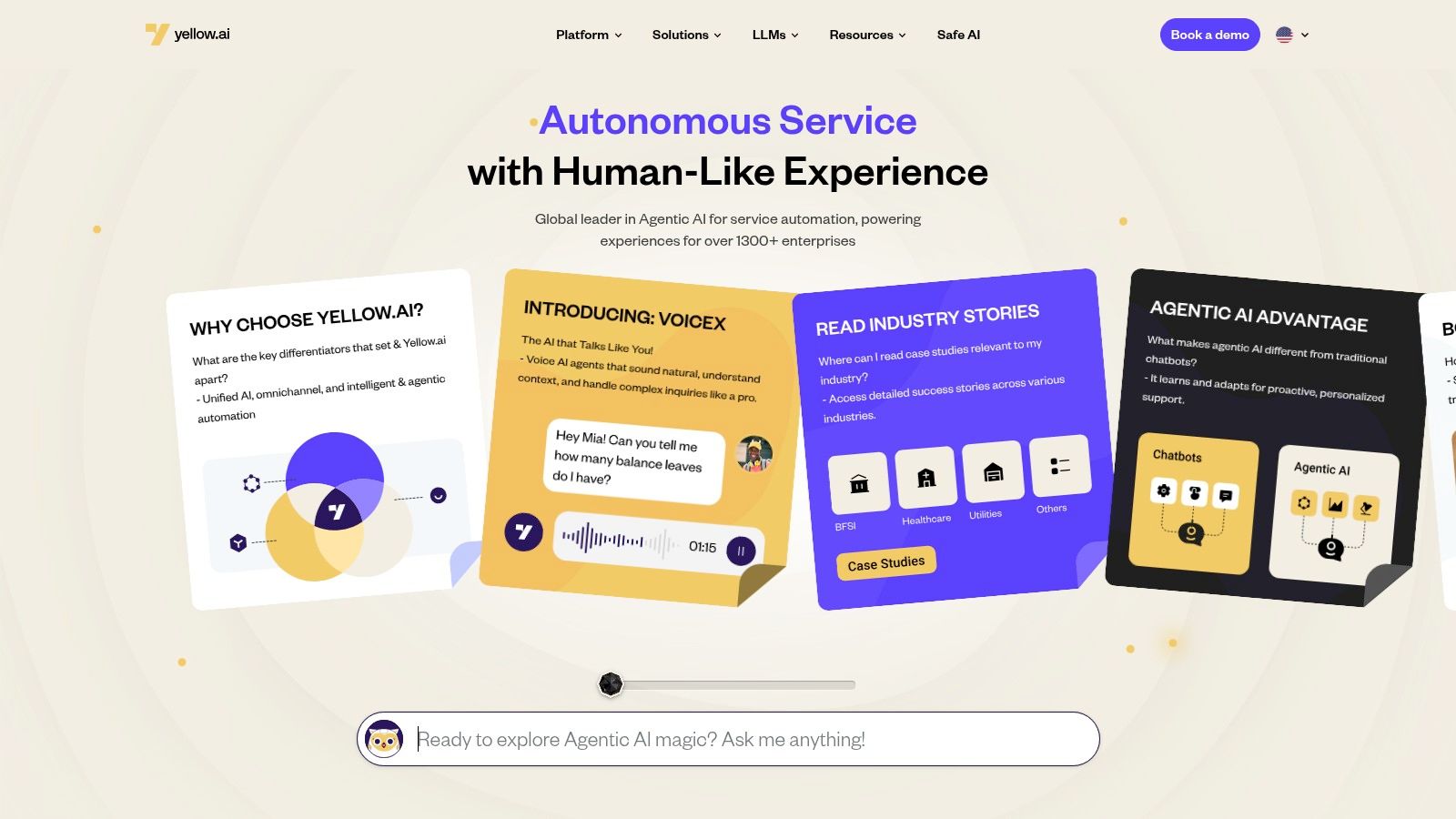
For customer support managers, Yellow.ai can automate responses to frequently asked questions, resolve common issues, and escalate complex queries to human agents seamlessly. This frees up human agents to focus on more demanding tasks, leading to increased productivity and improved customer satisfaction. Hospitality professionals can utilize Yellow.ai to manage bookings, answer guest inquiries, and provide personalized recommendations, enhancing the guest experience. Real estate agents can automate property inquiries, schedule viewings, and qualify leads, allowing them to focus on closing deals. Healthcare providers can deploy virtual assistants to schedule appointments, answer patient questions, and provide post-discharge instructions, improving patient engagement and operational efficiency. Enterprise IT managers can leverage Yellow.ai to automate internal IT support, troubleshoot common issues, and streamline onboarding processes. For business owners, CEOs, and CTOs, Yellow.ai provides a scalable solution to automate critical business processes, improve communication, and drive efficiency across the organization.
Key Features and Benefits:
- Dynamic AI Agents: Yellow.ai's advanced NLP capabilities enable the creation of sophisticated virtual assistants that can understand complex language and context, leading to more natural and engaging conversations.
- Low-Code/No-Code Bot Builder: The platform's intuitive interface empowers users to build and deploy bots quickly, even without extensive coding experience. Pre-built templates further accelerate the development process.
- Omnichannel Deployment: Deploy bots across 35+ channels, including websites, mobile apps, messaging platforms, and social media, ensuring a consistent brand experience across all touchpoints.
- Multilingual Support: With support for 100+ languages, Yellow.ai is ideally suited for global enterprises seeking to cater to diverse customer bases.
- Enterprise Integrations: Pre-built integrations with CRM, ERP, and other enterprise systems enable seamless data flow and automation of complex business processes.
Pros:
- Strong multilingual capabilities ideal for global enterprises.
- Comprehensive platform covering both customer and employee experiences.
- Flexible deployment options (cloud, hybrid, on-premises).
- Powerful analytics and automation capabilities.
Cons:
- Less established in the North American market compared to some competitors.
- Advanced customizations may require professional services.
- The enterprise pricing model may be expensive for smaller organizations.
Pricing: Contact Yellow.ai directly for detailed pricing information as it is tailored to specific enterprise needs.
Technical Requirements: As a cloud-based platform, Yellow.ai requires a stable internet connection for access and management. Specific integration requirements will depend on the enterprise systems being connected.
Implementation Tips:
- Clearly define your use cases and objectives before implementation.
- Leverage pre-built templates and integrations to accelerate development.
- Thoroughly test your bots across all intended channels and languages.
- Continuously monitor and optimize your bots' performance based on user feedback and analytics.
Comparison with Similar Tools: While platforms like Dialogflow and IBM Watson Assistant offer strong conversational AI capabilities, Yellow.ai stands out with its robust multilingual support, comprehensive platform encompassing both customer and employee experiences, and flexible deployment options.
Yellow.ai’s robust capabilities and comprehensive feature set justify its inclusion in this list of top conversational AI solutions. By streamlining communication and automating critical processes, Yellow.ai empowers organizations to enhance customer and employee experiences, ultimately driving efficiency and growth. Visit Yellow.ai to learn more.
Conversational AI Solutions: Head-to-Head Comparison
| Platform | Core Features ✨ | Performance ★ | Value Proposition 💰 | Ideal For 👥 |
|---|---|---|---|---|
| Voicetta 🏆 | 24/7 AI calls/chats, adaptive AI, seamless CRM/PMS/ERP integration | Rapid responses, personalized interactions | Boosts conversions & reduces costs | Hospitality, Healthcare, Real Estate |
| IBM Watson Assistant | Conversational AI, advanced NLP, generative AI integration | Highly customizable, robust analytics | Enterprise-grade solution at a premium | Large enterprises, tech-savvy teams |
| Google Dialogflow | Multilingual support, voice & text recognition, intuitive visual builder | Intuitive, strong NLP | Generous free tier; smooth Google integration | Developers, SMEs, global brands |
| Microsoft Azure Bot Service | Bot Framework SDK, LUIS integration, omnichannel deployment | Scalable, secure, enterprise-ready | Deep Microsoft ecosystem integration (higher cost) | Enterprises using Microsoft tools |
| Intercom | AI chatbots with live chat, CRM integration | Easy-to-use, personalized customer touch | Unified messaging with premium pricing | Customer service teams, growing businesses |
| Drift | Conversational marketing, real-time personalization & scheduling | Optimized for sales, efficient lead routing | Revenue-focus with enterprise-level features | B2B sales & marketing teams |
| Rasa | Open-source, customizable NLU, on-premises deployment | Advanced customization, full data control | No vendor lock-in; requires technical expertise | Developers, enterprises seeking control |
| LivePerson Conversational Cloud | Intent routing, multi-channel messaging, automation | Robust analytics, large-scale performance | Tailored for complex, enterprise deployments | Large enterprises, messaging-centric brands |
| Ada | No-code bot builder, automated support, multilingual capabilities | User-friendly, quick implementation | Efficient support automation at a premium | Customer support teams, SMBs |
| Yellow.ai | Low-code builder, omnichannel deployment, support for 100+ languages | Global reach; flexible deployment | All-in-one platform with enterprise pricing | Global enterprises, customer & employee experience |
Choosing the Right Conversational AI for Your Business
Selecting the optimal conversational AI solution from the array of available platforms—including Voicetta, IBM Watson Assistant, Google Dialogflow, Microsoft Azure Bot Service, Intercom, Drift, Rasa, LivePerson Conversational Cloud, Ada, and Yellow.ai—is a crucial decision for any business. This choice hinges on a careful evaluation of your specific needs, technical capabilities, and budget. Key takeaways to remember when making this decision include the importance of scalability to accommodate future growth, seamless integration options with existing systems, and the level of customization required to tailor the solution to your unique customer interactions. For instance, are you primarily focused on text-based chat, voice interactions, or a combination of both? Do you need advanced natural language processing capabilities or a simpler solution for handling routine inquiries?
Furthermore, consider the level of technical expertise you have in-house. Some platforms require more coding and development work than others. Conversational AI can significantly reduce customer service costs while improving customer satisfaction. To delve deeper into the cost-saving benefits and strategies, check out this helpful resource: conversational AI for customer service from My AI Front Desk. By carefully considering these factors and evaluating the strengths of each platform discussed in this article, you can empower your business with a conversational AI solution that streamlines operations, enhances customer experiences, and drives growth.
The right conversational AI solution can transform how you interact with your customers, turning routine interactions into valuable opportunities for engagement and growth. Ready to explore a powerful and versatile conversational AI platform? Discover Voicetta, a leading solution for building engaging voice and chat experiences. Voicetta offers robust features and flexible integrations, empowering you to create personalized and efficient conversational AI solutions tailored to your business needs.
Was this useful?
If this article helped, add Voicetta as a preferred source in Google Search. Your results can then highlight our writing.
Add as preferred source